
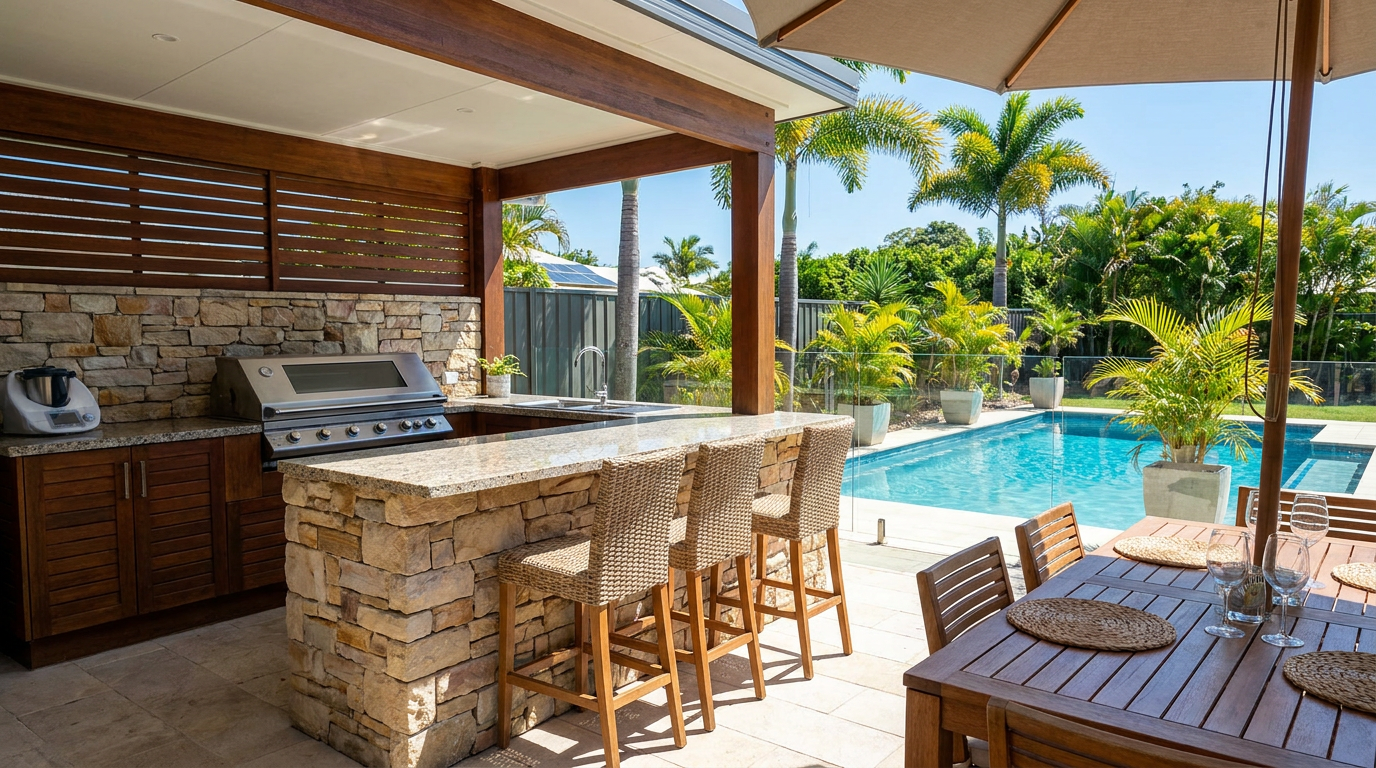
By Space · Pool, Alfresco & Outdoor Kitchen
Brisbane entertainer homes typically have multiple distinct outdoor zones — pool deck for relaxation, alfresco area for dining, outdoor kitchen for cooking. Each zone has different functional demands and different material discipline; generic "outdoor furniture for entertaining" advice misses what makes these zones work or fail. This guide covers the three function-specific zones with their distinct demands, the pool zone material discipline most articles skip, the outdoor kitchen seating geometry framework, the multi-zone coordination decisions, and the high-AOV buying considerations that apply to entertainer-home setups. For the broader Brisbane outdoor space framework, see our Brisbane outdoor furniture by space guide.
The three function-specific zones
Pool decks, alfresco areas, and outdoor kitchens are functionally distinct spaces with distinct furniture demands. The most common mistake in entertainer-home outdoor furniture decisions is treating them as variations of the same problem. The function × demand framework:
| Zone | Primary functional demand | Secondary demands | Furniture priority |
|---|---|---|---|
| Pool deck | Chlorine + splash + maximum UV exposure | Storm-season wind risk (lightweight pieces blow into pools) | Sun loungers, daybeds, durable side tables |
| Alfresco area | Indoor-outdoor flow + entertaining scale | Humidity from limited airflow, integration with kitchen sightlines | Substantial dining sets, lounge configurations |
| Outdoor kitchen | Heat proximity + grease exposure + seating geometry | Easy-clean materials, wipe-down surfaces | Bar-height seating along island, durable counter pieces |
Brisbane entertainer homes across Pullenvale, Kenmore Hills, Brookfield, Anstead, Mount Crosby, Hamilton, Ascot, Clayfield, Hendra, and Bardon often feature all three zones on a single property. The right approach is zone-specific furniture decisions with a coordination layer — not a single style applied uniformly across functionally different spaces. The broader Queensland framework that drives multi-zone planning is in our complete outdoor furniture guide for Brisbane and Queensland.
Pool zone furniture — chlorine, UV, splash, storm risk
The pool deck is the most demanding outdoor furniture environment in any Brisbane property. Three exposures combine that don't apply equally elsewhere:
- Chlorine and pool-water exposure. Splash from the pool, drips from wet swimwear, and chlorinated water on furniture surfaces degrade fabrics and some metals. Chlorine specifically attacks textile cushions without proper resistance ratings.
- Maximum UV exposure. Pool zones typically face full direct sun for most of the day during summer (the design intent is sun exposure for swimmers), plus reflected UV from the water surface and the pool deck surface. The cumulative UV load is significantly higher than alfresco or general patio applications. The full UV framework is in our UV damage prevention guide.
- Storm-season wind risk. Lightweight pool furniture blowing into pools during summer storms is a real Brisbane problem — the pool itself becomes the destination for chairs, umbrellas, and side tables. Quality weighted bases or anchored configurations are mandatory.
Pool zone material discipline
Quality marine-grade powder-coated aluminium handles all three exposures — chlorine-resistant, UV-stable with proper specification, and available in heavier configurations that resist storm wind. The full marine-grade framework is in our marine-grade outdoor furniture guide. Quality polywood (HDPE recycled plastic) handles the conditions without any maintenance — the right answer for full-exposure pool decks where the maintenance discipline can lapse. Our polywood outdoor furniture guide covers the specification framework.
Pool zone cushion fabric requirements
Cushions specifically need quality solution-dyed acrylic (Sunbrella, Outdura, or equivalent) — the chlorine resistance and UV intensity exceed what budget polyester fabric tolerates. Standard outdoor polyester fades and degrades within 1–2 summers in pool zone conditions; quality solution-dyed acrylic typically holds for 5+ years. The fabric framework is in our outdoor fabric guide.
Materials and configurations to avoid
Avoid: timber furniture in direct splash zones (chlorine accelerates timber degradation beyond what regular maintenance can address); standard polyester cushions (1–2 summer life); lightweight aluminium chairs without weight or anchoring (storm-season pool risk); natural rattan or budget synthetic wicker; umbrellas without proper weighted bases or anchoring (the most common pool-zone storm casualty); and any furniture with metal hardware below 316 stainless steel grade (chlorine corrodes 304 stainless within 2–3 years on coastal SEQ properties).
The pool zone reality: Most pool deck furniture failures in Brisbane trace to under-specifying for the conditions. Marine-grade is the right baseline, not a premium upgrade. The pool zone is the worst outdoor furniture environment on most properties — material discipline that would be overkill on a covered alfresco is the right baseline at the pool deck.
Alfresco dining — covered area and indoor-outdoor flow
The Brisbane alfresco area is the social heart of most entertainer homes — covered overhead, open at the sides, integrated with the kitchen and indoor living spaces. The furniture demands are different from pool zones in important ways.

The alfresco-as-room framing
Modern Brisbane alfresco areas function as third living rooms — proper room scale, dedicated furniture configurations, integrated lighting, often year-round daily use. Furniture decisions should reflect that rather than treating alfresco as a category of "outdoor furniture." The substantial dining sets (6–10 seater capacity) and substantial lounge configurations (modular sofas, daybeds, coffee tables) that fit the room scale are the right defaults — bistro pieces that work on apartment balconies look undersized in entertainer-home alfrescos.
Material flexibility under cover
Covered alfresco areas allow significantly wider material choice than pool decks. Quality teak performs well under cover — the protected position extends usable life, and the natural aesthetic matches the substantial scale. Quality synthetic HDPE wicker handles humidity well in covered conditions. Quality timber furniture (acacia, eucalyptus) gains years of usable life from overhead protection. The material flexibility framework is in our outdoor furniture materials guide.
Indoor-outdoor flow considerations
Alfresco areas typically sit in direct sightline from indoor living spaces through large sliding doors — the visual continuity matters. Stark style contrasts between indoor minimalist and outdoor traditional read as visual disconnection. Consistent colour temperatures, coordinated material directions, and complementary scale across the threshold support proper flow. The same indoor-outdoor flow framework that applies to suburban patios and decks applies here at larger scale — covered in our suburban patio, deck and pergola furniture guide.
Style direction options
Alfresco-as-room scale supports a wide range of style directions. Hamptons works particularly well at this scale — the substantial proportions match Hamptons's traditional style logic, and the colour palette (warm whites, cream, navy accents) reads cleanly against typical Brisbane architectural materials. The full Hamptons framework is in our Hamptons outdoor furniture guide for Brisbane. Resort-style with deep modular sofas and oversized lounge proportions also fits the entertainer scale; modern minimalist works in newer architectural builds.
Outdoor kitchen seating — heat, grease, bar geometry
Outdoor kitchens (built-in BBQs, pizza ovens, prep zones, sometimes full kitchen islands with sinks and refrigeration) create specific seating demands that don't apply elsewhere. Heat proximity, grease exposure, and bar-height seating geometry are the three considerations.
Heat and grease distance rules
Furniture proximity to active cooking zones requires concrete distance discipline. The practical rules:
| Furniture position relative to cooking zone | Minimum distance | Material implication |
|---|---|---|
| Adjacent to BBQ side (grease splatter zone) | 60cm minimum from cooking surface | Easy-clean only — wipe-down aluminium or polywood; no fabric cushions |
| BBQ proximity (1–1.5m from cooking surface) | 1m minimum, 1.5m preferred | Fabric acceptable but expect grease residue over time; choose cleanable fabrics |
| Pizza oven proximity (radiant heat) | 1.5m+ from oven face | Heat-tolerant materials only; avoid thermoplastics close to active oven |
| General cooking zone (2m+ from active cooking) | 2m+ from active cooking surfaces | Full material flexibility — fabric cushioned pieces fine |
Bar-height seating geometry
Outdoor kitchen islands typically use bar-height counter (105–110cm counter height) with bar-height stools (75–80cm seat height) or counter-height counter (90–95cm) with counter-height stools (60–65cm). Standard dining height (75cm table, 45cm seat) doesn't work at kitchen islands. Bar-height geometry creates a different social pattern than dining — guests can stand at the counter or perch on stools while the cook works, supporting the "kitchen as social space" pattern rather than separating cooking and conversation.
Bar stool clearance and safety
Allow 90cm minimum behind seated stools for traffic flow past the kitchen island; 60cm minimum between island edge and back wall if the kitchen sits against a structural element. Stools should be fixed enough not to slide on tile or paver surfaces — non-slip stool feet or weighted bases prevent the common problem of stools sliding backwards as guests stand up. Avoid bar stools without back support for extended use; backless stools work for occasional perching but cause discomfort during longer entertaining sessions.
Material choices for kitchen seating
Quality marine-grade powder-coated aluminium bar stools handle heat proximity, grease exposure, and frequent wipe-down better than timber or fabric alternatives. Polywood bar stools work well for full-exposure outdoor kitchen positions. Cushioned pieces should use removable, machine-washable covers given the inevitable grease and food residue exposure — the cushion-cleaning framework is in our outdoor cushion care guide.
The multi-zone coordination framework
Entertainer homes with all three zones face a coordination decision: should furniture match across zones, or should each zone get function-specific furniture without forced consistency?
The matched-across-zones approach
Single style direction applied across all three zones — same frame finish, complementary cushion palette, consistent material direction. Visual benefits: the property reads as cohesive when viewed across multiple zones simultaneously (common from elevated indoor positions looking out across pool, alfresco, and kitchen). Practical drawbacks: forces material compromises in at least one zone (typically the pool deck, where the cohesive look may not match the discipline pool conditions actually demand).
The zone-specific function-first approach
Each zone gets the furniture that suits its specific demands without forcing consistency. Pool deck gets quality marine-grade aluminium and polywood; alfresco gets a substantial Hamptons or resort-style coordinated set; outdoor kitchen gets functional bar-height seating in heat-tolerant materials. Visual benefit: each zone performs and looks appropriate for its function. Practical drawback: requires more design discipline to maintain visual coherence across the property.
The hybrid recommendation
Most entertainer-home setups benefit from a hybrid: shared colour palette and shared material temperature across all three zones, but function-specific configurations in each zone. A property might choose warm white frames as the consistent finish — applied to pool sun loungers, alfresco lounge configuration, and outdoor kitchen bar stools — with cushion colours coordinating across zones (sandy neutrals, navy accents) but configurations matching each zone's function. This achieves coherence without forcing compromises.
Material decisions across all three zones
The cross-reference matrix for entertainer-home material decisions:
| Material | Pool deck | Alfresco area | Outdoor kitchen |
|---|---|---|---|
| Marine-grade powder-coated aluminium | Best — chlorine, UV, weight | Best — versatile, low-maintenance | Best — heat, grease, wipe-down |
| Polywood (HDPE) | Best — full exposure, no maintenance | Good — modern aesthetic | Best — heat-tolerant, wipe-down |
| Quality teak | Avoid — chlorine + UV combination | Best — alfresco scale, premium aesthetic | Limited — grease difficult to remove |
| Synthetic HDPE wicker | Good — covered pool zone only | Good — resort lounge configurations | Limited — grease residue in weave |
| Solution-dyed acrylic cushions | Best — chlorine + UV resistance mandatory | Best — durability under regular use | Good — only at 2m+ from cooking |
The aluminium and polywood defaults
Quality marine-grade powder-coated aluminium and quality polywood handle all three zones without compromise — the safest defaults for entertainer-home setups where each zone needs to perform across years of use. The full aluminium framework is in our aluminium outdoor furniture guide; the broader material framework is in our outdoor furniture materials guide for Queensland. The pre-storm protocol matters at the pool zone specifically — covered in our Queensland storm protection guide.
The high-AOV buying considerations
Complete entertainer-home outdoor furniture setups typically run $8,000–$30,000 across all three zones — significantly higher AOV than single-zone or compact-space purchases. The buying decisions warrant different discipline than smaller purchases.
Quality threshold matters more
At entertainer-home AOV, the quality difference between budget and premium pieces compounds. Budget pool deck furniture that fails in 2–3 summers requires complete replacement; quality marine-grade pieces last 10+ years with maintenance. Across a $15,000+ multi-zone setup, the lifecycle cost difference between "premium pieces" and "premium pieces replaced twice" is significant.
Brand and supplier consistency
Sourcing from a single supplier across all three zones supports the coordination framework — frame finishes match, replacement parts (cushion covers, fasteners) are easier to source, warranty and service relationships are simpler. The coordination advantage compounds with the volume — discounts on multi-zone purchases are typical at this AOV level. Complete entertainer setups warrant in-person showroom consultation rather than online-only buying.
Phased buying for complete setups
Most entertainer-home setups benefit from phased buying rather than all-at-once purchase. Year one: anchor the alfresco area with the substantial dining or lounge set (highest visibility, daily use, sets the property's style direction). Year two: complete the pool zone (sun loungers, daybeds, side tables). Year three: complete the outdoor kitchen seating (bar stools, prep-zone seating). This approach allows time to assess actual zone use patterns before completing the investment, and spreads the AOV across three financial years.
Showroom consultation
At entertainer-home AOV, in-person consultation with quality outdoor furniture suppliers is significantly more valuable than online browsing alone. Multi-zone setups have coordination decisions that are difficult to assess from product photography — frame finish reading across different lighting conditions, cushion fabric coordination across zones, scale appropriate to specific entertainer-home dimensions. A2Z's five SEQ showrooms — Rocklea, North Ipswich, Sandgate, Bundall, and Beenleigh — support this consultation process for the geographic spread of Brisbane entertainer homes.
FAQs
-
What outdoor furniture is best for a Brisbane pool deck?
Quality marine-grade powder-coated aluminium for frames, quality polywood (HDPE) for full-maintenance-free configurations, and quality solution-dyed acrylic for cushions. Pool zones combine three demanding exposures — chlorine, maximum UV (often the worst exposure on the property), and storm-season wind risk where lightweight pieces blow into pools. Marine-grade is the right baseline, not a premium upgrade. Avoid timber furniture in direct splash zones (chlorine accelerates degradation), standard polyester cushions (1–2 summer life), lightweight aluminium chairs without weight or anchoring, natural rattan, and metal hardware below 316 stainless steel grade. Configure for storm season — weighted bases, anchored umbrellas, or pre-storm bring-inside protocol for lighter pieces.
-
How do I choose furniture for a Brisbane alfresco dining area?
Treat the alfresco as a third living room rather than a category of "outdoor furniture." The substantial dining sets (6–10 seater capacity) and lounge configurations (modular sofas, daybeds, coffee tables) that fit the room scale are the right defaults — bistro pieces that work on apartment balconies look undersized in entertainer-home alfrescos. Covered overhead protection allows wider material flexibility than pool zones — quality teak performs well, quality synthetic HDPE wicker handles the humidity, quality timber furniture gains years of usable life from the protection. Visual continuity from indoor living spaces matters; consistent colour temperatures and complementary material directions across the threshold support proper flow. Hamptons style works particularly well at alfresco-room scale.
-
What's the right seating height for an outdoor kitchen island?
Outdoor kitchen islands typically use bar-height counter (105–110cm counter height) with bar-height stools (75–80cm seat height), or counter-height counter (90–95cm) with counter-height stools (60–65cm). Standard dining height (75cm table, 45cm seat) doesn't work at kitchen islands — guests sit too low relative to the counter. Allow 90cm minimum behind seated stools for traffic flow past the island; 60cm minimum between island edge and back wall if against a structural element. Stools should be fixed enough not to slide on tile or paver surfaces — non-slip stool feet or weighted bases prevent the common problem of stools sliding backwards as guests stand up. Bar stools with back support work better for extended use than backless stools.
-
How far should outdoor furniture be from an outdoor BBQ or pizza oven?
The distance discipline depends on the cooking source and furniture type. For BBQ side (grease splatter zone): 60cm minimum from cooking surface, with easy-clean materials only — wipe-down aluminium or polywood, no fabric cushions. For BBQ proximity (1–1.5m from cooking surface): fabric becomes acceptable but expect grease residue over time. For pizza oven proximity: 1.5m+ from the oven face — radiant heat is significant, and thermoplastics close to an active oven can soften or warp. For general cooking zones (2m+ from active cooking surfaces): full material flexibility — fabric cushioned pieces fine. Don't place a fabric-cushioned outdoor lounge immediately adjacent to active grilling — grease and smoke embed quickly, and removable washable covers become essential rather than optional.
-
Should I match furniture across pool, alfresco, and outdoor kitchen zones?
The hybrid approach works best for most entertainer-home setups: shared colour palette and shared material temperature across all three zones, but function-specific configurations in each zone. A property might choose warm white frames as the consistent finish — applied to pool sun loungers, alfresco lounge configuration, and outdoor kitchen bar stools — with cushion colours coordinating across zones but configurations matching each zone's function. Pure matched-across-zones forces material compromises (typically at the pool deck, where the cohesive look may not match what pool conditions demand). Pure zone-specific function-first risks visual disconnection across the property when viewed simultaneously from elevated indoor positions. The hybrid achieves coherence without forcing compromises.
-
What budget should I plan for a complete entertainer-home outdoor furniture setup?
Complete entertainer-home outdoor furniture setups typically run $8,000–$30,000 across all three zones at quality specifications. The breakdown: pool zone ($2,500–$8,000 for sun loungers, daybeds, side tables, anchored umbrellas in marine-grade specifications); alfresco area ($4,000–$15,000 for substantial dining set plus lounge configuration in coordinated style); outdoor kitchen seating ($1,500–$5,000 for bar-height stools and prep-zone seating in heat-tolerant materials). Most setups benefit from phased buying rather than all-at-once purchase — anchor the alfresco area in year one, complete the pool zone in year two, complete the outdoor kitchen in year three. Quality threshold matters more at entertainer-home AOV — budget pieces that fail in 2–3 summers compound to significant lifecycle cost differences across multi-zone setups.
Quality multi-zone outdoor furniture for Brisbane entertainer homes
Pool decks, alfresco areas, and outdoor kitchens reward zone-specific furniture decisions with a coordination layer — the right material for each zone's function, the right scale for the entertainer-home context, the right style direction matched across zones without forcing compromises. All five of our South East Queensland showrooms — Rocklea, North Ipswich, Sandgate, Bundall, and Beenleigh — carry multi-zone outdoor furniture matched to entertainer-home scale, and our team can talk through the zone-specific decisions and multi-zone coordination for your property. Free local delivery applies across Greater Brisbane and SEQ on eligible orders.
Shop the range
Ready to buy? Browse the matching outdoor collections: