
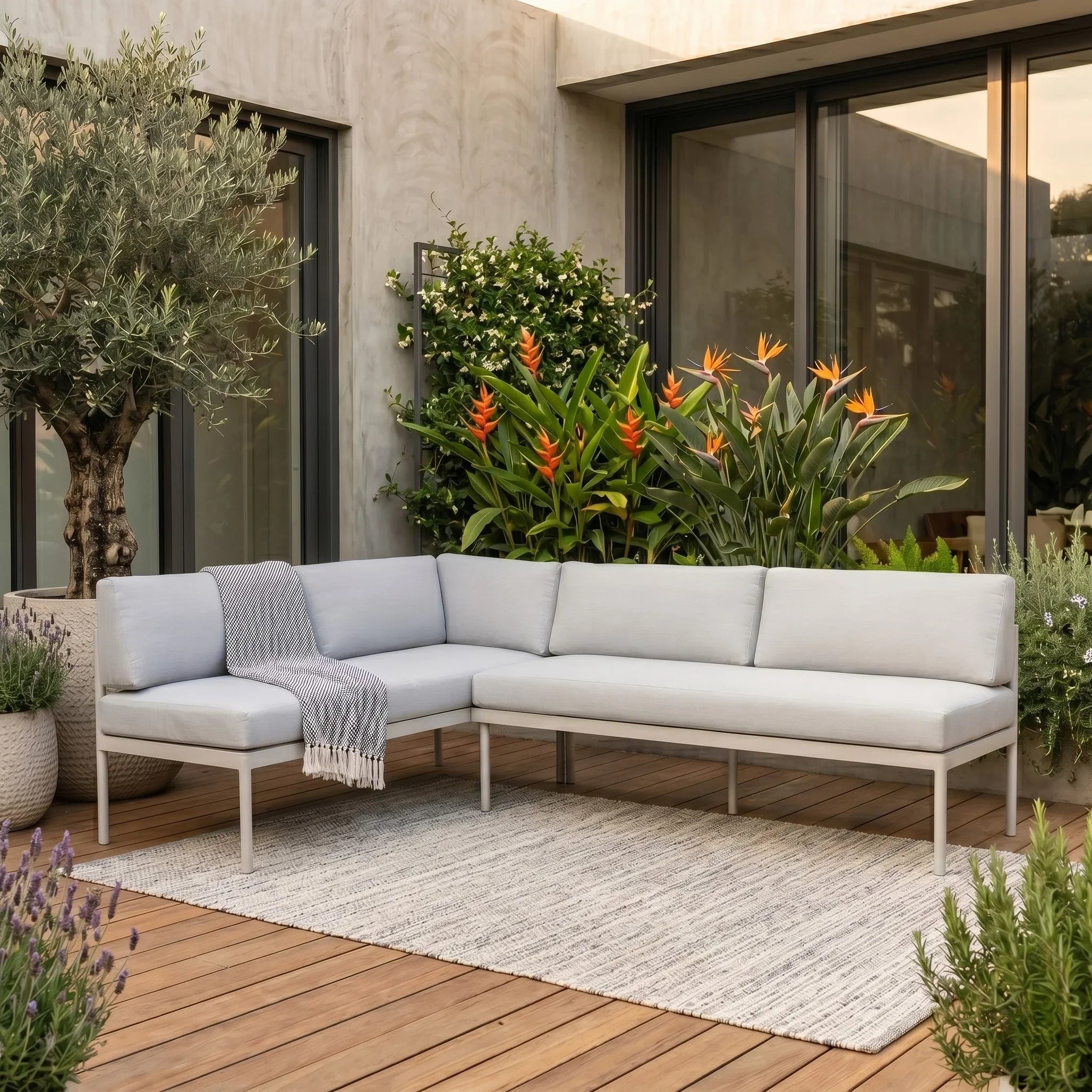
Materials · Aluminium
Powder-coated aluminium is the most versatile outdoor furniture material for Queensland — particularly if you live within a few kilometres of the bay. It's rust-proof, lightweight, low-maintenance, and handles UV exposure better than almost any alternative. The catches are mostly subtle: cheap aluminium is genuinely cheap, the powder-coat quality varies more than buyers realise, and the same lightness that makes pieces easy to move makes them easy to lose in a cyclone-season gust. This guide is part of our broader Queensland outdoor furniture materials guide, where we compare every common option side by side. Here we go deep on aluminium — construction grades, powder-coat quality cues, the storm-season tradeoff, and when another material is genuinely the smarter buy.

Why aluminium suits Queensland's climate
Aluminium is the workhorse of modern outdoor furniture for one fundamental reason: it doesn't rust. Iron and steel oxidise into rust when exposed to water and oxygen; aluminium forms a thin, stable oxide layer on its surface that protects the metal underneath. That single chemistry difference is why aluminium outperforms steel almost everywhere outdoors — and why it dominates coastal Queensland buying patterns.
Looking at the four pressures that define Queensland's climate (covered in our complete outdoor furniture guide for Brisbane and Queensland), aluminium handles three of them outstandingly:
- UV. Bare aluminium reflects rather than absorbs UV. With a quality powder-coat finish, the underlying metal is protected from oxidation indefinitely. Quality powder-coats are themselves UV-stable for decades.
- Humidity. Brisbane's 70%+ summer humidity is destructive to most metals; aluminium ignores it. The natural oxide layer is unaffected by water content in air.
- Salt air. This is where aluminium wins decisively. In coastal Queensland — Sandgate, Manly, Wynnum, Bundall, Burleigh — salt accelerates corrosion on every metal except aluminium and 316-grade marine stainless steel. Aluminium delivers ~90% of the corrosion resistance of marine stainless at roughly half the price, which is why we see almost every coastal customer buying aluminium frames.
- Storm season. This is the one pressure where aluminium has a tradeoff worth understanding — covered in detail below.
Cast vs extruded vs hollow — the construction grades
"Aluminium" is not a single category. Outdoor furniture uses three fundamentally different construction methods, and they perform very differently. Most retailers don't differentiate clearly, but the price gap between them is real and the durability gap is bigger.
| Type | How it's made | Weight | Durability | Price tier |
|---|---|---|---|---|
| Cast aluminium | Molten aluminium poured into moulds | Heavy | Very high — rigid, structural | $$$$ |
| Extruded aluminium | Heated billets pushed through a die | Medium | High — strong tube sections | $$$ |
| Hollow tube aluminium | Thin-walled tube cut and welded | Very light | Moderate — flexes under load | $$ |
Cast aluminium
Premium tier. The molten aluminium is poured into a mould, producing a solid, often ornate piece with a smooth finish and significant weight. Cast aluminium chair frames feel substantial, resist flexing under load, and often feature decorative detailing that extruded tube can't match. The weight also means cast pieces stay put in storm winds. The downside is price — cast aluminium dining sets typically run two to three times the price of extruded equivalents.
Extruded aluminium
The workhorse. Most quality outdoor furniture in the mid-price tier uses extruded aluminium tubes for frames, often combined with cast aluminium feet or joints for rigidity. Extruded sections are uniform, strong, and weld cleanly. This is the construction method behind most of the aluminium pieces in our range, including the Astra Outdoor 7 Piece Dining Set and the Bryde Outdoor Corner Lounge in white aluminium.
Hollow tube aluminium
Budget tier. Thin-walled aluminium tube — typically 1mm to 1.5mm wall thickness — welded into frames. It's significantly lighter and cheaper than extruded or cast, but the flex under load is real. Hollow-tube chairs creak when you sit; hollow-tube tables wobble at the joints. They're fine as a short-term option but rarely last more than three to five summers in Queensland. If a piece is suspiciously cheap and the seller can't or won't specify the construction method, assume hollow tube.
For most Queensland buyers, extruded aluminium with cast feet is the sweet spot — substantial enough to feel premium and stay put in storms, lightweight enough to reposition, and significantly more affordable than fully cast pieces.
Powder coating — what makes a quality finish
The aluminium itself is rust-proof. The powder-coat finish is what gives outdoor furniture its colour, scratch resistance, and added UV protection — and it's where quality varies most. A bare aluminium frame would be dull silver and vulnerable to surface scuffs. A correctly powder-coated frame can stay looking new for ten or more years.

How powder coating works
Powder coating is a dry process. The metal is electrostatically sprayed with a fine pigment powder, then baked in an oven where the powder melts and bonds to the surface. The result is a thicker, harder, and more uniform finish than wet paint can achieve. The thickness is measured in microns — quality outdoor furniture finishes typically run 60 to 100 microns; cheap finishes can be as thin as 30 microns and prone to chalking within a couple of years.
Quality cues to look for
- Even coverage at corners and welds. Run a finger along weld points and tube intersections. A quality coat is consistent; a cheap coat thins at corners and pools at lower edges.
- No orange-peel texture or pinholes. Surface defects on a new piece signal poor preparation — usually dust contamination or insufficient pre-treatment of the aluminium before coating.
- UV stability statement. Reputable manufacturers state the powder-coat's UV rating in years; quality finishes are typically rated 7+ years before noticeable colour shift.
- Stainless or zinc-plated fasteners. Mild steel screws will rust within a season and bleed orange streaks onto the powder-coat surface. Quality aluminium furniture uses stainless or zinc-plated hardware.
- Touch-up paint availability. Reputable brands sell colour-matched touch-up paint for chip repair. If the seller doesn't offer it, the piece probably uses a generic colour you won't be able to match later.
- Warranty on the finish. A 2+ year warranty against finish defects suggests the manufacturer has tested under load. Generic 12-month warranties cover the frame structure but rarely the coating.
The lightweight tradeoff in storm season
Aluminium's lightness is sold as an advantage — and it is, for daily use. You can reposition a six-seat aluminium dining set yourself; you can drag chairs across the deck without leaving marks; you can store pieces compactly when you need to. But the same physics that makes aluminium easy to move on a calm Tuesday makes it easy to move in a 90 km/h storm gust.

Practical storm-season handling for aluminium
- For November-to-April: Treat aluminium pieces as movable. Either move them against a wall before forecast storms, or anchor heavier pieces with cushion weights and umbrella weights.
- Lighter chairs: Stack and weight, or move into a shed or garage. Single-piece aluminium dining chairs are the highest projectile risk.
- Cantilever umbrellas: Wind down at the first wind warning. Even quality cantilever bases can tip in storm gusts.
- Coffee tables and side tables: Weight them with planters or move them inside. Light aluminium tables are routinely picked up and thrown in cyclone-rated wind.
The right answer depends on your suburb. Coastal homes that face the open bay (Sandgate, Wynnum, Manly) get higher gust speeds than inner-suburban homes; cyclone-rated areas need significantly more aggressive storm prep. Our Queensland care and maintenance guide covers seasonal handling across all materials in more detail.
Heat retention and the colour decision
The under-discussed downside of aluminium in Queensland: it gets hot in direct sun. Aluminium is highly thermally conductive, which means a black aluminium chair sitting in 35°C summer sun can reach surface temperatures uncomfortable to touch by mid-afternoon. This isn't a structural issue — it's a comfort one — and it's why colour choice matters more on aluminium than on most other materials.
- White and light grey: Reflect more solar energy. The cooler choice for full-sun positions like pool decks and unshaded patios. Most of our aluminium range comes in white or light grey for exactly this reason.
- Charcoal and black: Modern look, but absorb more heat. Best in shaded positions — under pergolas, on covered alfresco spaces, or in eastern-facing patios that get morning sun only.
- Mid-tone taupe and beige: A reasonable compromise — enough colour for a contemporary look, less heat absorption than full black.
- Cushions help: A thick cushion on the seat insulates you from the frame. Mesh sling seats stay cooler than bare metal.
When aluminium isn't the right choice
Aluminium is the right answer for most Queensland buyers, but not all. Three situations where another material is the smarter buy:
You want timber warmth
If the aesthetic you want is warm, traditional, and natural — a Queenslander verandah, a deep timber deck, a coastal cottage feel — aluminium will look out of place. Genuine teak or Australian-relevant hardwoods (acacia, eucalyptus, merbau) deliver the look aluminium can't match. See our complete teak buyer's guide for Queensland homes for the warm-timber alternative.
You're not coastal and budget is tight
If you're in inland Queensland — Ipswich, Beenleigh, the western suburbs — and salt air isn't a factor, powder-coated steel can be a reasonable lower-cost alternative for dining tables and bar stools. Steel is heavier (better in wind), stiffer (better for long tables), and typically 20–30% cheaper than equivalent aluminium. The tradeoff is the rust risk if the powder-coat is ever chipped. The dedicated steel-vs-aluminium comparison covers this in detail.
You want plush cushioned lounges
For modular sofa lounges and deep-cushioned seating, aluminium is rarely the visible material — it's usually the structural frame hidden under woven synthetic wicker or fabric upholstery. The cushion specification matters far more than the frame material in these formats. The Tagula 4 Piece Outdoor Sofa Set is a typical example: aluminium frame, but the buying decision is mostly about cushion quality.
FAQs
-
Is aluminium outdoor furniture good for Queensland's climate?
Yes — powder-coated aluminium is the most versatile outdoor furniture material for Queensland. It's rust-proof, lightweight, low-maintenance, and handles UV, humidity, and salt air better than almost any alternative. It's particularly well-suited to coastal Queensland homes (Sandgate, Bundall, Manly, Burleigh) where salt air rusts most other metals. The main caveat is storm-season handling — lightweight aluminium pieces need to be anchored or stored before strong winds.
-
Does aluminium outdoor furniture rust?
No. Aluminium does not rust — that's its primary advantage over steel. It can develop a thin oxide layer on bare surfaces (a process sometimes called oxidation), but this is cosmetic and self-limiting; the underlying metal stays intact. Powder-coated aluminium is essentially maintenance-free as long as the coating remains intact. Salt air, humidity, and rain don't affect it the way they affect steel.
-
What's the difference between cast and extruded aluminium?
Cast aluminium is made by pouring molten aluminium into moulds, producing solid, heavy pieces with a smooth surface and structural rigidity. Extruded aluminium is made by pushing heated aluminium billets through a die to form uniform tubes. Cast is heavier, more rigid, and significantly more expensive. Extruded is lighter, more affordable, and used for most mid-range outdoor furniture. Many quality pieces combine both — cast feet or joints with extruded tube frames — to balance weight, rigidity, and price.
-
How long does aluminium outdoor furniture last in Australia?
Quality powder-coated aluminium frames typically last 10 to 15 years in Queensland conditions, often longer with basic care. Cheap hollow-tube aluminium with thin powder-coats may only last 3 to 5 years before showing chalking or frame flex. The aluminium itself is essentially permanent — what fails is usually the powder-coat finish or the cushions. Touching up powder-coat chips quickly significantly extends usable life.
-
Does aluminium outdoor furniture get too hot in summer?
It can in direct Queensland summer sun, particularly on darker colours like charcoal and black. Aluminium is highly thermally conductive, so a dark aluminium chair in 35°C sun reaches surface temperatures that are uncomfortable to touch by mid-afternoon. This is a comfort issue, not a structural one. Solutions: choose lighter colours (white or light grey reflect more heat), position furniture in partial shade, or use cushions and mesh sling seating which insulate you from the frame.
-
How do I touch up chips in powder-coated aluminium?
For small chips, touch-up paint matched to the powder-coat colour is the practical fix. Clean the area with mild detergent, dry fully, then apply touch-up paint with a fine brush in two thin coats rather than one thick one. Reputable manufacturers sell colour-matched touch-up paint as an accessory — ask before buying if this is available. For larger areas of damage, professional powder-coating restoration is possible but expensive; in most cases the touch-up approach is more practical. Brisbane's humidity will start to chalk any exposed aluminium within months, so address chips quickly rather than letting them spread.
Ready to choose aluminium?
Powder-coated aluminium is the right starting point for most Queensland homes — and the only sensible answer for buyers within a few kilometres of the bay. The construction method, powder-coat quality, and colour choice all matter more than the brand label, and the differences are often visible if you know what to inspect. All five of our South East Queensland showrooms — Rocklea, North Ipswich, Sandgate, Bundall, and Beenleigh — carry our outdoor aluminium range, and our team can walk you through frame welds, powder-coat thickness, and finish quality on any piece. Free local delivery applies across Greater Brisbane and SEQ on eligible orders.
Shop the range
Ready to buy? Browse the matching outdoor collections: