
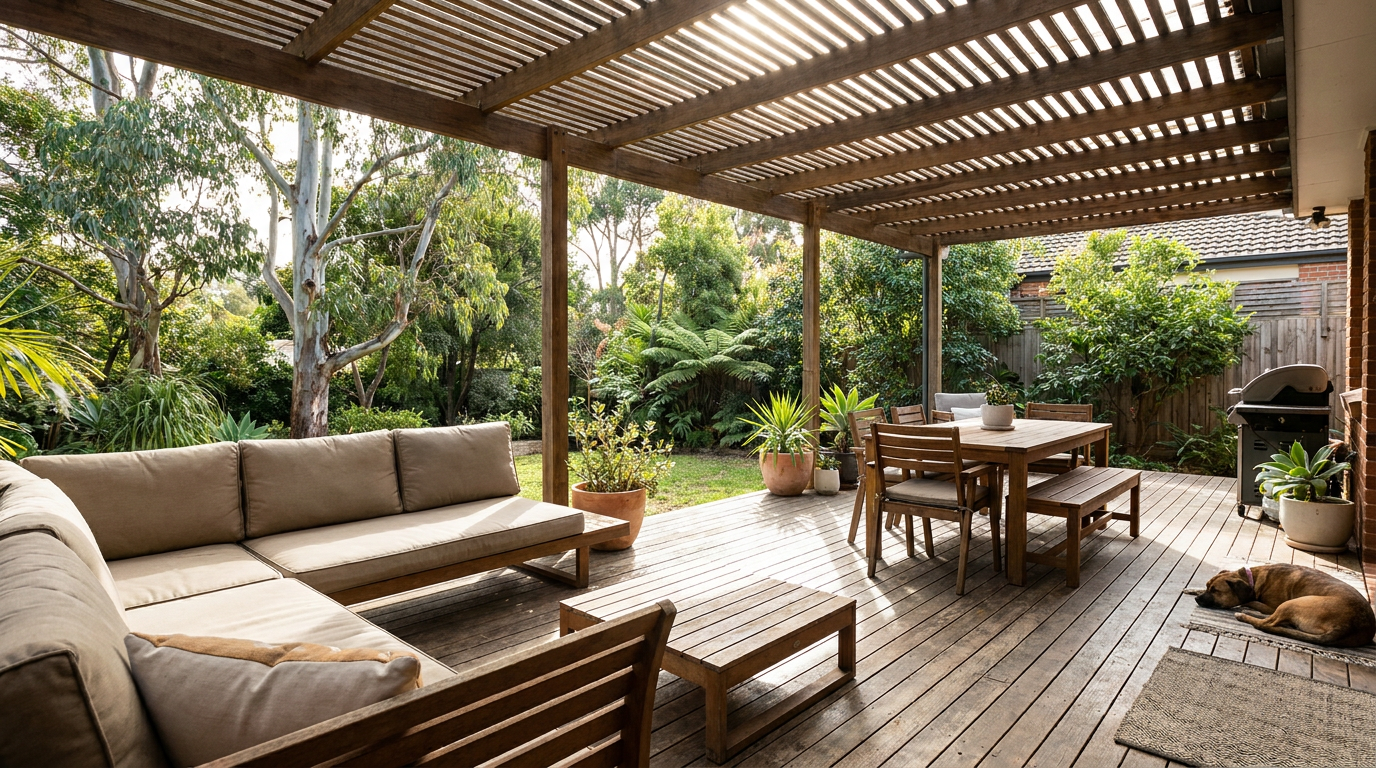
By Space · Suburban Brisbane
Suburban Brisbane outdoor spaces aren't a single category. A covered patio, a timber or composite deck, and a pergola each have different weather profiles, different furniture demands, and different style logic — even when they sit on neighbouring properties in the same street. This guide covers the three structure types, the size-scaling matrix for typical suburban dimensions, the material-by-structure decisions, the indoor-outdoor flow framework specific to subtropical living, and the full-set vs piecemeal buying decision. For the broader Brisbane outdoor space framework, see our Brisbane outdoor furniture by space guide.
Patio, deck, pergola — three structures, three furniture problems
The terminology gets blurred in everyday Brisbane usage, but the three structure types have meaningfully different weather profiles. Knowing which you have is the first step toward the right furniture decision.
Patio (covered, attached, fully protected)
In Australian usage, a patio is an outdoor living area attached to the home, typically with a permanent roof — Colorbond steel, polycarbonate sheeting, or insulated panel are the common Brisbane builds. The space is fully protected from direct rain and most direct UV, with airflow at the perimeter. Patios are the most forgiving environment for outdoor furniture — material choices that wouldn't survive on an exposed deck can perform well under a covered patio for years.
Deck (timber or composite, often partially or fully exposed)
Decks are platforms — usually timber (merbau, ironbark, treated pine) or composite — raised above ground level, attached to or near the home. Many Brisbane decks have partial overhead protection (roof eaves, shade sails, retractable awnings) but most have significant direct-sun exposure and full rain exposure. Decks are the most demanding of the three structures — full UV, full rain, and timber surface temperature variation that affects furniture placement.
Pergola (lattice or open beams, partial shade with rain pass-through)
Pergolas are open structures — cross-beams, lattice panels, or climbing-plant frameworks — that filter sun without blocking rain. Modern Brisbane pergolas often add lightweight roofing (aluminium sheeting, polycarbonate) that converts them effectively into patios; traditional open pergolas remain the most common. The defining feature for furniture decisions: partial shade plus full rain exposure means furniture needs the same weather rating as deck-grade pieces, despite the apparent shade protection.
The structure-type rule: Patios are forgiving. Decks are demanding. Pergolas look protected but aren't. Furniture that suits one structure often doesn't suit the others — even within the same suburban Brisbane property.
The structure × furniture matrix
Each structure type has different furniture priorities. The cross-reference for typical suburban Brisbane decisions:
| Furniture priority | Covered patio | Deck | Pergola (open) |
|---|---|---|---|
| Weather rating needed | Moderate — protected from direct rain | Full — exposed to rain and UV | Full — rain passes through despite shade |
| Material flexibility | Wide — including teak, rattan, fabric | Narrow — marine-grade aluminium, polywood, HDPE wicker | Narrow — same as deck, despite shade |
| Cushion handling | Cushions stay out routinely | Cushions inside between use, or pre-storm only | Cushions inside between use |
| Style flexibility | Highest — full lounge or dining sets | Moderate — robust pieces preferred | Moderate — climate-matched style |
| Storm-season handling | Light — confirm anchoring | Active — cushions inside, lighter pieces secured | Active — cushions inside, lighter pieces secured |
The size-scaling framework for suburban Brisbane
Suburban Brisbane outdoor structures span a wide size range — from compact 3m × 3m patios in older Beenleigh, Annerley, or inner-suburban builds to 8m × 6m or larger covered alfresco extensions in newer developments through Springfield Lakes, North Lakes, Forest Lake, and Shailer Park. The practical fit at common suburban dimensions:
| Structure size | Recommended configuration | Typical Brisbane homes |
|---|---|---|
| 3m × 3m (compact) | 4-seater dining set OR small lounge configuration — not both | Older inner-suburban builds, retrofitted patios on 1970s–80s homes |
| 4m × 4m (standard) | 6-seater dining set OR 4-piece lounge with coffee table | Mid-90s through mid-2000s suburban builds, typical alfresco minimums |
| 5m × 5m (generous) | 6-8 seater dining set + 2-piece lounge separation, or daybed feature | Mid-2000s and newer builds, dedicated alfresco zones |
| 6m × 6m+ (entertainer) | Full coordinated dining + lounge zones, daybed feature pieces, separate bar setup | 2010s+ entertainer homes, larger acreage builds, retrofit major renovations |
The sizing rules from our Brisbane apartments and small spaces guide still apply — 90cm clearance around dining tables for chair pull-out, 60cm clearance for traffic flow past lounge configurations — but the suburban context typically allows the full clearances rather than the compromises apartment dwellers face. The broader Queensland framework that drives space planning is in our complete outdoor furniture guide for Brisbane and Queensland.

Material decisions across the three structure types
The structure type drives the material decision more than the home style does. Quality marine-grade powder-coated aluminium handles all three structures and is the safest default for most suburban Brisbane applications — the full specification framework is in our aluminium outdoor furniture guide.
Patio (covered, protected)
Material flexibility is highest. Quality teak works well under proper roof protection — its natural oils repel humidity and the aesthetic ages gracefully. Synthetic HDPE wicker handles the climate exceptionally on covered patios. Quality timber furniture (acacia, eucalyptus) extends usable life significantly with overhead protection. The material framework in our hardwood comparison guide applies fully on covered patios.
Deck (exposed)
Material discipline matters more. Quality marine-grade powder-coated aluminium and quality polywood (HDPE recycled plastic) handle full UV and rain exposure better than timber furniture or natural materials. The polywood option specifically suits exposed decks — covered in our polywood outdoor furniture guide. Quality solution-dyed acrylic cushions handle the UV intensity better than budget polyester.
Pergola (open structure)
Same material discipline as deck. The apparent shade protection is misleading — rain passes through open beams or lattice, and UV during morning and afternoon hours often reaches furniture as the sun angle changes. Plan furniture around the worst weather conditions, not the best. Cushion handling specifically matters: even covered-pergola cushions left out through a wet-season afternoon storm can develop the foam interior problem covered in our outdoor cushion care guide.
The indoor-outdoor flow framework
Modern suburban Brisbane builds increasingly feature integrated alfresco design — large sliding doors, level floor transitions between indoor living and outdoor structure, visual sightlines that treat the outdoor space as an extension of the indoor living area. This pattern, common in Carindale, Chermside, Forest Lake, The Gap, Westlake, and Indooroopilly through Mansfield and Wishart, drives different furniture decisions than older suburban builds with stepped transitions and separate outdoor zones.
Visual continuity over isolated outdoor styling
When the outdoor space sits in direct sightline from indoor living areas, the furniture style needs to bridge both spaces visually. Stark contrasts between indoor minimalist and outdoor traditional (or vice versa) create visual disconnection. Consistent colour temperatures (warm whites or cool greys throughout), coordinated materials (timber inside / timber-look or warm aluminium outside), and complementary scale all support visual continuity.
Furniture scale and proportion
Suburban Brisbane outdoor structures are typically larger than apartment outdoor spaces but smaller than acreage entertaining areas. The scale that works: dining tables proportionate to the structure's main visual axis (a 4m-wide patio takes a 1.6–2m wide table comfortably; an 8m-wide patio needs 2.2–2.6m to feel proportionate); lounge depths matched to the seated-eye-line height; sufficient clearance to traffic-flow without cramping.
Storm season handling for integrated spaces
Integrated indoor-outdoor design often means cushions and lightweight pieces can be moved indoors quickly during storm season. The pre-storm protocol becomes more practical when the indoor-outdoor transition is seamless — pieces can stage inside the threshold rather than requiring full storage relocation. Full storm-season framework is in our Queensland storm protection guide.
Style direction — Hamptons, Coastal, Modern, Resort
Suburban Brisbane outdoor structures support a wider range of style directions than apartment balconies or pool zones. The major directions and how each translates to furniture decisions:
- Hamptons. White or cream powder-coated aluminium or warm-tone timber, navy and stripe accents, classic dining proportions, warm white frames over stark white. The full Hamptons framework is in our Hamptons outdoor furniture guide for Brisbane.
- Coastal. Light timber or natural-tone HDPE wicker, blues and sandy neutrals, casual and informal proportions, weathered-look acceptable. Pairs with the coastal modifier for properties closer to the Bay or southern Gold Coast.
- Modern. Black or graphite powder-coated aluminium, clean lines, minimal ornamentation, monochrome or tonal palettes. Best fit for newer architectural builds and major renovations.
- Resort. Deep modular sofas, daybeds, oversized lounge proportions, neutral-tone solution-dyed acrylic. Best fit for entertainer homes (5m × 5m+ structures) where the scale supports the substantial pieces.
The architectural style match
The strongest results come from matching outdoor furniture style to the home's architectural style direction rather than chasing a separate outdoor aesthetic. A 1990s suburban Brisbane home in Indooroopilly with traditional cream-rendered facade reads as inconsistent with stark black modern outdoor furniture. A 2020s contemporary home in Springfield with charcoal Colorbond and concrete reads as inconsistent with cream-painted Hamptons furniture. Choose furniture style that the home's architecture would accept as a natural extension.
Full set vs piecemeal — the buying decision
Suburban Brisbane outdoor structures typically justify substantial furniture investment — sets in the $3,000–$15,000 range across A2Z's price tiers. The decision: full coordinated set or piece-by-piece accumulation?
Full set advantages
Coordination across pieces is significantly easier when buying as a set — matching frame finishes, complementary cushion colours, consistent style direction. Sets typically include better unit pricing than equivalent individual pieces. Delivery and showroom-floor inspection together makes the purchase decision more confident. The visual result is more polished than mismatched piece-by-piece accumulation.
Piecemeal advantages
Budget flexibility — start with a dining set in year one, add a lounge configuration in year two, expand to umbrellas and side tables in year three. Allows more time to assess what the space actually needs before committing. Lets you upgrade individual pieces (a feature daybed, a premium dining table) without committing to a full premium set.
The hybrid approach
Most suburban Brisbane buyers benefit from a hybrid approach — buy a coordinated dining set or coordinated lounge set as the primary commitment, then add complementary pieces (umbrella, side tables, footstools) over time from the same supplier or matching aesthetic ranges. This captures the coordination advantage of sets while maintaining the budget flexibility of piecemeal buying.
FAQs
-
What's the difference between a patio, deck, and pergola in a Brisbane home?
In Australian usage: a patio is an outdoor living area attached to the home with a permanent roof (Colorbond steel, polycarbonate, or insulated panel) — fully protected from rain and most UV. A deck is a platform raised above ground level, usually timber or composite, often with significant direct-sun exposure and full rain exposure. A pergola is an open structure (cross-beams, lattice, or climbing-plant framework) that filters sun without blocking rain — partial shade with full rain pass-through. The practical difference for furniture: patios are forgiving (wide material flexibility), decks are demanding (full weather rating needed), and pergolas look protected but require the same weather discipline as decks.
-
What outdoor furniture is best for a Brisbane timber deck?
Quality marine-grade powder-coated aluminium and quality polywood (HDPE recycled plastic) handle the full UV and rain exposure that timber decks typically face. Quality timber outdoor furniture (acacia, eucalyptus, teak) works on decks with overhead protection but needs more care without it. Quality solution-dyed acrylic cushions handle the UV intensity significantly better than budget polyester. Avoid: natural rattan, indoor-grade wicker, and standard polyester cushions on exposed decks — Brisbane sun and humidity destroy these materials within 1–2 summers. The decking timber itself can also affect furniture placement — darker timbers (ironbark, spotted gum) reach significantly higher surface temperatures in summer sun than lighter timbers (treated pine, merbau).
-
How do I choose furniture for a pergola that gets rained on?
Treat pergola furniture decisions the same as exposed-deck decisions — the apparent shade protection is misleading because rain passes through open beams or lattice. Quality marine-grade powder-coated aluminium frames, quality solution-dyed acrylic cushions (Sunbrella or equivalent), and HDPE polywood pieces handle the conditions. Cushions specifically need active handling — bring inside between use during wet periods, never leave through forecast storms. The foam interior problem develops fast on pergola cushions because the partial shade slows drying after rain events. Avoid timber furniture on open pergolas unless you accept the higher maintenance — the unprotected rain exposure shortens timber furniture life significantly.
-
How big a dining set fits on a typical suburban Brisbane patio?
For a typical 4m × 4m suburban Brisbane patio (the most common size in mid-90s through mid-2000s builds), a 6-seater dining set fits comfortably with proper clearances — the table is typically 1.8–2m long, leaving 90cm clearance on each side for chair pull-out. A 5m × 5m patio supports a 6–8 seater dining set plus a separate small lounge zone (2-piece configuration with coffee table). A 6m × 6m+ patio supports full coordinated dining and lounge zones with daybed or feature pieces. Always confirm that the structure's main visual axis (typically the longest dimension) accepts the table length comfortably — a 1.6m wide patio with a 2m table feels cramped regardless of clearance maths.
-
Should I buy outdoor furniture as a set or piece by piece?
Most suburban Brisbane buyers benefit from a hybrid approach. Buy a coordinated dining set or coordinated lounge set as the primary commitment (matching frame finishes, complementary cushion colours, consistent style direction give a more polished result than mismatched accumulation). Then add complementary pieces over time — umbrella, side tables, footstools — from the same supplier or matching aesthetic ranges. This captures the coordination advantage of full sets while maintaining the budget flexibility of piecemeal buying. Pure full-set buying is best for buyers with confident space planning and clear design direction; pure piecemeal works for buyers who want to assess the space's actual use before major commitment.
-
What outdoor furniture style suits a modern Brisbane suburban home?
Modern Brisbane suburban homes (newer architectural builds with charcoal Colorbond, large sliding glass, concrete or rendered facades) suit black or graphite powder-coated aluminium frames, clean lines, minimal ornamentation, and monochrome or tonal palettes (charcoal, white, natural timber accents). Avoid stark traditional Hamptons treatments unless your home's architecture supports them — a modern build with cream Hamptons furniture reads as inconsistent. The strongest results come from matching outdoor furniture style to the home's architectural style direction rather than chasing a separate outdoor aesthetic. For Hamptons-style homes specifically, the dedicated Hamptons outdoor furniture guide for Brisbane covers the framework in detail.
Quality outdoor furniture for suburban Brisbane spaces
Suburban Brisbane patios, decks, and pergolas reward thoughtful furniture decisions — the right structure-matched material, scale-appropriate sizing, and style direction matched to the home's architectural character. All five of our South East Queensland showrooms — Rocklea, North Ipswich, Sandgate, Bundall, and Beenleigh — carry full dining sets, lounge configurations, and feature pieces matched to the typical suburban Brisbane scale, and our team can talk through structure-specific decisions for your space. Free local delivery applies across Greater Brisbane and SEQ on eligible orders.
Shop the range
Ready to buy? Browse the matching outdoor collections: