
Care & Maintenance · Cushion Care
Cushions are usually the first part of an outdoor setting to fail in Brisbane — not because they're poorly made, but because cushion care in QLD humidity is dramatically more demanding than in drier climates. The biggest single mistake is treating water-repellent fabric as if the foam underneath stays dry too. This guide covers the routine cleaning protocols matched to fabric type, the deep-clean protocol for stains and mould, the foam interior problem most articles skip, the QLD storage spectrum from minimal to comprehensive, and the honest framework for when a cushion is past saving. For the buyer-side fabric specifications and UV-resistance comparisons, see our existing outdoor fabric guide; this article is the care-side companion. Part of our broader Queensland outdoor furniture care guide.
Why cushions fail first in Brisbane — the QLD reality
In most outdoor furniture sets, the frame outlasts the cushions by a wide margin — quality teak, aluminium, or polywood frames last 10–20 years; cushions typically need replacement every 3–7 years. In Brisbane and SEQ, the gap is even wider because three QLD-specific pressures combine to age cushions faster than competitor articles assume: humidity drives foam saturation (water-repellent fabric covers don't keep moisture out indefinitely; after heavy rain or extended exposure to QLD's 70%+ summer humidity, foam interiors absorb water through fabric pores, zipper seams, and stitching, and during the slow drying window internal mould can establish).
UV intensity fades fabrics faster (Brisbane's UV index regularly hits 13+ in summer, dramatically faster fabric ageing than the climates most outdoor cushion fabrics were tested in); and storm season concentrates damage (November to March, intense rain events drive water deep into cushion foam in single afternoon storms — faster saturation than weeks of normal humidity). The broader Queensland climate framework that drives this is covered in our complete outdoor furniture guide for Brisbane and Queensland.
The fabric-doesn't-equal-cushion principle
The single most important framing for QLD cushion care: water-repellent fabric is not the same as a waterproof cushion. Fabric performance specifications describe how the woven surface handles water; the foam underneath is a separate problem. A cushion can have high-quality solution-dyed acrylic fabric and still fail because the foam interior is staying wet between rain events. Most cushion failures in Brisbane trace to foam saturation, not fabric failure.
The QLD honesty: Premium fabric specifications protect the cushion's appearance. Foam interior care protects the cushion's lifespan. The two are different problems requiring different protocols, and most generic care content focuses only on the fabric side.
The routine cleaning protocol — fabric-matched
Routine cleaning prevents most cushion problems. Done weekly during heavy use periods and fortnightly otherwise, it stops dirt, pollen, and salt from embedding into fabric where they accumulate moisture and accelerate UV degradation.

The fabric-type cleaning matrix
Different outdoor cushion fabrics tolerate different cleaning approaches. Knowing which fabric you have determines what cleaners and techniques are safe to use.
| Fabric type | Bleach tolerance | Machine wash | Routine cleaner |
|---|---|---|---|
| Solution-dyed acrylic (Sunbrella, Outdura) | Yes — 1:10 bleach-water for mould | Yes if covers unzip and label permits | Mild dish soap + warm water |
| Olefin / Polypropylene | Limited — test first | Cold gentle cycle if label permits | Mild dish soap + warm water |
| PU-coated polyester | No — damages PU coating | No — coating breaks down | Damp cloth + mild soap; spot clean only |
| Standard polyester | Light dilution only | Cold gentle cycle if label permits | Mild dish soap + warm water |
The routine technique
For most QLD outdoor cushions, the routine is: brush off loose debris with a soft-bristled brush; mix 1 tablespoon mild dish soap (Dawn, Method, or equivalent) per litre of warm water; apply with a soft cloth or sponge in sections, working in the direction of any fabric pattern; rinse thoroughly with a garden hose at low pressure; press out excess water without wringing; stand cushions on edge to drain and dry.
Avoid soaking the cushion if possible — surface cleaning the fabric while keeping foam dry is significantly better than full saturation.
Removable covers — the easy mode
If your cushion covers unzip, removable-cover cleaning is dramatically easier than whole-cushion cleaning. Unzip the cover, set the foam insert in a clean dry location, wash the cover separately (machine or hand depending on label), then dry the cover and reassemble. This keeps the foam dry entirely, avoids the foam-saturation problem, and is the practical default for any cushion with removable covers.
The deep-clean protocol — stains, mould, stubborn cases
For cushions that have developed stains, surface mould, or accumulated grime that routine cleaning won't shift, the deep-clean protocol is appropriate. This is more aggressive than routine cleaning and should be reserved for genuine need — the more aggressive the cleaning, the more wear on the fabric.
Mould and mildew on cushion fabric
Surface mould on outdoor cushions appears as dark spots (mould) or flat powdery patches (mildew). For solution-dyed acrylic fabrics that tolerate bleach: mix a 1:10 bleach-water solution (one part bleach to ten parts water), apply with a soft brush working with the fabric grain, allow 5–10 minutes, scrub gently, rinse thoroughly, dry fully.
For fabrics that don't tolerate bleach (PU-coated polyester, sensitive fabrics): use a 50/50 white vinegar and water solution, applied the same way. Borax (¼ cup per bucket of warm water) is an alternative for sensitive fabrics. The cross-material diagnostic protocols are covered in our mould and mildew removal guide.
Bird droppings, food spills, and grease
Time matters more than technique for organic stains. Address spills within hours, not days — once organic matter has dried into the fabric, it becomes much harder to remove. For bird droppings, blot (don't rub) with a microfiber cloth, then spot clean with mild soap. For oil-based stains (sunscreen, food oils), blot the excess, apply cornstarch or baking soda to absorb remaining oil, allow 10–15 minutes, vacuum or scrape off the powder, then spot clean. For wine, fruit, or other organic stains, blot immediately with cool water, then spot clean with mild soap.
The bleach-vinegar safety warning
Never combine bleach and vinegar. The reaction produces chlorine gas, which is genuinely dangerous and can cause severe respiratory injury. If you've used vinegar on a cushion and decide to try bleach for stubborn stains, rinse the cushion thoroughly with fresh water first and allow to dry. The same warning applies to bleach combined with ammonia-based cleaners — don't combine cleaners regardless of how mild they seem individually.
Pressure washing — the rare-exception tool
Pressure washing cushions is risky and only appropriate in specific cases. The high pressure can damage fabric fibres, tear seams, and force water deep into foam — the exact opposite of what you want for QLD conditions. If you do use a pressure washer on cushions, set to lowest pressure (under 1,000 PSI), use a wide spray nozzle, keep at least 30cm distance, and never stop the spray pattern in one place. Reserve pressure washing for severely soiled cushions where you're prepared to risk fabric damage and where alternatives have failed. For most situations, hand cleaning is significantly safer.
The foam interior problem — what surface cleaning misses
This is the section most cushion care articles skip entirely, and it's where most QLD cushion failures actually happen. Surface cleaning addresses the fabric; the foam interior is a separate problem that requires different protocols.
Quality outdoor cushion foam
Quality outdoor cushion foam is reticulated (open-cell) foam designed for fast water drainage rather than the closed-cell or high-density foam used in indoor cushions. Reticulated foam looks like a sponge under magnification — water passes through rather than absorbing into closed cells. This is why quality outdoor cushions feel different from indoor cushions when you press them: the open structure allows airflow and drainage.
Budget cushions often use closed-cell foam that absorbs water and dries slowly, which is the root cause of most cushion mould problems. The buyer-side foam and fabric specifications that determine quality are covered in our outdoor fabric guide.
The foam saturation cycle
Even reticulated foam can become saturated under sustained QLD wet-season conditions. The cycle: heavy rain or storm event drives water through fabric and zipper seams into foam; foam holds water through the recovery period; humidity prevents the foam from fully drying between events; mould spores in the air establish on the wet foam interior; surface cleaning the fabric appears to fix the problem but the foam interior continues releasing spores; mould returns within weeks of cleaning.
This explains the common QLD complaint: "I cleaned the cushion thoroughly but the mould came back."
Drying foam properly
Drying foam after saturation requires more than letting the cushion sit in the sun. Effective foam drying: stand the cushion on edge with the wettest side facing down so gravity helps drainage; ensure airflow on both sides (don't flatten against a wall); press the cushion firmly several times during drying to push retained water out; allow 24–48 hours minimum in direct sun and good airflow before declaring it dry; consider opening removable covers and standing the foam insert separately. In severe cases, a fan accelerates the drying significantly.
When foam can't be saved
If foam has internal mould — visible black or grey spots inside when you compress and inspect, persistent musty smell, foam that releases dirty water when pressed — surface cleaning won't reach it. The foam itself is the reservoir, and the mould will return after every cleaning. The honest answer: replace the foam insert (for removable-cover cushions) or replace the cushion entirely (for non-removable-cover cushions). Trying to clean mould-affected foam wastes time and chemicals. The replacement framework is in the past-saving section below.
The QLD storage spectrum
Storage is the single most underused tool for extending outdoor cushion life in QLD. Even minimal storage during peak risk periods dramatically reduces cumulative damage. The spectrum of options:
Tier 1 — Bring inside (zero cost, maximum protection)
The best storage option in QLD is the easiest: bring cushions inside when not in use for extended periods. Indoor air conditioning and lower humidity prevent the foam saturation problem entirely. For cushions that aren't used daily — guest spaces, formal entertaining areas, secondary outdoor settings — inside storage is the practical default. The objection is usually "where do I put them?" — a corner of a garage, the bottom of a wardrobe, or under a bed all work fine.
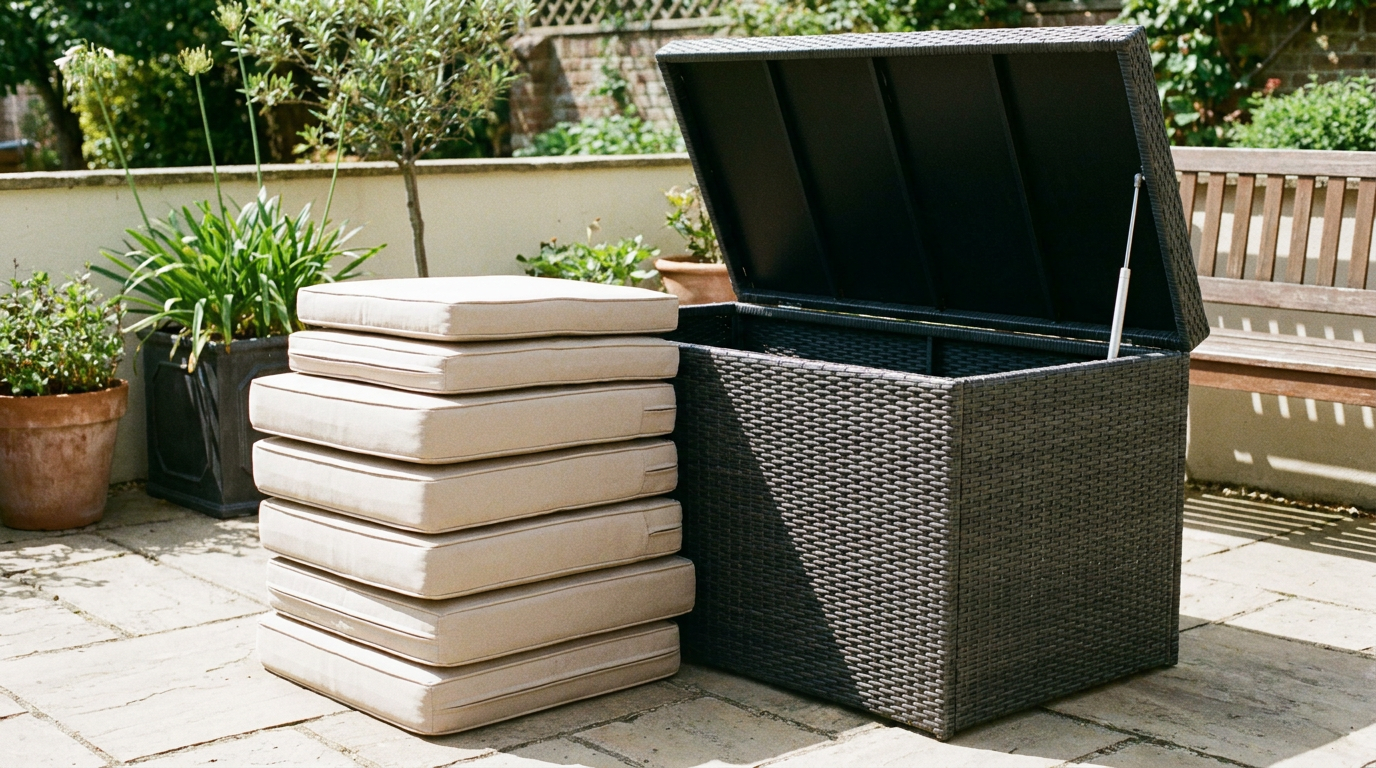
Tier 2 — Outdoor cushion storage box or deck box
For cushions used regularly enough that bringing them inside is impractical, a quality outdoor storage box is the next-best option. Look for: ventilation (vents or breathable construction prevent condensation buildup); waterproof construction (sealed seams, waterproof finish, drainage); appropriate sizing (cushions should fit without compression).
Plastic and resin storage boxes work well; timber boxes need their own care routine. Budget $200–$500 for a quality storage box that fits a typical 4-piece cushion set; $500–$1,500 for larger benches that double as storage.
Tier 3 — Storage bags or cushion covers
For cushions that need protection but can't move to indoor storage or a deck box, individual cushion storage bags or fitted covers are the third-tier option. Look for breathable construction (waterproof bags trap humidity inside, defeating the purpose); zippered closure to keep insects out; fitted shape that prevents the cushion from shifting inside. Cushion bags are significantly less effective than the higher tiers; reserve them for situations where Tier 1 and 2 aren't workable.
Tier 4 — Vented furniture covers (the partial solution)
Quality vented furniture covers can serve as cushion protection when the cushions stay on the furniture. The Queensland-specific tradeoffs of furniture covers — when they help, when they cause more damage than the elements they protect against — are covered in detail in our outdoor furniture covers guide. For cushions specifically, the rule is: covers work for short-term protection (overnight, before-storm), not for long-term storage where Tier 1 or 2 is dramatically better.
What about the cushion-on-aluminium contact-point problem?
Cushions left on aluminium frames in QLD humidity trap moisture between cushion and frame, accelerating powder-coat damage at contact points. This affects the frame as well as the cushion. The practical solutions: lift cushions occasionally to allow airflow underneath; bring cushions inside during extended wet periods; or if cushions stay outside, ensure adequate routine cleaning and the foot-cap drainage check covered in our aluminium outdoor furniture cleaning guide.
Pre-storm and post-storm cushion handling
Storm-season cushion handling is different from routine care. November to March, the practical defaults shift to handling intense rain events and the high-humidity recovery periods that follow.
Pre-storm protocol
When storms are forecast, bring cushions inside before the storm arrives — not during, not after. Cushions caught in storm rain take significantly more damage than cushions stored before the event. The practical timeline: check the forecast each morning during storm season; if afternoon storms are forecast (the QLD pattern), bring cushions inside in the morning before they're at risk. For weekday afternoon storms when no one is home, leaving cushions in a Tier 2 storage box during storm season is a defensible default. The broader storm-protection routine is covered in our Queensland storm protection guide.
Post-storm 24-hour rule
If cushions get caught in storm rain despite preparation, address them within 24 hours. The protocol: stand cushions on edge to drain immediately; rinse with fresh water (storm rain can carry salt and pollutants in coastal areas); allow full drying in good airflow before returning to use or storage; check for any mould development over the following week as the foam continues to dry. The 24-hour window prevents the salt-and-mould establishment that turns a single storm event into a multi-week recovery problem.
Cumulative storm-season strategy
Across the November–March wet season, cushions experience repeated cycles of saturation and drying. Cumulative damage builds even with proper post-storm handling. The practical mitigation: rotate cushions during the wet season so no single cushion takes all the exposure; inspect for early mould development weekly; consider dedicated storm-season storage (Tier 2 deck box) and bring cushions out only for active use periods; accept that some cushion ageing is inevitable through QLD wet seasons regardless of care intensity.
When a cushion is past saving
Most cushion care articles assume cleaning will work. Sometimes it doesn't, and continuing to clean cushions that have reached end-of-life costs more in time and chemicals than replacement would.
Honest indicators that a cushion is past saving: foam interior has visible mould or persistent musty smell (surface cleaning won't reach foam mould, and the cushion will continue releasing spores even after multiple cleanings); foam has lost structural integrity (cushions that no longer recover their shape, that compress permanently under weight, or that feel lumpy and uneven have broken down internally regardless of fabric condition); fabric has UV degradation beyond cosmetic fade (fabric that has become brittle, that shows fibre breakdown when pulled, or that has developed UV-driven holes or thin spots indicates the fabric structure has failed).
Stitching has failed at multiple seams (one blown seam can be repaired; multiple failures indicate the thread itself has UV-degraded); or you've cleaned the cushion three or more times for the same recurring problem (mould keeps returning, stains keep reappearing, smell persists despite cleaning) — the underlying problem is in the foam or fabric structure, and cleaning treats symptoms rather than cause.
The replacement vs full cushion replacement decision
For cushions with removable covers, foam replacement alone is sometimes the right answer — the fabric is fine but the foam has failed. Quality outdoor cushion foam (reticulated outdoor-grade) costs significantly less than full cushion replacement, and the labour to replace foam in an existing cover is minimal. For cushions where covers don't unzip or where both fabric and foam have failed, full cushion replacement is the practical answer. Custom cushion replacement matched to your specific furniture sizes is widely available in Australia; budget $80–$300 per replacement cushion depending on size, fabric, and foam quality.
FAQs
-
How often should I clean outdoor cushions in Brisbane?
Routine cleaning weekly during heavy use periods, fortnightly otherwise — quick brush-off of loose debris plus spot cleaning of any visible marks. Add a deeper clean (mild soap solution, soft cloth, full surface wipe-down) once a month, plus thorough deep cleaning twice a year (October pre-summer and April post-wet-season). Coastal SEQ properties may need more frequent fresh-water rinsing during onshore wind periods to remove salt deposits. The big rule: address spills, bird droppings, and food stains within hours rather than days — organic matter that dries into fabric becomes significantly harder to remove.
-
Can I put outdoor cushion covers in the washing machine?
Some yes, some no — depends on the fabric and the specific care label. Solution-dyed acrylic (Sunbrella, Outdura) covers usually tolerate machine washing on cold gentle cycle if the label permits. Olefin covers similarly often allow cold gentle cycle. PU-coated polyester covers should NOT go in the washing machine — the coating breaks down with machine agitation. Standard polyester covers vary; check the label. Universal rules: only wash covers if they unzip and the label permits; use cold water, gentle cycle, mild detergent (no fabric softener); air-dry only — never tumble dry unless the label specifically permits, and even then prefer air drying. The foam insert never goes in the washing machine regardless of fabric type.
-
How do I get rid of mould on outdoor cushions?
Surface mould on quality solution-dyed acrylic fabrics: mix a 1:10 bleach-water solution, apply with a soft brush working with the fabric grain, allow 5–10 minutes, scrub gently, rinse thoroughly, dry fully. For fabrics that don't tolerate bleach (PU-coated polyester especially), use a 50/50 white vinegar and water solution applied the same way. Borax (¼ cup per bucket of warm water) is an alternative for sensitive fabrics. Critical safety: never combine bleach and vinegar — the reaction produces dangerous chlorine gas. If the mould keeps returning after multiple cleanings, the foam interior has mould that surface cleaning can't reach — replacement is the practical answer rather than continued cleaning.
-
Why do outdoor cushion fabrics still feel wet after they look dry?
Because the fabric is dry but the foam interior isn't. Outdoor cushion foam holds water for hours or days after the surface fabric appears dry, particularly in QLD humidity where airflow is limited and ambient moisture stays high. The fabric-doesn't-equal-cushion principle: water-repellent fabric protects the cushion's appearance; foam interior care protects its lifespan. Effective drying requires standing cushions on edge with airflow on both sides, allowing 24–48 hours minimum after saturation, pressing the cushion firmly to push retained water out, and ideally using a fan to accelerate drying. A cushion that feels dry on the surface but has wet foam underneath, put under a cover or stacked in storage, is the most common path to internal mould.
-
What's the best way to store outdoor cushions in Queensland?
Indoor storage when possible (best protection, zero cost) — a corner of a garage, bottom of a wardrobe, or dedicated storage area works fine. For cushions used regularly enough that indoor storage is impractical, a quality outdoor storage box with ventilation, waterproof construction, and appropriate sizing is the next-best option (budget $200–$500 for a 4-piece set, more for larger). Individual cushion storage bags work as a third tier where higher tiers aren't practical — choose breathable construction rather than waterproof, since waterproof bags trap humidity inside and defeat the purpose. For the November–March wet season specifically, bringing cushions inside or into a Tier 2 storage box during peak risk periods extends cushion life dramatically compared to leaving them on furniture.
-
When should I replace outdoor cushions instead of cleaning them?
Replace rather than clean when: the foam interior has visible mould or persistent musty smell (surface cleaning won't reach it); the foam has lost structural integrity (won't recover shape, compresses permanently, feels lumpy); the fabric has UV degradation beyond cosmetic fade (brittle, fibre breakdown, holes, or thin spots); stitching has failed at multiple seams; or you've cleaned three or more times for the same recurring problem. For removable-cover cushions, foam replacement alone is sometimes the right answer — fabric is fine but foam has failed, and quality outdoor reticulated foam costs less than full replacement. Custom cushion replacement is widely available in Australia; budget $80–$300 per cushion depending on size, fabric, and foam quality.
Quality cushioned outdoor furniture for QLD conditions
The most effective long-term cushion care is choosing quality cushions matched to QLD conditions in the first place. Quality solution-dyed acrylic fabrics, reticulated outdoor-grade foam, and removable cover construction all dramatically reduce the care intensity needed for cushions to last. All five of our South East Queensland showrooms — Rocklea, North Ipswich, Sandgate, Bundall, and Beenleigh — carry quality cushioned outdoor furniture matched to QLD conditions, and our team can talk through fabric specifications and foam construction for any piece in our range. Free local delivery applies across Greater Brisbane and SEQ on eligible orders.
Shop the range
Ready to buy? Browse the matching outdoor collections: