
By Space · Sub-Pillar
Brisbane outdoor furniture decisions aren't the same as Sydney or Melbourne. The combination of subtropical climate, the verandah-as-room architectural tradition, and the city's range of home types — from 1900s Queenslanders to 2020s apartment towers — creates space-type distinctions that generic outdoor furniture content misses entirely. This sub-pillar is the directory: identify your space type, get the right approach for your situation, then follow through to the deep guide for that space. Part of our broader complete outdoor furniture guide for Brisbane and Queensland.
Why Brisbane's outdoor spaces are different
Most outdoor furniture content assumes a generic "patio" or "garden" that doesn't really exist in Brisbane. The city's outdoor spaces are shaped by three interlocking factors that don't apply equally elsewhere in Australia:
- The verandah-as-room tradition. Brisbane's pre-war architecture treated the verandah as a living space — semi-protected, semi-outdoor, used year-round. That tradition extends to modern Brisbane homes through covered alfresco areas, deep eaves, and indoor-outdoor flow design. Outdoor furniture in Brisbane often sits in spaces that are genuinely rooms, not just exposed patios.
- The subtropical climate logic. Storm season (November–March), high UV (index 13+ in summer), high humidity, and salt air on coastal SEQ properties combine to demand material decisions that make sense for QLD specifically. The full climate framework is covered in our Queensland outdoor furniture care guide.
- The home-type variety. Brisbane has more architectural variety than most Australian cities — from heritage Queenslanders in Paddington and New Farm, to mid-century apartments in Toowong and South Brisbane, to new-build estates in North Lakes and Springfield, to bayside cottages in Sandgate and Wynnum. Each home type has different outdoor space characteristics that warrant different furniture approaches.
The Brisbane reality: "Outdoor furniture for Brisbane" is rarely the right search. The right question is usually "outdoor furniture for my Queenslander verandah" or "for my apartment balcony" or "for my suburban deck and pergola" — because the constraints, opportunities, and material decisions differ dramatically between these spaces.
The five Brisbane outdoor space archetypes
A2Z customers across our Rocklea, North Ipswich, Sandgate, Bundall, and Beenleigh showrooms split fairly cleanly into five archetypes. Identifying yours is the first step toward the right furniture decision.
| Archetype | Typical home types | Key constraints | Key opportunities |
|---|---|---|---|
| Heritage Queenslander | Pre-war Queenslanders, traditional cottages | Heritage character, narrow verandah depth, weight on stumps | Year-round use, semi-protected from rain, indoor-outdoor flow |
| Apartment / rooftop | Inner-city apartments, rooftop terraces, new-build townhouses | Body corporate rules, weight limits, wind exposure on rooftops | Compact-furniture market, often premium views |
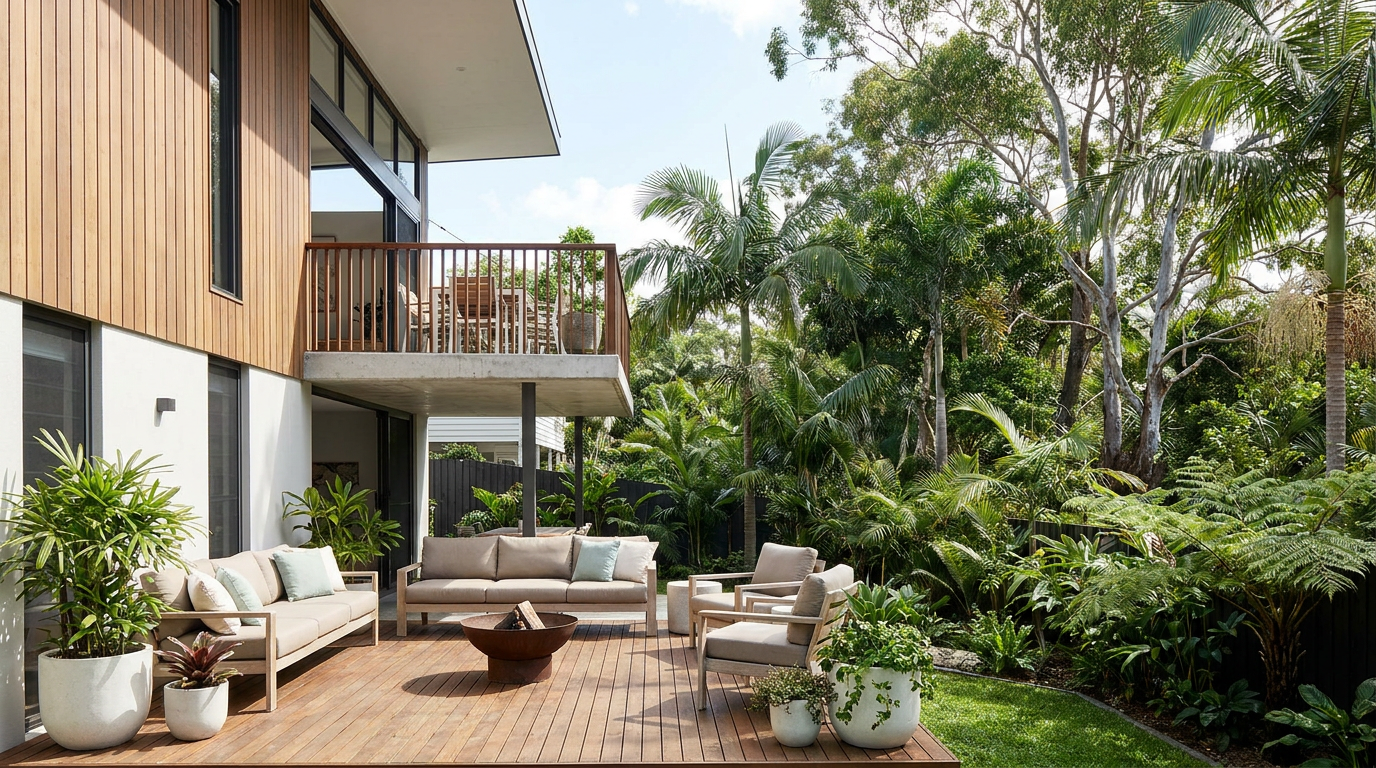
| Suburban patio/deck/pergola | Mid-century & modern suburban homes, new estates | Variable shade and exposure, often largest space | Full dining/lounge sets feasible, real outdoor entertaining |
| Pool/alfresco/outdoor kitchen | Larger blocks, entertainer homes, retrofit pool zones | Function-specific demands (chlorine, heat, grease) | High-AOV setups, dedicated zones, premium materials warranted |
| Coastal/bayside | Sandgate, Manly, Wynnum, Bundall, southern bayside, Gold Coast | Salt air, onshore winds, higher UV reflection | Marine-grade investment justified, year-round outdoor use |
The next four sections work through the first four archetypes in detail. The coastal/bayside archetype isn't a separate space type — it's a modifier that overlays any of the others, so it's covered through cross-cluster links to our salt air and corrosion guide and marine-grade outdoor furniture guide rather than a standalone section.
The Queenslander verandah — heritage outdoor rooms
The Queenslander verandah is the most distinctive Brisbane outdoor space and the one most generic furniture content gets wrong. Three characteristics shape the right furniture approach:
Architectural constraints and opportunities
Traditional Queenslander verandahs are narrow (1.5–2.5m typical depth), with timber floorboards, painted timber posts and balustrades, and roof overhang that provides genuine weather protection. The narrow depth limits dining-set options — a circular 4-seater works where a rectangular 6-seater doesn't. The semi-protected nature means timber and rattan furniture that wouldn't survive on an exposed patio can perform well on a verandah. The heritage character calls for furniture with traditional aesthetic credibility — modern-industrial pieces look out of place against fretwork and tongue-and-groove boards.
The indoor-outdoor flow tradition
Verandahs were designed as outdoor rooms before the term existed. Furniture decisions should reflect that — proper seating depth (not just bistro chairs), considered lighting, side tables, sometimes a daybed. The verandah is where Brisbane families actually live in the cooler months, and the furniture should support that rather than treat the space as a passing-through area.
Heritage-respectful style choices
Cane and rattan reads correctly on a Queenslander verandah but sits awkwardly on a modern apartment balcony. White-painted aluminium or timber-frame pieces with traditional silhouettes work where black powder-coat and minimalist forms don't. Coordinating soft furnishings — washable cushion covers, sisal rugs, hanging plants — bridge the practical (humidity, wear) and the aesthetic (heritage character). The cluster's hardwood comparison work in our hardwood comparison guide applies particularly to verandah furniture decisions.
→ Full guide: Queenslander Verandah Furniture — Style Meets Heritage
Brisbane apartment balconies & rooftop terraces — small-space mastery
Brisbane's apartment market has expanded significantly over the past decade — from inner-city projects in South Brisbane, West End, Newstead, and Fortitude Valley to suburban townhouse developments and rooftop conversions. Apartment outdoor space is its own discipline.
The body corporate reality
Most generic small-space furniture content ignores the rules apartment dwellers actually face. Body corporate by-laws often restrict: maximum furniture weight (relevant for older buildings and rooftop terraces), permanent fixtures (no drilling into balcony walls), planter and barbecue restrictions, and visual uniformity rules (some buildings restrict furniture colour on street-facing balconies). Check your building's by-laws before any significant outdoor furniture purchase — the rules are real and enforced.
The small-space material logic
Apartment balconies typically have less weather exposure than ground-level outdoor spaces (overhead protection from the next floor, partial wall protection on at least one side), but more wind exposure (high-rise positioning, building wind tunnels). The combination favours: lightweight powder-coated aluminium frames (for weight limits), foldable or stackable pieces (for storage flexibility), and pieces with low wind profile (avoid umbrellas, large screen panels, lightweight chairs that blow over). Our aluminium outdoor furniture guide covers the material specifications.
Rooftop terrace specifics
Rooftop terraces add wind exposure (significantly higher than ground-level), weight considerations (building structural limits matter), and UV reflection (white concrete or tile surfaces multiply UV exposure). The right furniture for a Sandgate ground-floor patio isn't the right furniture for a 30th-floor South Brisbane rooftop. Quality marine-grade powder-coat handles the higher exposure; lightweight pieces work better with the weight constraints.
→ Full guide: Outdoor Furniture for Brisbane Apartments & Small Spaces
Suburban patios, decks, and pergolas — the workhorse Brisbane outdoor space
The Brisbane suburban outdoor space is the largest market segment — covered patios, timber or composite decks, and pergola-shaded entertaining areas across the suburbs from Carindale to Chermside, Forest Lake to The Gap, plus Ipswich and the broader SEQ growth corridors.

Space-size guidelines
Suburban Brisbane outdoor spaces vary widely. Practical sizing rules: a 4-seater dining set needs roughly 3m × 3m of clear floor area; a 6–8 seater needs 3.5m × 4m or more (allow 90cm of clearance around the table on all sides for chair pull-out). A 4-piece sofa lounge set needs roughly 3m × 2.5m. Outdoor coffee tables work in spaces from 1.8m square upward. If you're working with a covered alfresco minimum 4m × 4m, you have genuine entertaining space; smaller and you're optimising for everyday use.
Pergola, deck, and patio variations
Each variation has different demands. Pergola seating is typically partial shade with rain exposure — material decisions need to handle both sun and water. Decks (timber or composite) often have minimal overhead protection and full exposure — the most demanding material conditions of the suburban variations. Covered patios are the most forgiving — overhead protection from rain and most sun extends material lifespan dramatically. The same furniture set will perform very differently across these three sub-spaces.
The full-set vs piece-by-piece decision
Suburban Brisbane outdoor spaces often justify full coordinated sets — a dining set plus a separate lounge area. Coordination across pieces (matching frame finish, complementary cushion colours, consistent style direction) creates a more polished result than mismatched piece-by-piece accumulation. Consider planning the whole space at purchase time, even if you buy in phases. Our outdoor furniture materials guide covers the cross-piece material consistency considerations.
→ Full guide: Patio, Deck & Pergola Furniture for Brisbane Suburban Homes
Pool, alfresco, and outdoor kitchen zones — function-specific decisions
Brisbane's larger blocks and entertainer homes often have multiple distinct outdoor zones — a pool deck, an alfresco dining area, an outdoor kitchen with adjacent seating. Each zone has function-specific material and configuration demands.
Pool deck furniture
Pool surrounds combine three challenges: chlorine exposure (degrades fabrics and some metals), full sun (UV intensity for hours daily during summer), and water splash (frame and cushion saturation cycles). Quality marine-grade powder-coated aluminium handles the chlorine and UV; quality solution-dyed acrylic cushions handle the water and UV. Sun loungers, daybeds, and side tables are the typical pool-zone configurations. Avoid: timber that doesn't tolerate chlorine repeatedly, fabric cushions without proper UV ratings, and lightweight chairs that blow into the pool during storms.
Alfresco dining areas
Covered alfresco spaces (the modern Australian outdoor dining tradition) protect furniture from the worst weather but bring their own considerations: lower ambient airflow can drive humidity issues, lower UV exposure shifts material priorities, and the indoor-outdoor flow makes furniture style choices more visible than on an exposed patio. Quality dining sets — typically larger 6–8 seater configurations — are the natural fit. Our outdoor fabric guide covers the alfresco-specific cushion fabric considerations.
Outdoor kitchen seating
Outdoor kitchens (built-in BBQs, pizza ovens, prep zones) create a specific seating problem — proximity to heat, grease, and steam. Bar-height seating along a kitchen island works well; bar stools need to be fixed enough not to slide on tile or paver surfaces. Materials need to handle grease splatter (powder-coated aluminium and HDPE polywood are easier to wipe down than timber or fabric). Avoid placing fabric-cushioned lounge furniture immediately adjacent to active cooking zones — grease and smoke embed quickly.
→ Full guide: Pool, Alfresco & Outdoor Kitchen Furniture Ideas for Brisbane
Material decisions across all space types — what works where in Brisbane
Material choice cuts across all space types, but each space type has different material priorities. The cross-reference matrix:
| Material | Queenslander verandah | Apartment balcony | Suburban patio/deck | Pool/alfresco/kitchen |
|---|---|---|---|---|
| Powder-coated aluminium | Good — choose lighter colours | Best — lightweight, weight limits | Best — versatile, low maintenance | Best — chlorine and UV tolerance |
| Quality teak | Best — heritage character match | Limited — weight considerations | Good — premium aesthetic | Good — alfresco, mixed near pool |
| Synthetic HDPE wicker | Best — heritage rattan look | Good — lightweight option | Good — covered/pergola | Good — alfresco lounge |
| Polywood / HDPE | Limited — modern aesthetic | Good — durable, low-care | Best — pergola/exposed | Best — pool, kitchen, full UV |
| Natural rattan | Good — only if covered | Limited — humidity risk | Avoid — outdoor exposure | Avoid — outdoor exposure |
The Brisbane material defaults
For most Brisbane outdoor furniture decisions, quality marine-grade powder-coated aluminium is the safest material default — it handles every space type, the climate range, and the typical use cases. Quality teak is the premium upgrade where heritage character matters (Queenslanders specifically) or where the aesthetic warrants the higher maintenance. Quality polywood is the right answer for the most weather-exposed spaces (pool decks, full-sun rooftops, exposed pergolas). Synthetic HDPE wicker is the right answer for lounge configurations where the resort-style aesthetic matters. The full material framework is in our outdoor furniture materials guide for Queensland.
The coastal modifier
Coastal SEQ properties (Sandgate, Manly, Wynnum, Bundall, southern Gold Coast bayside) need additional material discipline — marine-grade specifications matter more, 316 stainless steel fasteners are essential, and the maintenance routine includes additional fresh-water rinsing. The full coastal framework is covered in our marine-grade outdoor furniture guide and salt air and corrosion guide.
The buying process — measure, plan, prioritise
Across all five space archetypes, the buying process follows the same pattern. Skipping any step is the single most common reason Brisbane outdoor furniture purchases disappoint.
Step 1 — Measure your space
The most-skipped step. Outdoor furniture looks deceptively small in showrooms and dominant in compact spaces. Measure: total clear floor area; ceiling height for any covered alfresco areas; doorway widths for moving furniture in; balustrade heights for apartment balconies. Take photos with your phone for reference at the showroom. Note any architectural features (posts, planters, BBQ position, pool edge) that affect layout.
Step 2 — Plan the use
Different uses warrant different setups. Daily family dining — simple 6-seater dining set, durable materials, easy maintenance. Entertaining 12+ people occasionally — extendable dining table, separate lounge zone for pre/post-meal. Pool zone — sun loungers and a small side table rather than a full dining set. Multi-zone — plan how the zones relate (alfresco for dining, pool deck for relaxing, pergola for everyday use).
Step 3 — Prioritise quality where it matters
Quality investment pays back more on some pieces than others. Frames last 10–20 years; cushions need replacement every 3–7 years. Quality powder-coat lasts 10+ years; budget paint-on finish fails in 2–3. Premium teak lasts 20–30 years with care; budget timber fails in 5. Spend up on the long-life components (frames, structural elements, marine-grade fasteners on coastal pieces); be more pragmatic on the components that need replacement anyway (cushion covers, umbrellas).
Step 4 — Visit a showroom
Outdoor furniture is hard to evaluate online — comfort, scale, build quality, and finish are all easier to assess in person. A2Z's five SEQ showrooms (Rocklea, North Ipswich, Sandgate, Bundall, Beenleigh) cover the major Brisbane geographic spread; the closest showroom to your home is usually the easiest starting point.
FAQs
-
What's the best outdoor furniture for a Queenslander verandah?
The right Queenslander verandah furniture matches three things: the architecture's heritage character (cane, rattan, white-painted timber, or quality teak with traditional silhouettes work; modern industrial pieces look out of place); the verandah's narrow depth (typically 1.5–2.5m, which suits circular dining sets and compact lounge configurations rather than rectangular 6-seater tables); and the semi-protected weather conditions (covered overhead means timber and rattan that wouldn't survive on an exposed patio can perform well). For deeper guidance on heritage-respectful furniture choices, scale considerations, and Brisbane-specific recommendations, see our Queenslander verandah furniture guide.
-
How do I choose outdoor furniture for a small Brisbane apartment balcony?
Start with the body corporate by-laws — most Brisbane apartment buildings have rules on weight limits, permanent fixtures, and sometimes visual uniformity that affect what you can actually install. Then prioritise: lightweight powder-coated aluminium frames (manage weight limits and high-rise wind), foldable or stackable pieces (storage flexibility for multi-use balconies), and low-wind-profile designs (avoid umbrellas and large screen panels that catch wind). A bistro table with two chairs fits comfortably on a 1.5m × 2m balcony; a 4-seater compact dining set needs roughly 2.5m × 2.5m. Avoid heavy timber and large lounge configurations on balconies under 4m × 4m.
-
What outdoor furniture material is best for Brisbane's climate?
For most Brisbane outdoor furniture decisions, quality marine-grade powder-coated aluminium is the safest default — it handles every space type, the climate range, and typical use cases. Quality teak is the premium upgrade where heritage character matters or the aesthetic warrants higher maintenance. Quality polywood is right for the most weather-exposed spaces (pool decks, full-sun rooftops, exposed pergolas). Synthetic HDPE wicker is right for lounge configurations where resort-style aesthetic matters. Natural rattan should be reserved for covered indoor-adjacent spaces only — Brisbane humidity destroys it outdoors. Coastal SEQ properties need additional marine-grade discipline regardless of which base material you choose.
-
How much outdoor space do I need for a 6-seater dining set?
Roughly 3.5m × 4m of clear floor area as a minimum, with 90cm of clearance around the table on all sides for chair pull-out. A rectangular 6–8 seater table is typically 1.8–2.2m long; add 90cm clearance per side gives you the 3.6–4m floor footprint. If your space is tighter, an extendable table that collapses to a 4-seater configuration when not entertaining gives you the flexibility of both setups. Smaller spaces (covered alfresco under 3m × 3m) work better with circular 4-seater tables which need less clearance overall and feel more proportionate to the space.
-
Is outdoor furniture worth investing in for a Brisbane rental property?
Yes, but with budget discipline matched to your rental tenure. For short-term renters (under 2 years), prioritise lightweight portable pieces that can move easily to your next property — powder-coated aluminium folding chairs, compact bistro tables, modular pieces that disassemble. For longer-term renters (3+ years), the calculus shifts toward quality pieces that justify the investment over multiple summers — quality teak or marine-grade aluminium that will outlast multiple rental moves. Either way, avoid built-in or fixed installations that you can't take with you. Budget guide context for renters specifically is part of our broader buying-guide content.
-
What's the difference between alfresco and patio in a Brisbane home?
In Australian usage, "alfresco" typically refers to a covered outdoor area with full overhead protection — usually a roofed extension of the home, often integrated with the kitchen or living areas, suitable for dining and entertaining year-round. A "patio" is a more general term for an outdoor floor area, often paved, that may or may not have overhead protection — the term covers everything from a small uncovered terrace to a large pergola-shaded entertaining area. The practical difference for furniture decisions: covered alfresco protects furniture from direct rain and most UV, allowing material choices (teak, rattan) that wouldn't survive on an uncovered patio. The most-exposed end of "patio" requires the most weather-resistant materials (marine-grade aluminium, polywood, solution-dyed acrylic cushions).
Find your space's right furniture at A2Z
Across Brisbane's five outdoor space archetypes, the right furniture decision starts with identifying your space type and its specific demands. A2Z's five South East Queensland showrooms — Rocklea, North Ipswich, Sandgate, Bundall, and Beenleigh — carry quality outdoor furniture matched to each archetype, and our team can talk through the decisions specific to your space, budget, and home type. Free local delivery applies across Greater Brisbane and SEQ on eligible orders.
Shop the range
Ready to buy? Browse the matching outdoor collections: