By Space · Queenslander Verandah
The Queenslander verandah is the most distinctive Brisbane outdoor space — semi-protected from rain, architecturally specific in ways that drive different furniture decisions than any other Brisbane outdoor space type, and at the heart of how subtropical living actually works in this city. Generic outdoor furniture advice misses what makes verandah furniture work or fail. This guide covers the verandah depth realities most retail content avoids, the L-shape configuration strategy, the heritage-character-versus-heritage-period honesty owners deserve, materials that respect the architecture, and the contemporary-renovation Queenslander angle that acknowledges the actual market reality. For the broader Brisbane outdoor space framework, see our Brisbane outdoor furniture by space guide.
The Queenslander verandah — Brisbane's most distinctive outdoor space
The classic Queenslander emerged in the late nineteenth century as a climate-responsive housing answer for subtropical Brisbane — timber construction, elevated on stumps for airflow, with deep verandahs that created semi-protected outdoor rooms long before the modern alfresco existed. The verandah wasn't an add-on; it was the home's primary informal living space, used year-round for dining, lounging, sleeping in summer, and entertaining.
Today's Queenslander stock concentrates in Brisbane's character suburbs — Paddington, Red Hill, Auchenflower, Bardon, Ashgrove, New Farm, Rosalie, Wilston, Windsor, Highgate Hill, West End, Annerley, Yeronga, East Brisbane, Kangaroo Point, Hamilton, Clayfield, and Toowong, plus character-overlay protected areas through the inner city and inner-northern suburbs. Many properties are heritage-listed (full restrictions) or sit within character overlays (lighter restrictions on facade and street-presenting structures). Owners' furniture decisions sit within this architectural and regulatory context in ways that don't apply to apartment balconies or new-build suburban patios.
The furniture problem the verandah presents is unusual: the space is genuinely an outdoor room (use it like one — proper seating depth, considered lighting, side tables, sometimes a daybed) but the architecture demands aesthetic consistency with the heritage character. Modern industrial outdoor furniture that suits a charcoal Colorbond contemporary build looks visually wrong against fretwork, tongue-and-groove boards, and white-painted balustrades. The broader Queensland framework that drives outdoor furniture planning is in our complete outdoor furniture guide for Brisbane and Queensland.
Verandah depth and configuration realities
Most generic outdoor furniture content assumes patios that are at least 3m × 3m. Traditional Queenslander verandahs are typically narrower — 1.5–2.5m deep is the common range, with some grand pre-1900 verandahs at 3m+ and many cottage-scale verandahs at 1.2–1.5m. The depth dictates what configurations actually work.
| Verandah depth | What fits | What doesn't |
|---|---|---|
| 1.2–1.5m (cottage scale) | Single bench seat against wall; pair of armchairs with shared narrow side table; daybed positioned along length | Any dining configuration; lounge configurations with coffee table |
| 1.5–2m (standard pre-war) | Pair of armchairs with side table; small bistro table for 2; bench plus armchair combination | Rectangular dining sets; full lounge configurations; large daybeds |
| 2–2.5m (generous pre-war) | Circular 4-seater dining set; 2-seater outdoor sofa with armchair; substantial daybed | 6-seater rectangular dining; full lounge suites |
| 2.5m+ (grand or post-war) | Round 4-seater or compact rectangular 6-seater dining; modular lounge configurations; full daybed plus chairs | Few constraints — proceed with style and scale priorities |
The circular table advantage
For verandahs in the 1.8–2.5m depth range (the most common Queenslander stock), circular dining tables solve the geometry problem better than rectangular ones. A 1.2–1.4m diameter round table seats four comfortably and needs less depth clearance than a rectangular table — the chair pull-out clearance arc fits within narrower verandah depth than a rectangular table's straight pull-out demands. This is why Houzz's "verandah dining" coverage typically shows round tables — it's the right answer for the architecture.
The clearance reality
Allow 60cm minimum from any wall or balustrade for furniture against the verandah edge — closer than that compromises both visual proportion and movement past the furniture. For dining configurations, the standard 90cm chair pull-out clearance still applies; on narrow verandahs, this is the constraint that determines what tables actually fit, not the table's footprint dimensions. Sizing principles that apply to apartment balconies appear in detail in our Brisbane apartments and small spaces guide — the depth-constrained logic is similar.
The L-shape verandah strategy — front, side, sleep-out
Many Queenslanders have L-shaped verandahs wrapping two or three sides of the house, plus often a rear sleep-out (the enclosed or partially enclosed verandah space at the back, historically used as additional sleeping quarters in summer). Different sections of the verandah serve different functions and warrant different furniture decisions.
| Verandah section | Typical use | Furniture priority |
|---|---|---|
| Front verandah | Entry, formal seating, street-facing presence | Pair of armchairs with side table; bench seat; signature pieces; restrained scale |
| Side verandah (kitchen-adjacent) | Informal living, dining, daily use | Compact dining set; daybed; substantial seating that supports daily use |
| Side verandah (bedroom-adjacent) | Quiet seating, reading, occasional sleep zone | Daybed; pair of armchairs; small side table; minimal traffic flow |
| Sleep-out (rear, partially enclosed) | Sometimes converted to office or extra living, sometimes traditional sleep zone | Daybed (signature piece); compact desk if used as office; storage-integrated furniture |
The front verandah's restrained scale
Front verandahs face the street and are visible from outside the property. Heritage and character overlay rules often restrict what can be visible from the street — and visual proportion matters here regardless of regulation. Restrained scale (a pair of armchairs, a bench seat, a side table) reads correctly; full dining configurations or large lounge sets compete with the architecture rather than complementing it. Front verandah pieces work harder visually than they do functionally.
The side verandah's everyday use
Side verandahs (typically kitchen-adjacent in classic Queenslander layouts, or bedroom-adjacent in larger properties) are where the verandah functions as outdoor room rather than entry presence. This is where dining sets and daybeds genuinely live — used daily, sized for the space, supported by adjacent kitchen access. The kitchen-adjacent side verandah in a Queenslander functions much like the modern alfresco area in a contemporary home, just at narrower scale.
The sleep-out's transition
Most Queenslander sleep-outs have transitioned away from their original sleeping function. Common contemporary uses: home office (desk plus chair, sometimes a small reading nook), guest sleeping (a daybed that converts to bed for occasional visitors), or extra living room (daybed plus armchair pair). The sleep-out's partial enclosure typically protects from rain better than open verandah sections, allowing slightly wider material flexibility — though humidity remains a consideration.
Materials that respect heritage character
Material choice on a Queenslander verandah operates differently from other outdoor spaces. The architecture has aesthetic consistency requirements that drive material decisions, not just performance requirements.
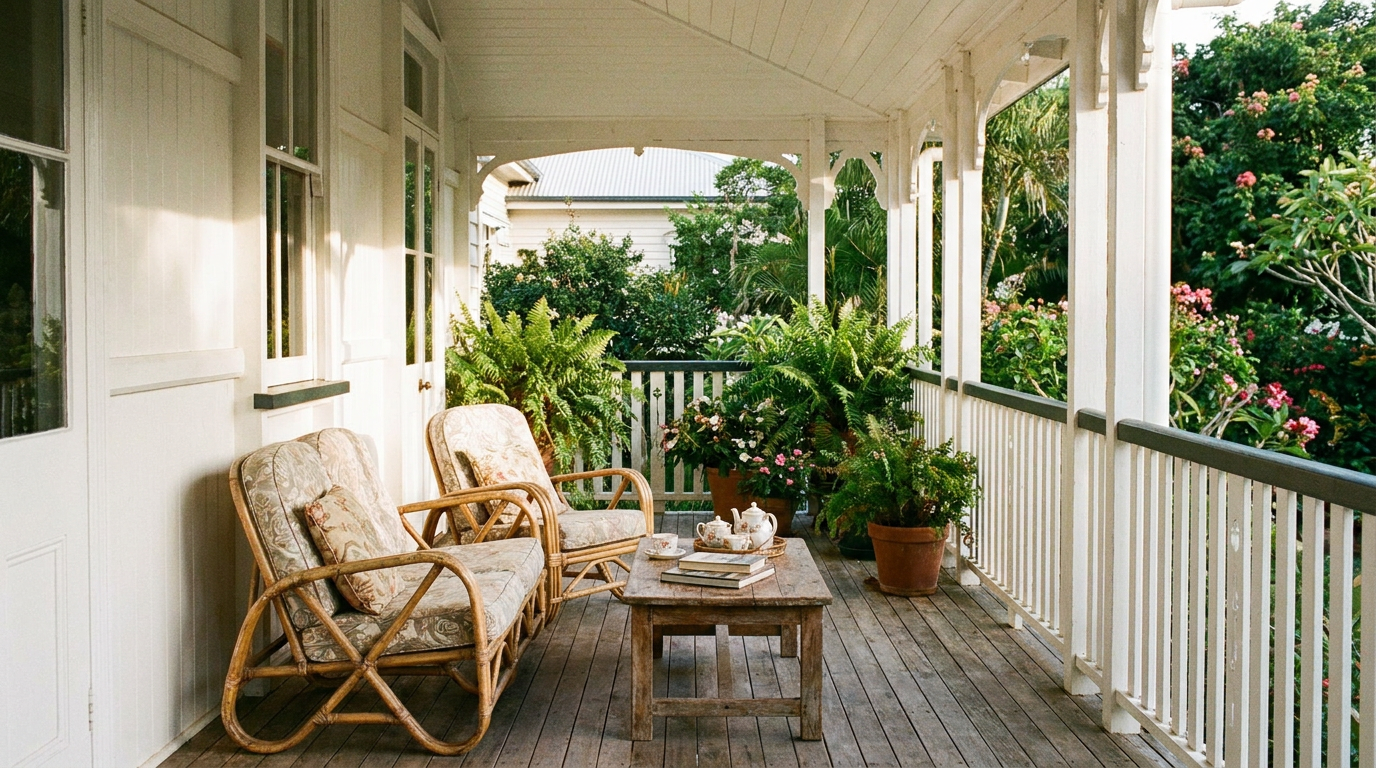
The honesty about heritage: Today's "Queenslander verandah look" — cane chairs, sisal rugs, lush potted plants — is a contemporary interpretation of the architecture's spirit, not a historical reproduction. Period-correct cane and rattan was indoor furniture that moved to verandahs incidentally; the curated heritage verandah aesthetic is a 1990s–2020s creation. Owners benefit from knowing this. You're styling for character, not authenticity.
Materials that read correctly on a Queenslander verandah
- White-painted timber or aluminium — matches the verandah balustrade and post finishes, reads as architectural extension rather than imposed object. Quality powder-coated aluminium in white delivers the heritage look without the maintenance demands of painted timber. Our aluminium outdoor furniture guide covers the white powder-coat specification framework.
- Quality cane and rattan (covered position only) — the iconic verandah look. The semi-protected nature of most verandahs allows these materials in ways that wouldn't survive on an exposed deck. Quality synthetic HDPE wicker delivers a similar aesthetic with fewer maintenance demands than natural rattan.
- Quality teak — heritage character match through warm timber tones, ages gracefully to silver-grey patina that reads correctly against painted balustrades. The hardwood comparison framework is in our hardwood comparison guide.
- Wrought iron or steel with traditional silhouettes — period-feeling for traditional restoration, common in heritage Queenslander verandah photography. Quality powder-coated steel handles the climate adequately; cast iron is a historical reference but requires significantly more maintenance.
Materials to approach with care or avoid
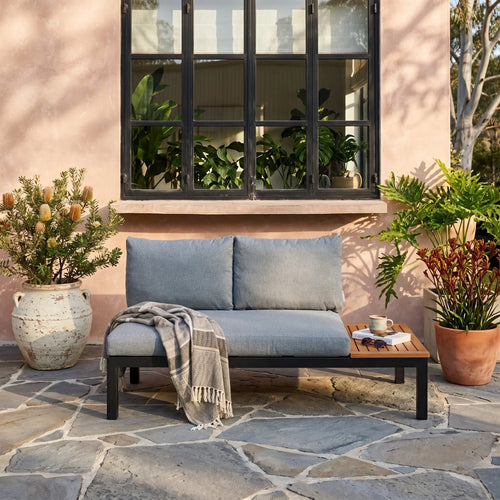
- Modern industrial finishes (black powder-coat, brushed aluminium, concrete) — visually wrong against fretwork and tongue-and-groove timber. Saves these for renovated rear alfresco zones where modern architecture takes over.
- Natural rattan (genuine cane) — works on covered verandahs but Brisbane humidity is challenging. Synthetic HDPE wicker delivers similar aesthetic with fewer demands.
- Plastic resin (low-grade) — reads as compromise on a heritage architecture. Quality polywood (HDPE) is acceptable for renovated rear alfresco but doesn't read correctly on traditional front verandah.
- Cushions in modern abstract patterns — visually competes with verandah architecture. Plain neutrals, traditional stripes, or restrained botanical prints read better. Quality solution-dyed acrylic in heritage colour palettes (warm whites, sandy neutrals, navy accents) bridges performance and aesthetic.
Style direction within Queenslander contexts
Queenslander verandahs support several style directions, each appropriate to different owner aesthetics and renovation states. The major options:
Hamptons
Hamptons works exceptionally well on Queenslander verandahs — the traditional silhouettes, white frames, navy accents, and warm timber notes all align with the architecture's existing palette. Most Queenslander verandah photography that reads as polished defaults to Hamptons direction without naming it explicitly. The full Hamptons framework is in our Hamptons outdoor furniture guide for Brisbane; it applies to Queenslander verandahs as cleanly as to dedicated Hamptons-style modern builds.
Coastal
Coastal direction works particularly well for Queenslanders in bayside or river-adjacent suburbs (Hamilton, Ascot, New Farm, Bulimba, East Brisbane, Kangaroo Point). Light timber, sandy neutrals, casual configurations — slightly less formal than Hamptons, with rattan-and-linen leanings. The aesthetic reads correctly in walking-distance-to-water locations and slightly off-key further from water.
Period traditional (cane and rattan)
The classic "verandah cane chair" aesthetic — natural cane or quality synthetic wicker, traditional silhouettes, often with floral or stripe cushions. Best suited to fully restored Queenslanders prioritising heritage authenticity. The maintenance trade-off is real (natural rattan demands attention; synthetic HDPE wicker delivers the look with fewer demands). Eclectic mix of cane chairs, painted timber bench, vintage finds — the "Houzz Queenslander verandah" look — works well at this direction.
Contemporary heritage
Substantially renovated Queenslanders sometimes warrant a more contemporary direction — quality teak with clean lines, white-painted aluminium with modern silhouettes, pieces that respect the architecture without slavishly reproducing period aesthetics. Best suited to Queenslanders that have been substantially modernised internally, where the verandah's heritage character is one element of a broader contemporary home rather than the dominant aesthetic.
Weight, scale, and proportion considerations
Queenslander verandahs sit on timber stumps with timber floor structures. The weight discipline is rarely a deal-breaker for normal furniture but worth knowing for owners of pre-1947 properties.
The weight-on-stumps reality
Original Queenslander stump structures vary in condition. Newer concrete stumps (typical for post-1990 underpinning work) handle full furniture loads without concern. Original timber stumps in good condition handle normal furniture loads, but heavily concentrated point loads (a 200kg dining table on small feet) warrant more thought than distributed loads (a 200kg lounge configuration spread across 4–6 contact points). Owners of pre-1990 properties without recent underpinning work should look at the verandah's existing condition — visible flex, sloping floors, or compromised stumps warrant structural review before adding substantial new furniture loads.
Scale and proportion
Queenslander architecture is typically restrained in scale — pre-war proportions, single-storey or storey-and-a-half elevations, traditional ceiling heights of 3.0–3.6m. Furniture proportion should match. Oversized contemporary pieces (deep modular sofas, oversized daybeds) compete with the architecture; restrained scale (proper armchair proportions, traditional dining heights) reads correctly. The "alfresco-as-room" framing that suits modern entertainer homes covered in our pool, alfresco and outdoor kitchen furniture guide doesn't translate directly to verandahs — the room scale is different.
The cushion handling reality
Queenslander verandahs with their semi-protected nature support cushion choices that wouldn't survive on exposed decks — but Brisbane humidity still applies, and storm-season rain can blow onto verandah furniture during summer events. Removable cushion covers, quality solution-dyed acrylic fabric, and the bring-inside protocol during forecast storms all matter. The full cushion framework is in our outdoor cushion care guide.
The contemporary-renovation Queenslander angle
A meaningful share of Queenslanders have been substantially renovated — extended at the rear with modern alfresco zones, ground-level living added under the original house, contemporary kitchen and bathroom updates throughout. These properties have traditional verandahs at the front but contemporary outdoor spaces at the rear. Furniture decisions split accordingly.
Front verandah preservation
The front verandah (street-facing, often heritage-protected) typically warrants full heritage-respectful treatment — restrained scale, materials that read correctly against the architecture, style direction matched to the home's character. The decisions in this article apply directly here.
Rear alfresco modernisation
The rear alfresco zone (added during renovation, typically with charcoal Colorbond, large sliding doors, modern kitchen integration) functions as a contemporary suburban alfresco space. Different decisions apply — the framework in our suburban patio, deck and pergola furniture guide covers the modern alfresco approach. The home's overall furniture story can sustain the contrast — traditional front, contemporary rear — provided the transition through the home itself supports it.
The visual transition discipline
Properties where front verandah and rear alfresco are both visible from inside the home (long sightlines through central hallways, open-plan extensions) warrant more coordination thought. Stark style contrasts between traditional cane front verandah and modern minimalist rear alfresco read as visual disconnection if both are simultaneously visible. Coordination at the colour palette level (warm whites, traditional neutrals applied through the home) supports the contrast at the configuration level (traditional silhouettes front, modern silhouettes rear).
FAQs
-
What furniture is best for a Queenslander verandah?
The right Queenslander verandah furniture matches three things: the architecture's heritage character (white-painted timber or aluminium, quality cane or synthetic HDPE wicker, quality teak with traditional silhouettes work; modern industrial pieces look out of place); the verandah's narrow depth (typically 1.5–2.5m, which suits circular dining sets and compact configurations rather than rectangular 6-seater tables); and the semi-protected weather conditions (covered overhead means timber and rattan that wouldn't survive on an exposed deck can perform well). The strongest results come from choosing furniture that the home's architecture would accept as a natural extension — Hamptons direction works particularly well, as do period-traditional cane and contemporary heritage approaches matched to the home's renovation state.
-
Can I use cane or rattan furniture on a Queenslander verandah?
Yes — Queenslander verandahs are one of the few Brisbane outdoor spaces where cane and rattan genuinely work. The semi-protected nature of most verandahs (full overhead protection from rain, partial protection from direct sun) extends usable life significantly compared to exposed patios or decks. Natural rattan still demands attention in Brisbane humidity — annual conditioning, watching for moisture in joints, replacement of sun-degraded sections every 5–10 years. Quality synthetic HDPE wicker delivers the same aesthetic with substantially fewer maintenance demands and is the practical default for owners who want the look without the upkeep. Avoid placing cane or rattan in exposed corner positions where rain blows under the verandah roof during storms — even semi-protected positioning has limits.
-
What's the right size dining table for a Queenslander verandah?
For most Queenslander verandahs (1.8–2.5m depth range), a circular 4-seater dining table at 1.2–1.4m diameter is the right answer. Round tables solve the geometry problem better than rectangular tables on narrow verandahs — the chair pull-out clearance arc fits within narrower depth than a rectangular table's straight pull-out demands. Verandahs at 2.5m+ depth can accommodate compact rectangular 6-seaters (table length 1.6–1.8m), though the 90cm chair pull-out clearance still constrains placement. Verandahs under 1.8m depth typically don't fit dining configurations comfortably; consider relocating dining to a kitchen-adjacent side verandah or rear alfresco space rather than forcing it into a depth-constrained front verandah.
-
Should I match my verandah furniture to my Queenslander's heritage character or modernise it?
Match the home's actual aesthetic state, not its theoretical heritage potential. A fully restored Queenslander prioritising heritage authenticity warrants traditional direction — cane and rattan, white-painted timber, period-feeling silhouettes. A substantially renovated Queenslander with modern interiors and contemporary rear extensions can support more contemporary verandah furniture, particularly if the home's overall design story justifies the consistency. Mid-state renovations (heritage facade preserved, contemporary interiors) often work best with Hamptons direction — traditional silhouettes that read correctly against the architecture but with cleaner contemporary execution. The wrong answer is forcing pure heritage authenticity onto a substantially modernised home, or forcing contemporary minimalism onto a fully restored character home.
-
Are there weight restrictions for furniture on an old Queenslander verandah?
Rarely an absolute restriction, but worth thinking through for pre-1990 properties without recent underpinning work. Original Queenslander stump structures vary in condition; newer concrete stumps and properly underpinned timber stumps handle full furniture loads without concern. Heavily concentrated point loads (a 200kg dining table on small feet) warrant more thought than distributed loads (a 200kg lounge configuration spread across 4–6 contact points). Owners of older properties should look at the verandah's existing condition — visible flex, sloping floors, or compromised stumps warrant structural review before adding substantial new furniture loads. A licensed Brisbane builder familiar with Queenslander construction can assess this in 30 minutes if you're uncertain. Most furniture purchases don't require this discipline; substantial dining or lounge configurations on visibly aged verandahs do.
-
What style of outdoor furniture works on a renovated Queenslander?
The answer depends on which part of the home — a renovated Queenslander typically has both traditional verandahs and contemporary rear alfresco zones, and these warrant different furniture approaches. The traditional front verandah works best with heritage-respectful direction (Hamptons, period-traditional cane, or contemporary heritage at restrained scale). The contemporary rear alfresco — usually added during renovation with charcoal Colorbond, modern kitchen integration, large sliding doors — works as a standard suburban alfresco space with the full range of contemporary outdoor furniture options. Properties where both are visible from inside the home benefit from coordination at the colour palette level (warm whites, traditional neutrals applied throughout) while sustaining contrast at the configuration level (traditional front, contemporary rear).
Quality verandah furniture for Brisbane Queenslander homes
Queenslander verandahs reward thoughtful furniture decisions — restrained scale matched to the architecture's depth, materials that read correctly against the home's heritage character, style direction matched to the home's actual renovation state. All five of our South East Queensland showrooms — Rocklea, North Ipswich, Sandgate, Bundall, and Beenleigh — carry verandah-appropriate pieces in white powder-coated aluminium, quality teak, synthetic HDPE wicker, and traditional silhouettes that suit Queenslander architecture. Our team can talk through verandah-specific decisions for your property and architectural state. Free local delivery applies across Greater Brisbane and SEQ on eligible orders.