
Care & Maintenance · UV Protection
Brisbane summer UV index regularly hits 13+ — among the highest readings recorded in any populated area on Earth. No outdoor material is genuinely UV-proof, including the most expensive premium options. The real question isn't "how do I stop UV damage" but "how slowly does each material fade, and which protective strategies actually work in QLD intensity?" This guide explains how UV degrades different outdoor furniture materials, the QLD-specific shade strategy, the directional exposure framework, and the diagnostic test that distinguishes UV damage from other degradation. We've covered material-specific UV protection in our existing Queensland outdoor furniture care guide and individual material articles; this piece is the cross-material UV understanding that helps you find the right protocol.
The Queensland UV reality
Australian sun is intense everywhere, but Queensland's combination of low latitude, clear skies, and high altitude in the inland produces UV intensity that genuinely changes how outdoor furniture ages compared to almost anywhere else. The broader Queensland climate framework that drives this is covered in our complete outdoor furniture guide for Brisbane and Queensland.
The UV index numbers
The UV index is a global standard measure of erythemal (sunburn-causing) UV intensity. UVI 0–2 is low; 3–5 is moderate; 6–7 is high; 8–10 is very high; 11+ is extreme. The same scale predicts how quickly UV degrades materials — higher UVI means faster fade, faster polymer breakdown, faster timber drying.
Brisbane's typical readings: UVI commonly 12–14 in peak summer (December–February), occasionally 15+ on cloudless days at solar noon — among the highest readings in any populated Australian capital outside the tropics. Shoulder seasons (September–November and March–April) see UVI 8–11, still in the "very high" to "extreme" range. Winter (June–August) drops to UVI 4–7 at solar noon — outdoor furniture continues to fade through winter, just more slowly.
On annual cumulative UV exposure, Brisbane receives roughly 60–80% more total UV per year than London, Paris, or New York. This is why imported European or American outdoor furniture often fades faster here than its country-of-origin warranty contemplates.
Why this matters for outdoor furniture
UV damage is cumulative and largely irreversible. Materials fade or degrade in proportion to total UV exposure over their lifetime. A piece that lasts 10 years in shaded use might last 5–6 years in full QLD sun; the same piece in covered alfresco lasts longer than catalogue specifications suggest because it gets dramatically less UV exposure than the testing assumed.
The fade-resistant vs fade-proof distinction
This is the honesty most marketing material avoids. No outdoor material is truly UV-proof — including premium solution-dyed acrylic fabrics, marine-grade powder coats, and quality teak. The genuine question is how slowly each material fades. Quality materials with proper UV-stabilising additives blended into the base material (not applied as surface coatings) fade slowly enough that they look acceptable for 10+ years; budget materials without proper UV stabilisation fade visibly within 1–3 seasons. The choice at purchase matters more than any after-the-fact protection strategy.
The unavoidable QLD truth: You can slow UV damage significantly with shade, material choice, and care routines — but you can't stop it entirely. Marketing claims that imply UV-proof outdoor furniture should be treated with skepticism. The honest goal is "fades slowly enough that you don't notice for years," not "never fades."
How UV damages outdoor furniture
UV photons carry enough energy to break chemical bonds in many materials. Different materials break in different ways, which explains why the same UV exposure produces fading on cushions, drying on timber, cracking on plastics, and dulling on metal coatings. Understanding the mechanism helps predict what your specific furniture needs.
Fading in fabrics and dyed materials
UV breaks the chemical bonds in dye molecules. The colour we see is reflected light at specific wavelengths; once the dye molecules break, they reflect different wavelengths or none at all, which we see as fading. Solution-dyed fabrics resist this better because the colour is built into the fibre during manufacturing rather than applied as a surface dye — the entire fibre is the colour, so surface fading reveals more of the same colour underneath.
Polymer breakdown in plastics
UV breaks the long polymer chains in plastic materials. The visible result is plastic that becomes brittle, develops surface cracks, and turns powdery or chalky. HDPE polywood resists this through UV-stabilising additives mixed into the base material; budget plastic furniture without proper stabilisers can become brittle within 2–3 QLD summers.
Lignin oxidation in timber
UV oxidises the lignin compounds in timber surface layers. The visible result is the silver-grey patina that develops on untreated timber over time. This is largely cosmetic — the timber underneath the silvered surface is structurally fine — but it changes the appearance significantly. Surface coatings (oils, sealers, varnishes) slow lignin oxidation by absorbing UV before it reaches the timber surface, but coatings themselves break down under UV and need periodic reapplication.
Powder-coat and paint dulling
UV breaks down the binder resins in surface coatings. The visible result is loss of gloss, chalking, and eventual coating failure. Quality powder-coat finishes with UV-stabilised polyester resins resist this for 10+ years; budget paint-on finishes can dull within 2–3 seasons.
Hardware and rubber component degradation
UV breaks down rubber, plastic feet, vinyl strapping, and similar components alongside the more visible fading. These often fail before the main material does — outdoor furniture that "still looks fine but has rubber feet that crumble when touched" is showing UV damage that's harder to see but very real.
Material-by-material UV vulnerability

Outdoor furniture materials respond very differently to UV exposure. Rather than repeat the deep material-specific UV protection content already in our cluster, this section is the diagnostic frontend that points you to the right protocol for your situation.
Hardwood furniture (teak, acacia, eucalyptus)
Quality hardwood handles QLD UV well structurally — Grade A teak especially has natural oils that protect against UV-driven structural damage. The surface appearance changes (silvering) but the timber underneath stays sound for 25+ years in QLD conditions. The buyer's choice is whether to maintain the golden colour (annual water-based UV-stabilised sealer application) or accept the silver patina (zero treatment needed). The full protocol is in our Queensland teak care guide — including why topical timber oils are the wrong product here despite what most generic UV-protection content recommends.
Cushions and outdoor fabric
UV is the fastest-acting damage mechanism for cushion fabrics. Solution-dyed acrylic (Sunbrella and equivalents) handles QLD UV for 5+ years before noticeable fade; PU-coated polyester and standard outdoor polyesters fade significantly faster. The buying-side decision and the fabric-specific UV resistance comparison are covered in our complete outdoor fabric guide. The care-side practice is rotation and storage during peak UV periods — covered in the rotation section below.
Aluminium and powder-coated metal
Aluminium itself is unaffected by UV; the powder-coat finish is the UV-vulnerable component. Quality powder-coat with UV-stabilised polyester resin handles QLD UV for 10+ years before noticeable dulling; budget paint-on finishes can dull within 2–3 seasons. The full powder-coat UV-resistance context is covered in our aluminium outdoor furniture guide; for coastal applications where UV combines with salt-air corrosion, see our marine-grade outdoor furniture guide.
Polywood and HDPE polymer furniture
Quality polywood is among the most UV-resistant outdoor materials available — UV-stabilising additives blended into the base polymer give the material its colour and protect against polymer breakdown. Budget recycled-plastic furniture without proper stabilisation is dramatically less UV-resistant despite looking similar at point of sale. The material-specific detail is in our polywood and recycled plastic guide.
Wicker and rattan
HDPE synthetic wicker with UV stabilisers handles QLD UV well for 5–7 years before noticeable fading; budget polyethylene wicker without proper stabilisation can become brittle within 2–3 summers. Natural rattan in full sun fails fastest of any common outdoor material — the natural fibres lose flexibility, become brittle, and the weave breaks down within a season or two of full QLD UV exposure. Our synthetic wicker vs natural rattan guide covers the material distinctions in detail.
The diagnostic question — is this UV damage?
Fading isn't always UV. If a piece is fading unevenly across surfaces with similar sun exposure, the cause might be pollution, salt spray, chemical exposure (pool chemicals, fertilisers), or thermal cycling rather than UV alone. UV fading shows characteristic patterns: even fade across exposed surfaces, sharp boundary at the edge of any shadow line, sun-side significantly more affected than shaded side, and gradual rather than sudden onset. If the pattern doesn't match — for example sudden discolouration, isolated spots, or fading on shaded surfaces — UV is unlikely to be the only cause. Surface marks that look like fading but trace to mould rather than UV are covered in our mould and mildew removal guide.
The shade strategy hierarchy

Shade is the single most effective UV protection available — significantly more effective than any after-the-fact protectant or cover. The hierarchy of shade options matters because they offer different UV-block percentages and different practical tradeoffs.
| Shade option | Typical UV block | Practical fit for QLD |
|---|---|---|
| Permanent covered patio (Colorbond, tiled alfresco) | ~99% | Best long-term option. Eliminates direct UV entirely. |
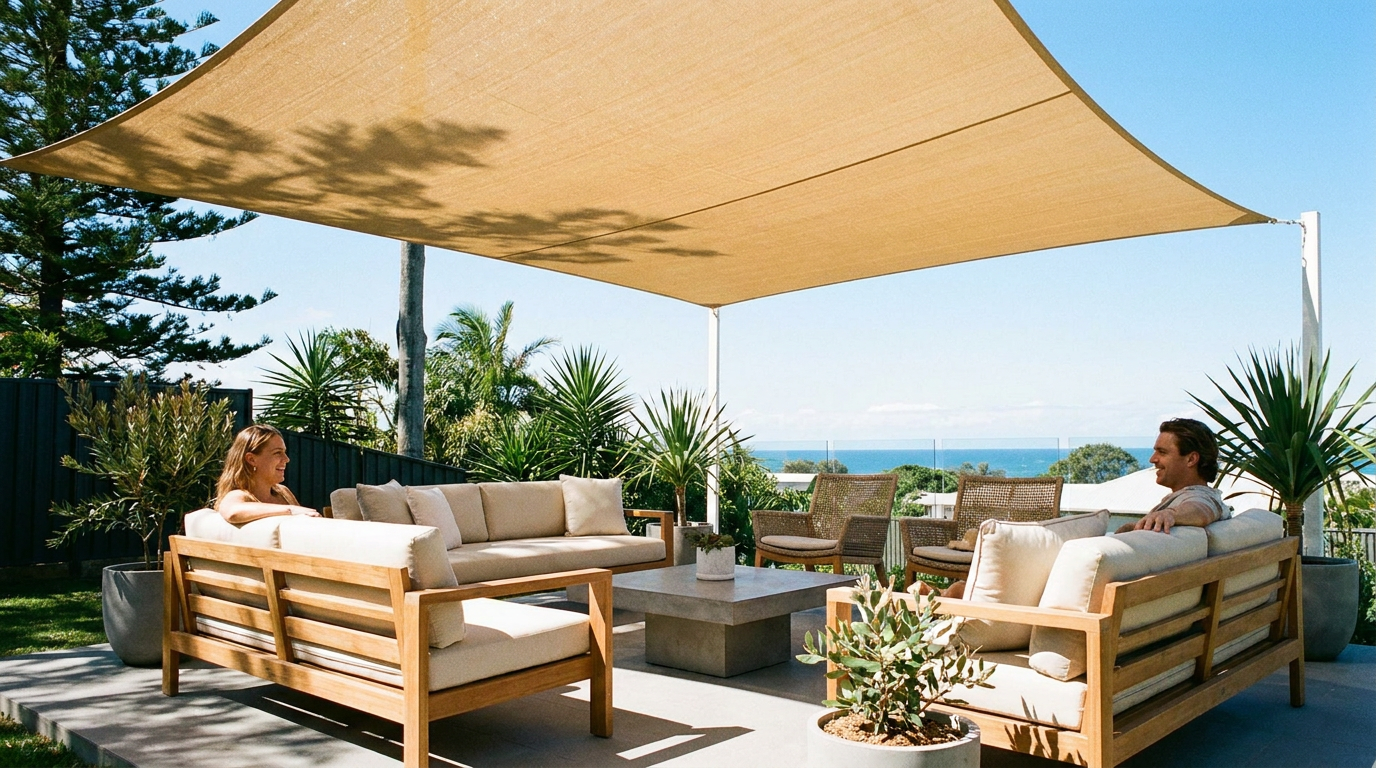
| Quality shade sail (95%+ UV block rating) | 95–98% | Excellent and flexible. Look for explicit UV-block specification. |
| Pergola with quality shade cloth | 90–95% | Good for most QLD situations. Requires occasional cloth replacement. |
| Large outdoor umbrella | 85–95% | Flexible and movable. Limited area; ineffective in wind. |
| Mature shade tree | 70–95% (highly variable) | Long-term but slow. Native QLD species (Bottlebrush, Grevillea, Banksia) suited to local conditions. |
| Light shade cloth (under 90% rating) | 60–85% | Insufficient for QLD intensity — significant UV still passes through. |
The 95% UV-block threshold
For Queensland's UV intensity, 95% UV block should be the minimum specification for any shade product expected to provide meaningful furniture protection. Lower-rated shade cloth still passes enough UV through to cause meaningful fade over time — useful for human comfort but inadequate for material protection. Quality outdoor shade products (sails, pergola cloth) explicitly state UV-block percentage; products that don't state a percentage should be assumed to be below threshold.
What about furniture covers as UV protection?
Furniture covers do block UV — but they have important QLD-specific limitations covered in detail in our outdoor furniture covers guide. The short version: covers used selectively (storms, extended absences, fully-exposed patios) work fine; year-round covering creates trapped-humidity problems that often cause more damage than UV would. For routine UV protection, shade structures outperform covers in QLD humidity.
The directional exposure framework
Outdoor furniture position relative to compass direction has a significant effect on cumulative UV exposure. SEQ sits around 27°S latitude — sun tracks north of overhead in summer, lower in the sky in winter, and the directional pattern determines which surfaces of your patio see the most UV pressure.
The four exposures ranked
Northern exposure receives the highest cumulative UV — direct sun for most of the day in QLD, morning through late afternoon depending on overhead structures. Furniture in this position experiences the most UV pressure of any orientation.
Western exposure gets the harshest peak UV — afternoon sun from about 2 PM onwards arrives at low angle and combines high UVI with maximum heat. The lower sun angle means more direct exposure on vertical surfaces (chair backs, table fronts) that other orientations partly avoid, ageing furniture faster per hour of sun.
Eastern exposure receives gentler morning UV through approximately midday — UV intensity is lower than afternoon western exposure because morning UVI peaks lower than afternoon UVI, and cooler morning temperatures reduce the thermal-cycling damage that compounds UV effects.
Southern exposure receives the least direct sun in Australia — the sun tracks north of overhead for most of the year, leaving south-facing positions in shadow. Outdoor furniture in southern exposure can last 50–100% longer than equivalent furniture in northern or western exposure. The tradeoff is that south-facing positions also receive less natural warmth, affecting how usable they are during cooler months.
Practical implication for furniture placement
If you're planning a new outdoor area, southern or eastern exposure dramatically reduces UV pressure on furniture. If you're working with existing northern or western exposure, shade structures and rotation become more important. For mixed exposure (covered alfresco that opens onto a sunny lawn area), positioning the most UV-vulnerable pieces (cushioned lounges, fabric umbrellas) under the covered structure and the most UV-resistant pieces (polywood, quality teak, powder-coated aluminium) in the open area extends the life of all of them.
The seasonal protective treatment calendar
UV protection treatments need to align with QLD's seasonal calendar to be effective. The October pre-summer prep window is the most important annual care intervention.
October — pre-summer treatment window
October combines dry weather (limited rain interference), moderate temperatures (treatments cure properly), and 4–6 weeks lead time before peak summer UV begins. This is when material-specific protective treatments should be applied. For golden-maintained teak, this is the annual UV-stabilised sealer reapplication window. For powder-coated metal, this is when to inspect for any chips or scratches and apply touch-up paint before exposed metal sees peak UV. For cushions, this is when to replace any covers that show last-summer's fade and confirm UV-resistant fabric specification on any new pieces. The material-specific protocols are in the linked guides; the timing is what's universal.
November–February — peak UV management
During peak summer, the focus shifts from treatment application to active management — rotation of cushions, repositioning where shade allows, ensuring umbrellas are deployed during peak hours. Don't apply protective treatments during peak summer if you can avoid it; high temperatures and humidity affect treatment cure quality.
March–May — post-summer assessment
After peak summer, assess what fade or damage developed. April–May is the right window for cleaning before any restoration or repair work. UV damage that's progressed to coating failure may need treatment now to prevent winter damage; cosmetic fade that's stable can wait for the next October prep window.
June–September — winter UV maintenance
Winter UV in Brisbane is significantly lower than summer UV but not zero — UVI 4–7 at solar noon means continued slow degradation of outdoor materials. The main winter intervention is ensuring shade structures stay in good condition (replace any degraded shade cloth, inspect umbrella canopies) so they're ready for the following summer.
Rotation and repositioning — free UV management

The most cost-effective UV protection costs nothing — physically rotating, repositioning, and flipping outdoor furniture distributes UV exposure across surfaces that would otherwise concentrate damage on one side. Most articles mention this in passing; it deserves more attention.
Cushion rotation
Outdoor cushions in fixed positions develop visible fade on the sun-facing surfaces while the underside stays original-colour. Rotating cushions weekly during peak summer (180° flip, top to bottom, side to side) distributes exposure across all surfaces. By the end of summer, all surfaces have faded slightly but evenly; without rotation, the sun side has faded significantly while the other side remains pristine. The cumulative effect over years is dramatically more uniform fade and cushions that look acceptable for longer.
Furniture repositioning, umbrella timing, and strategic placement
Modular outdoor lounges and lighter pieces can be physically repositioned between summer and winter — moving pieces under cover during peak summer, back into the sunlit position during cooler months when UV pressure is lower.
Outdoor umbrellas left deployed continuously through summer accumulate UV damage on the canopy faster than umbrellas wound down when not in use; the practical compromise is deploying umbrellas during use periods (mornings, afternoons when furniture is being used) and winding them down during the rest of the day.
Matching pieces to positions based on UV vulnerability also helps — the most UV-vulnerable pieces (cushions, umbrellas, lightweight wicker, budget materials) in protected positions; the most UV-resistant pieces (quality teak, polywood, powder-coated aluminium) in exposed positions — extends overall furniture life without buying any new equipment.
FAQs
-
How quickly does outdoor furniture fade in Brisbane?
Fade speed depends heavily on material and exposure. In full QLD summer sun, budget polyester cushions can show visible fade within a single season; quality solution-dyed acrylic (Sunbrella) typically holds colour for 5+ years before noticeable change. Powder-coated metal in full sun starts dulling at 3–5 years for budget finishes, 10+ years for quality UV-stabilised polyester powder coats. Quality teak silvers gradually over 6–18 months in full sun (this is cosmetic, not damage); budget recycled plastic can become brittle within 2–3 summers.
Brisbane receives roughly 60–80% more cumulative UV per year than London or New York, which is why imported European or American outdoor furniture often fades faster here than its country-of-origin warranty contemplates.
-
What's the best UV-resistant outdoor furniture material for Queensland?
For frames, quality powder-coated aluminium with UV-stabilised polyester resin and quality HDPE polywood are the most UV-resistant options for QLD conditions. Both have UV-stabilising additives blended into the base material rather than applied as surface coatings, which is the difference between fade-resistant and fade-prone. Quality teak handles UV well structurally — it silvers cosmetically but stays sound for 25+ years. For cushions, solution-dyed acrylic (Sunbrella and equivalents) is the QLD standard; the colour is built into the fibre during manufacturing rather than applied as a surface dye. The buying-side material decisions are covered in our outdoor furniture materials guide for Queensland.
-
Can you stop UV damage to outdoor furniture entirely?
No — and this is the honesty most marketing material avoids. No outdoor material is genuinely UV-proof, including the most expensive premium options. UV damage is cumulative and largely irreversible; you can slow it significantly with shade, material choice, and care routines, but you can't stop it entirely. Marketing claims that imply UV-proof outdoor furniture or guaranteed-no-fade fabrics should be treated with skepticism. The honest goal is "fades slowly enough that you don't notice for years," not "never fades." This is why shade structures and material choice at purchase matter more than after-the-fact protection sprays — preventing UV exposure is far more effective than trying to undo it.
-
Do outdoor furniture covers protect against UV damage?
Yes — covers do block UV, but they have important QLD-specific limitations. Year-round covering in Brisbane humidity creates trapped-moisture problems that often cause more damage than the UV would have caused. Selective cover use (storms, extended absences, fully-exposed patios with no shade structure) works well for UV protection without the trapped-humidity problem. For routine UV management, shade structures (covered patios, quality shade sails, pergolas with 95%+ UV-block cloth) outperform covers in QLD humidity. The full covers-vs-alternatives discussion is in our outdoor furniture covers guide.
-
What's the best position for outdoor furniture to minimise UV damage?
Southern exposure receives the least direct UV in Australia — the sun tracks north of overhead for most of the year, leaving south-facing positions in shadow. Outdoor furniture in southern exposure can last 50–100% longer than equivalent furniture in northern or western exposure. Eastern exposure gets gentler morning UV; western exposure gets the harshest peak UV with low-angle afternoon sun. If you're working with existing northern or western exposure, shade structures and seasonal repositioning become more important. For mixed-exposure outdoor areas, place the most UV-vulnerable pieces (cushioned lounges, fabric umbrellas) under covered structures and the most UV-resistant pieces (polywood, quality teak, powder-coated aluminium) in the open positions.
-
How often should I apply UV protectant to outdoor furniture in Queensland?
It depends entirely on the material. Quality teak being maintained at golden colour needs annual water-based UV-stabilised sealer reapplication, ideally in October before peak summer. Powder-coated metal frames generally don't need additional UV protection — the powder-coat itself is the UV barrier, and adding sprays can interfere with the finish.
Quality solution-dyed acrylic cushion fabrics generally don't benefit from UV protectant sprays — the colour is built into the fibre and surface protectants don't reach the underlying dye. Quality polywood needs no UV protection; it has UV stabilisers blended in during manufacturing. For most QLD outdoor furniture, the better question isn't "what protectant should I apply" but "what shade and rotation strategy can I use" — preventing UV exposure outperforms trying to add protection on top.
Choose UV-suited materials at the next purchase
The most effective long-term UV protection is choosing outdoor furniture built for QLD conditions in the first place. Quality powder-coated aluminium with UV-stabilised polyester resin, quality HDPE polywood with proper UV-stabilising additives, quality teak that silvers gracefully without structural damage, and solution-dyed acrylic cushions all handle Brisbane summer UV with dramatically less fade than poorly-suited alternatives. All five of our South East Queensland showrooms — Rocklea, North Ipswich, Sandgate, Bundall, and Beenleigh — carry quality outdoor pieces matched to QLD UV intensity, and our team can talk through the UV-resistance characteristics of any piece in our range. Free local delivery applies across Greater Brisbane and SEQ on eligible orders.
Shop the range
Ready to buy? Browse the matching outdoor collections: