
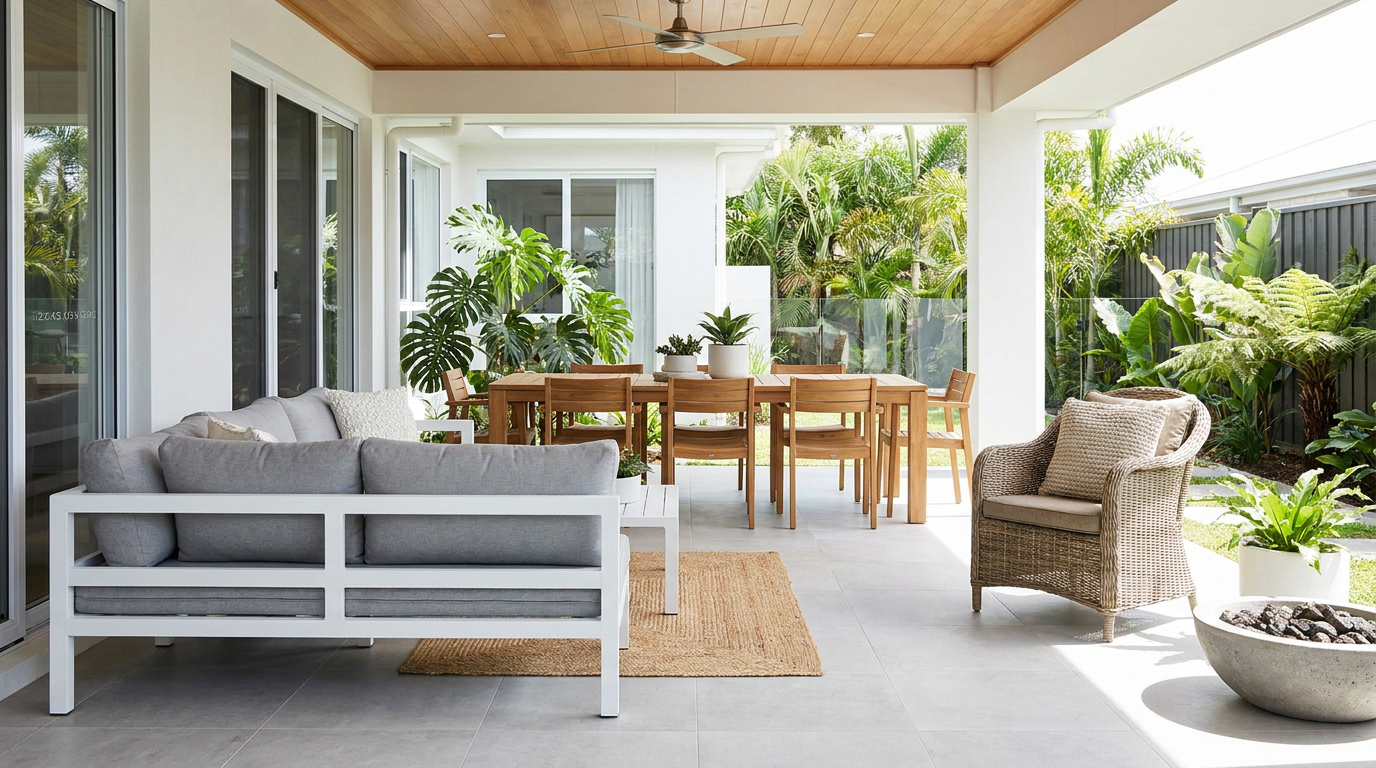
Outdoor Living · Materials Guide
The best outdoor furniture material for Queensland depends on where in Queensland you live: powder-coated aluminium for low-maintenance versatility almost anywhere; teak or other tropical hardwoods for premium warmth and longevity; UV-stabilised synthetic wicker for resort-style lounges that handle humidity; and marine-grade aluminium or stainless steel if you're a few streets from the bay. Get the material wrong and your furniture won't last a season. This guide is the deep version of our complete outdoor furniture guide for Brisbane and Queensland — focused on materials, with side-by-side comparisons and Queensland-specific recommendations for every option you're likely to consider.

Why Queensland's climate decides everything
Outdoor furniture sold in Melbourne or Hobart is rated for a different planet than the one Brisbane lives on. South East Queensland combines four pressures that destroy outdoor furniture if the materials aren't built for them:
- UV intensity. Brisbane sits at 27.5°S — UV index regularly hits 13+ in summer. Pigments fade, plastics become brittle, low-grade fabrics chalk and tear within 18–24 months.
- Humidity. Summer averages 70%+ relative humidity, which traps moisture in untreated timber, foam, and woven natural fibres. Mould and mildew follow.
- Storm season (November to April). Hailstones, horizontal rain, and 90 km/h gusts. Lightweight pieces become projectiles. Drainage matters.
- Salt air. If you live within a few kilometres of the bay or open ocean — Sandgate, Manly, Wynnum, Bundall, Burleigh — airborne salt accelerates corrosion on every metal that isn't aluminium, marine-grade stainless, or correctly powder-coated.
None of this means outdoor furniture has to be ugly or industrial. It means the material spec needs to match the load. The rest of this guide walks through every common option, what it actually does in this climate, and which Queensland buyers it suits best. For an even broader view of how furniture decisions break down by space and season, our Queensland care and maintenance guide covers the cleaning and protection side.
Materials at a glance
Use this table as a quick scan before reading the detail below. Every row is opinionated for South East Queensland conditions — a material that's "average" elsewhere may rate higher or lower here.
| Material | QLD durability | Maintenance | Price tier | Best for | Watch out for |
|---|---|---|---|---|---|
| Powder-coated aluminium | Excellent | Very low | $ – $$ | Most homes, coastal suburbs, modern aesthetics | Lightweight pieces in storm gusts |
| Teak (and other tropical hardwoods) | Excellent | Low–Medium | $$$ | Premium feel, traditional aesthetics, inland homes | Quality varies; avoid no-name "teak" |
| Synthetic wicker (HDPE / PE rattan) | Very good | Low | $$ | Lounges, resort-style, covered patios | Cheap PVC weave cracks within 2 years |
| Powder-coated steel | Good (inland) | Medium | $ – $$ | Heavy dining tables, bar stools, indoor-outdoor pieces | Rusts under chipped powder-coat near coast |
| Stainless steel (316 marine grade) | Excellent | Low | $$$$ | Coastal homes, hospitality, decades-long pieces | Premium price; 304-grade rusts at the coast |
| WPC / recycled plastic | Excellent | Very low | $$ | Table tops, slatted bench seats, low-fuss pieces | Heat retention in direct sun |
| Outdoor fabrics (UV polyester, Olefin) | Good–Excellent | Medium | varies | Cushions, upholstery, sling seating | Quality varies wildly; check fabric weight |
| Mesh / sling fabric | Very good | Very low | $ – $$ | Dining chairs, recliners, fast-drying poolside | Replacement slings rarely available |
Powder-coated aluminium
Aluminium is the workhorse of modern outdoor furniture and the right starting point for the majority of Queensland homes. It's lightweight, completely rust-proof, and when finished with a quality powder-coat it handles UV, salt air, and rain with almost no maintenance beyond an occasional wipe-down.
The "powder-coat" matters as much as the metal. A correctly applied powder finish bonds to the aluminium and provides UV stability plus scratch resistance — but cheap finishes can chalk or peel within two summers, leaving the bare aluminium underneath (which is fine in itself, but loses the colour and feel you bought). When you're inspecting an aluminium piece, look at the powder thickness around welds and corners; a good frame has even coverage with no thin spots.

Where aluminium shines
- Coastal Queensland — Sandgate, Bundall, Manly — where salt air will rust most other metals.
- Modern and contemporary aesthetics. Powder-coat comes in matte black, white, charcoal, taupe, and various greys, so it integrates cleanly with rendered brick, concrete, and large glazed sliders.
- Smaller spaces where moveable furniture matters — apartment balconies, narrow courtyards.
- Pool decks, where you want furniture you can drag aside for cleaning without breaking your back.
Where aluminium is the wrong choice
If you're buying for an exposed clifftop or a beachfront balcony where wind regularly exceeds 70 km/h, the same lightness that helps you move chairs becomes a liability. Pick heavier pieces (cast aluminium, not extruded), or weight them with cushions stored indoors during storm season. Aluminium dining tables also need to be heavy or anchored — a glass-topped aluminium table can lift in a storm gust.
For lounge sets, you'll usually find aluminium hidden under wicker or fabric. Brands like the Bryde Corner Lounge in white aluminium show the metal as a feature; others like the Panama 4 Piece Sofa Set use aluminium structurally with plush cushions over the top.
→ Full guide: Aluminium Outdoor Furniture for Queensland's Climate
Teak and tropical hardwoods
Teak is the premium tier of outdoor timber — and for good reason. Its high natural oil content makes it inherently water-resistant, dimensionally stable across humidity swings, and immune to most insects and rot. Left untreated, teak silvers to a soft grey patina over 12–18 months in Queensland sun. Sealed with teak oil, it stays a warm honey-gold but needs reapplication once a year.
Beyond teak, several other tropical hardwoods perform well in Queensland: Acacia (good budget option, needs more upkeep), Eucalyptus (Australian-relevant, durable, less oily than teak), and Merbau / Kwila (extremely dense, weather-stable, traditional choice for South East Queensland decking and benches). Each has its own grain, colour, and oil profile — the side-by-side comparison sits in our hardwood deep-dive linked below.

The "is this real teak?" problem
The word "teak" gets used loosely. Genuine plantation teak (Tectona grandis) carries a price floor — if a "teak" dining table is suspiciously cheap, it's probably another tropical hardwood being sold under a marketing label. None of this is bad per se; some alternatives are excellent. Just don't pay teak prices for stained acacia.
Quality cues for hardwood outdoor furniture: tight grain with no visible voids, properly mitred or joined corners (not just glued), brass or stainless fasteners, and a base that doesn't sit flush against tile (look for small feet that lift the timber a few millimetres off the surface to prevent moisture pooling).
If you choose a hardwood piece, factor in the maintenance load: most timbers benefit from an annual oil or a periodic clean to lift surface mould — covered in our care guide for Queensland outdoor furniture.
→ Full guide: Teak Outdoor Furniture for Queensland Homes | Comparison: Teak vs Acacia vs Eucalyptus
Synthetic wicker (PE rattan / HDPE)
Almost no outdoor wicker sold today is actually rattan. What looks like woven cane is in fact a synthetic resin — usually PE (polyethylene) rattan or HDPE (high-density polyethylene) — extruded into strands and woven over an aluminium or steel frame. The aesthetic is the same; the durability is dramatically better. Genuine natural rattan does not handle Queensland's humidity, UV, or rain, period.
Within synthetic wicker, the quality range is wider than most buyers realise. Cheap PVC-based weaves go brittle and crack within two summers. UV-stabilised PE rattan keeps its colour and flex for 7–10 years. HDPE — the same family of plastic used in marine ropes — is the top tier and routinely outlasts the frame underneath it.

How to spot good synthetic wicker
- Strands are flat or D-shaped, not perfectly round — round strands are usually PVC and brittle.
- Weave has consistent tension with no loose ends or visible glue.
- Manufacturer mentions UV stability, often quoted in years (5+ is decent, 10+ is excellent).
- Frame underneath is aluminium, not steel — a steel frame will eventually rust and bleed through the weave.
Synthetic wicker is the right choice if you want the warm, woven, resort look without the maintenance commitment of timber. It pairs well with deep cushions and dominates the lounge category — see our full outdoor lounges and sofas range for examples in different weave colours and tones. Stackable wicker dining chairs like the Sanbria Outdoor Stacking Dining Chair are also a smart fit for tight balconies where furniture needs to compress when not in use.
→ Full guide: Synthetic Wicker vs Natural Rattan in Queensland | Deep dive: HDPE Wicker Explained
Powder-coated steel
Steel is heavier, stiffer, and stronger than aluminium — it's the right choice for pieces that need to stay put in wind or carry significant load (long dining tables, bar stools, swing chairs). The catch is rust. Steel must be treated, primed, and powder-coated correctly to survive outdoors, and any chip or scratch in the finish creates a starting point for corrosion.
Inland Queensland — Ipswich, Beenleigh, the western suburbs — is friendly to powder-coated steel because the salt-air load is low. Coastal Queensland is not. If you're within ten kilometres of the bay, steel will eventually rust at every micro-scratch unless it's hot-dip galvanised under the powder coat.

When to choose steel over aluminium
- Inland location and you want a heavier, more permanent feel.
- Furniture that needs to anchor against wind without bolting down (heavy bistro tables, fire pits).
- Indoor-outdoor pieces that will spend most of their life under cover.
- Budget-conscious dining tables — steel-framed dining tables are often 20–30% cheaper than equivalent aluminium.
For dining sets specifically, browse our outdoor dining sets collection — both aluminium and steel-framed options are available, and the right answer depends mostly on your distance from the coast.
→ Full guide: Powder-Coated Steel vs Aluminium Frames Compared
Stainless steel and marine-grade options
Stainless steel sits in a different price tier from everything else in this guide. Done correctly — using 316-grade marine stainless — it lasts decades on a beachfront and develops only minor surface dulling. Done wrong, using cheaper 304-grade, it will tea-stain and pit within a year of coastal exposure.
For most Queensland buyers, marine-grade stainless is overkill. Powder-coated aluminium delivers 90% of the corrosion resistance for half the price. Stainless makes sense in three specific cases: hospitality (where the piece will see daily commercial cleaning), absolute beachfront properties (sand, salt-spray, near-constant wind), and buyers commissioning legacy pieces designed to outlive renovations.
If you're researching coastal furniture seriously, the linked guide below explains how to read a stainless grade, where 316 is genuinely worth it, and how to inspect welds for corrosion-prone heat-affected zones.
→ Full guide: Stainless Steel Outdoor Furniture for Coastal Queensland | Marine-Grade Outdoor Furniture for Coastal Properties
WPC and recycled-plastic table tops
Wood Plastic Composite (WPC) and similar recycled-plastic boards have quietly become one of the most useful materials in modern outdoor furniture — particularly for table tops, slatted bench seats, and shelves. WPC blends timber fibres with HDPE to produce a board that looks like timber but doesn't warp, swell, splinter, or need oiling. Polywood is a related product made from recycled milk jugs and industrial polymer, often used in adirondack chairs and similar slatted pieces.

Where WPC works best
- Dining and coffee table tops where you want timber warmth without the maintenance.
- Slatted seating that drains quickly after rain.
- Shelves and side tables on covered patios.
- Households with kids or pets — WPC handles spills, scuffs, and weather without showing damage.
The trade-off is heat retention. Dark-toned WPC table tops can become uncomfortably hot in direct summer sun — choose lighter tones, or position WPC pieces under a pergola or umbrella. The Chalfonte Rectangular Outdoor Table is a good example of a slatted WPC-style top in a lighter tone that handles sun without overheating.
→ Full guide: Polywood and Recycled Plastic Outdoor Furniture in Queensland
Outdoor fabrics and cushions
Cushions are where most outdoor furniture investments go wrong. Frames last decades; fabrics fail in two summers if they're not specced correctly. The good news: outdoor fabrics have improved dramatically, and modern UV-stabilised polyester, Olefin, and acrylics like Sunbrella deliver genuine 5–10 year fabric life if cared for.
The fabric to avoid is anything labelled simply "outdoor" without a UV rating. The fabric weight (measured in GSM — grams per square metre) and the dye method matter more than the brand name on the swing tag. Solution-dyed fabrics — where the colour is added to the fibre before it's woven — resist fading vastly better than printed fabrics, where the dye sits on the surface.

Cushion construction matters as much as fabric
- Quick-dry foam. Open-cell foam that drains and dries within hours, not days. Closed-cell budget foam holds water, grows mould, and never recovers.
- Removable, washable covers. Zipped covers that come off for machine wash. Sewn-in covers are a deal-breaker.
- Drainage holes. Look at the underside; quality cushions have small grommets so water doesn't pool.
- Edge piping. Reinforces the seam where wear concentrates; absent piping is a sign of corner-cutting.
For most lounge and sofa sets in our range, including the Portals Outdoor Corner Lounge and the Tagula 4 Piece Outdoor Sofa Set, the cushions use UV-resistant solution-dyed fabrics with quick-dry foam — the spec that matters for Queensland summers.
→ Full guide: Outdoor Fabric Guide — Sunbrella, Olefin and UV-Resistant Materials
Mesh and sling seating
Mesh — also called sling fabric, Batyline, or Textilene depending on the manufacturer — is a tensioned synthetic weave stretched across an aluminium or steel frame. It's the lowest-maintenance seating option in outdoor furniture: no cushion to store, no fabric to dry, no foam to replace. Rain hits it and runs straight through.

Mesh seating is the right choice for poolside and dining where you want the chair you sit in straight after a swim or after a downpour. It breathes — important on a 35°C Brisbane afternoon — and the seat tension naturally encourages decent posture. The downside is that the mesh itself is the weakest point: when it eventually wears or sags, replacement slings are rarely available, and the chair effectively reaches end-of-life.
For dining specifically, mesh-seated chairs have a real comfort advantage over hard slatted timber or plastic. The Panama Reclining Outdoor Chair is a typical example — aluminium frame, sling seat, and a recline mechanism that turns it into a sun chair without changing furniture.
Match the material to your suburb
Queensland is not one outdoor-furniture environment. Where you live changes the answer.

| Suburb type | Examples | Top materials | Avoid |
|---|---|---|---|
| Coastal / bayside | Sandgate, Manly, Wynnum, Bundall, Burleigh, Mermaid Beach | Powder-coated aluminium, 316 stainless, UV-stabilised wicker over aluminium frames | Untreated steel, low-grade chrome, cheap PVC wicker |
| Inland Brisbane | Toowong, Indooroopilly, Chermside, Mt Gravatt | Powder-coated aluminium, teak, hardwood, WPC tops | Untreated softwoods (pine), unsealed natural rattan |
| Western SEQ | Ipswich, Springfield, Beenleigh, Logan | Teak, hardwoods, powder-coated steel, aluminium | Lightweight pieces during storm season |
| Apartment balcony | Brisbane CBD, South Bank, Newstead, Surfers Paradise | Compact aluminium dining sets, stackable wicker chairs, foldable bistro pieces | Heavy hardwood (weight limits), oversized lounges (clearances) |
| Queenslander verandah | Paddington, Red Hill, Bardon, Ashgrove | Teak, hardwood, woven wicker, traditional rope | Modern brushed steel (clashes with timber heritage) |
If your space type isn't in this table, the outdoor furniture by space guide for Brisbane homes covers more layouts in detail — pool decks, courtyards, pergolas, and rooftop terraces.
The mixed-materials reality
Almost no outdoor piece is one material. A typical lounge set is an aluminium frame, woven with synthetic wicker, topped with UV-resistant fabric cushions on quick-dry foam, beside a coffee table with a WPC slatted top on a powder-coated steel base. The right question is rarely "should I buy aluminium or wicker?" — it's "is this combination of materials specced correctly for my conditions?"
Reading a piece is reading every layer. Frame, weave (or finish), fasteners, fabric, foam, base. A premium-looking piece with a steel frame hidden under wicker is still a steel-framed piece — and will eventually rust through if you live near the coast.
This is where reading a product spec sheet pays off. If you can't tell what the frame is made of, the cushions are made of, and the fasteners are made of, the seller hasn't given you enough information to evaluate the buy. Our team in our 5 SEQ showrooms — Rocklea, North Ipswich, Sandgate, Bundall, Beenleigh — can show you the construction details on any piece in person, and our broader outdoor furniture buying guide for Australia covers the rest of the buying-decision framework.
Quality cues regardless of material
Beyond material choice, certain construction details predict whether a piece will last 2 years or 12. Use this checklist when you inspect anything outdoor — in showroom or via online product photography.
Frame and construction
- Welds, not just screws. Welded joints on metal frames distribute load better than bolted ones. Look at the inside corners where two tubes meet.
- Even powder-coat coverage. Run a finger along welds and corners — a quality coat is even, with no thin spots or rough patches.
- Stainless or brass fasteners. Mild steel screws will rust within a season and stain whatever they're attached to.
- Levelling feet. Adjustable glides on chair and table legs solve uneven paving and protect tile finishes.
Weave and fabric
- UV stability stated in years. Manufacturers who don't quote a UV figure are usually using cheap material.
- Tight weave with no loose ends. Sloppy ends on a synthetic wicker piece signal cheap construction throughout.
- Solution-dyed fabric, not surface-printed. Solution-dyed fabric keeps its colour even after years of sun.
- Cushion covers that unzip. Removable covers extend cushion life by years.
Warranty and origin
- Warranty length signals confidence. Frames with 2+ years and fabrics with 12+ months suggest the manufacturer has tested under load.
- Australian retailer with a physical address. Online-only operations with no showroom and no spare-parts process leave you stranded if anything fails.
- Spare-parts availability. Cushion covers, slings, and feet should all be replaceable.
FAQs
-
What's the best material for outdoor furniture in Queensland's climate?
For most Queensland homes, powder-coated aluminium is the most versatile starting point. It's rust-proof, lightweight, low-maintenance, and handles UV exposure well. For premium aesthetics, teak and other tropical hardwoods are excellent long-term options. For lounges and resort-style seating, UV-stabilised synthetic wicker (PE rattan or HDPE) over an aluminium frame combines the woven look with weather durability. The right answer also depends on your suburb — coastal homes should prioritise aluminium and marine-grade materials, while inland homes have wider options.
-
Is teak or aluminium better for Queensland homes?
Both perform well in Queensland — they're complementary rather than competing. Teak has a warmer, more traditional aesthetic and develops a beautiful silver-grey patina over time. It costs more upfront and benefits from annual oiling if you want to retain the honey-gold colour. Aluminium is lighter, easier to move, completely rust-proof, and effectively maintenance-free — but the modern look may not suit every home. Many of our customers choose a hardwood dining table paired with aluminium-framed lounges, getting the best of both materials.
-
Does synthetic wicker fade in the Queensland sun?
Quality UV-stabilised PE rattan or HDPE wicker resists fading well — typically holding colour for 7–10 years in full Queensland sun. Cheaper PVC-based wicker (often unbranded or sold at very low prices) can fade noticeably within 1–2 summers and crack within 3. The difference is in the manufacturing: UV stabilisers are added to the synthetic resin during extrusion. When inspecting wicker, look for manufacturer-quoted UV figures and a flat or D-shaped strand profile rather than perfectly round.
-
How long does outdoor furniture typically last in Queensland?
Lifespan depends heavily on materials and care. Quality powder-coated aluminium frames typically last 10+ years. Teak and hardwood pieces can last 20+ years with periodic oiling. UV-stabilised synthetic wicker over aluminium lasts 7–10 years. Cushions are usually the first item to need replacement — quality outdoor fabric and quick-dry foam typically lasts 5–8 years before needing recovering. Cheap, unbranded outdoor furniture often fails within 2–3 summers, which is why investing in known materials and construction quality is more economical long-term.
-
What's the best material for coastal Brisbane homes (Sandgate, Bundall, Manly)?
For coastal Queensland homes, prioritise materials that handle salt-air corrosion. Powder-coated aluminium is the go-to choice — completely rust-proof and significantly cheaper than marine-grade stainless. UV-stabilised synthetic wicker over aluminium frames also works well. Avoid untreated steel, chrome-plated finishes, and natural rattan, all of which corrode or degrade rapidly within a few kilometres of the bay. If budget allows, 316-grade marine stainless steel offers decade-plus performance for hardware-critical pieces. We have showrooms in Sandgate and Bundall — staff can recommend specific products built for coastal conditions.
-
Is stainless steel worth the extra cost over aluminium for outdoor furniture?
For most homes, no. Powder-coated aluminium delivers around 90% of the corrosion resistance of marine-grade stainless steel at roughly half the price. Stainless steel makes sense in three specific situations: absolute beachfront properties with constant salt-spray exposure, hospitality settings where commercial cleaning is daily, and legacy pieces designed to outlast multiple renovations. If you're buying for a typical Queensland home — even a coastal one — quality powder-coated aluminium is usually the smarter purchase.
Ready to choose?
Material choice is the single biggest determinant of how long your outdoor furniture will last in Queensland — and how much you'll need to maintain it. Match the material to your suburb, inspect the construction details, and don't pay premium prices for ambiguous specifications.

If you'd like to see any of the materials in this guide in person, all five of our South East Queensland showrooms — Rocklea, North Ipswich, Sandgate, Bundall, and Beenleigh — carry a curated outdoor range. Our team can walk you through frame welds, weave construction, and fabric weight on the floor. Free local delivery applies across Greater Brisbane and SEQ on eligible orders.