
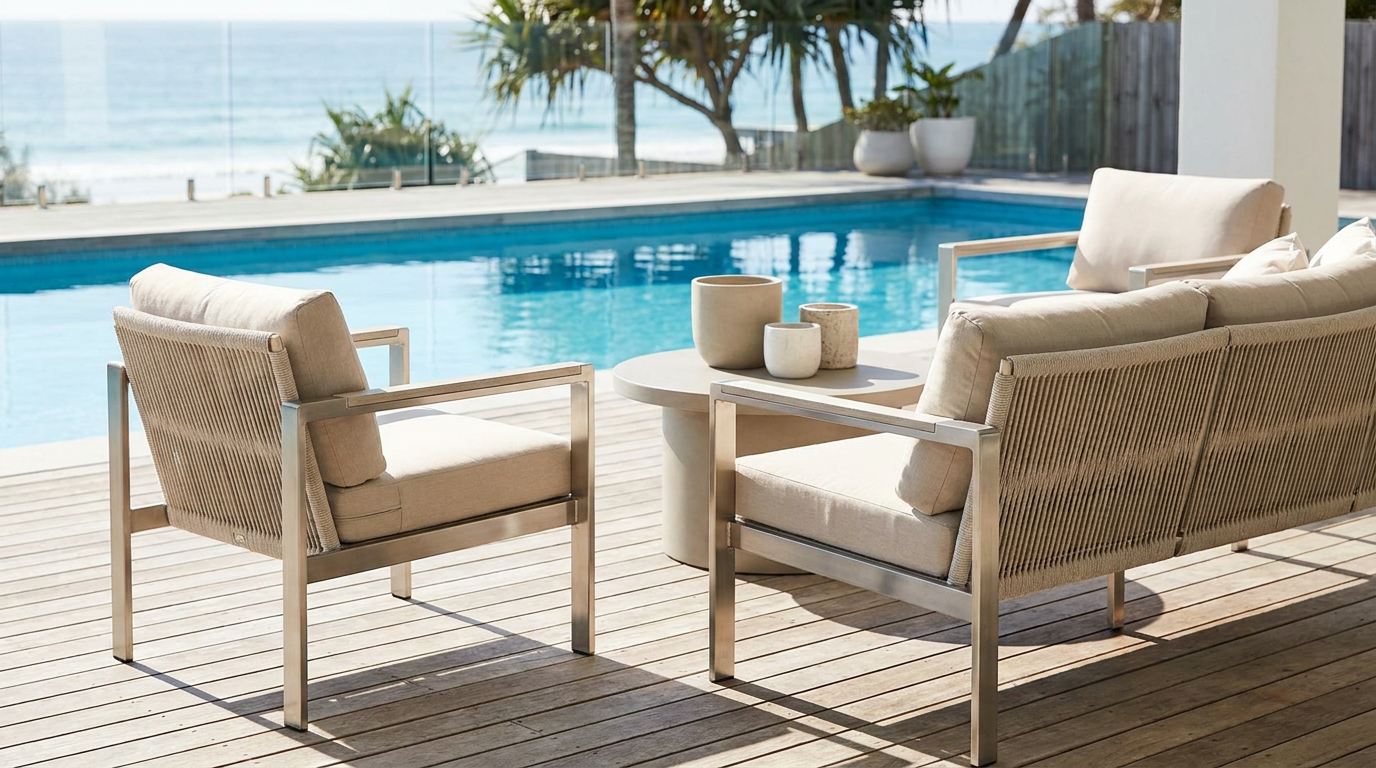
Materials · Stainless Steel
Stainless steel outdoor furniture is the right choice for a narrow band of Queensland buyers — beachfront properties within ~200 metres of open ocean, severe salt-spray exposure, or pool-side installations where you specifically want the polished metal look. For most coastal Queensland homes (Sandgate, Manly, Wynnum, Bundall, even Burleigh a few streets back from the beach), powder-coated aluminium delivers ~90% of the corrosion resistance at roughly half the price. This guide is part of our broader Queensland outdoor furniture materials guide; here we go deep on when stainless is genuinely worth the premium, the 304-vs-316 grade question that most product listings get wrong, and the under-discussed pool chlorine factor that catches buyers off-guard.

When stainless steel is actually the right choice
Stainless steel outdoor furniture is sold as the premium upgrade for coastal living. The reality is more specific. Stainless is engineered to resist a particular kind of attack — chloride pitting from concentrated salt exposure — at the cost of significantly higher price, more weight, and more demanding maintenance than most buyers expect. For homes that genuinely face that level of exposure, it earns its premium. For homes that don't, it's an expensive answer to a problem they don't have. Our complete outdoor furniture guide for Brisbane and Queensland walks through the bigger picture — climate pressures, material trade-offs, and how to think about the buying decision overall.
Three buyer profiles where stainless is genuinely the right call:
- Beachfront homes within ~200m of open ocean. Direct salt-spray exposure on the Gold Coast strip, Sunshine Coast beachfront, and bayside frontage where airborne chloride concentrations are at their highest. Powder-coated aluminium handles this too, but stainless is the long-game answer if the property is a long-term investment.
- Pool-side installations. Pool chlorine vapour attacks lower-grade metals faster than salt air does — covered in detail below. Quality stainless is often the right answer at the pool edge specifically.
- Buyers who want the polished metal aesthetic. Stainless has a distinctive industrial-modern look that powder-coated aluminium can't replicate. If that aesthetic is the design driver — minimalist coastal architecture, nautical references, contemporary pool-house pavilion — stainless is the right material for the visual reasons, not just the functional ones.
Three buyer profiles where stainless is the wrong call (and aluminium is right):
- Coastal Queensland but several blocks from the water. Sandgate, Manly, Wynnum, Bundall and similar near-coastal suburbs get salt air, not direct salt spray. Powder-coated aluminium handles this exposure indefinitely.
- Inland Brisbane and SEQ. Ipswich, Beenleigh, Logan, the western suburbs — salt isn't a factor at all. Specifying stainless here is overspecification.
- Heritage Queenslander or warm-timber aesthetic. Stainless's industrial look fights the visual language of timber decks, traditional verandahs, and natural-fibre styling. Teak or hardwood would serve those buyers better — see our teak buyer's guide for Queensland.
304 vs 316 — the grade decision
"Stainless steel" isn't a single material. It's a family of iron-chromium alloys, each with different corrosion-resistance properties. For outdoor furniture, two grades dominate the market: 304 and 316. The difference matters more than most product listings explain.
| Grade | Chromium | Nickel | Molybdenum | Best for | Price tier |
|---|---|---|---|---|---|
| 304 (food-grade / general) | ~18% | ~8% | None | Inland and lightly coastal use | $$$ |
| 316 (marine-grade) | ~16% | ~10% | 2–3% | Beachfront, pool-side, severe coastal | $$$$ |
Why 316 is "marine grade"
The critical difference is molybdenum. Adding 2–3% molybdenum to the alloy dramatically increases resistance to chloride pitting — the specific corrosion mechanism caused by salt and chlorine attacking the protective oxide layer on the steel's surface. 316 holds up indefinitely in environments where 304 starts pitting within a few years. The additional nickel content also improves general corrosion resistance and gives 316 a slightly warmer-toned finish.
The 20–25% premium
316 typically costs 20–25% more than equivalent 304 pieces because of the molybdenum and nickel content. For inland or lightly coastal use, that premium is wasted. For genuine beachfront or pool-side use, it's the entire reason to buy stainless in the first place — buying 304 in those environments will lead to pitting and tea-staining within a couple of summers.
Rule of thumb: If you're spending the money on stainless steel outdoor furniture, spend the extra 20–25% on 316. Buying 304 for a coastal application defeats the purpose of choosing stainless at all. If 304 is your budget, powder-coated aluminium is a better use of the money for that same level of exposure.
Stainless vs aluminium for coastal Queensland
The decision most coastal SEQ buyers actually face isn't 304 vs 316 — it's stainless vs aluminium. Both are corrosion-resistant; both are widely available; the price gap is significant. Here's the practical comparison.
| Powder-coated Aluminium | 316 Marine-Grade Stainless | |
|---|---|---|
| Corrosion resistance (coastal) | Excellent — handles salt air indefinitely | Excellent — handles direct salt spray indefinitely |
| Pool-side performance | Good — chlorine vapour can mark powder-coat over years | Excellent — designed for chloride exposure |
| Weight | Light — easy to move | Heavy — stays put in storms |
| Price | $$ to $$$ | $$$$ |
| Lifespan in Queensland | 10–15 years | 20+ years |
| Maintenance | Wipe-down every 2–3 months; touch up chips | Fresh-water rinse monthly; non-chloride cleaners only |
| Aesthetic | Wide colour range via powder-coat | Polished or brushed metal look only |
For most coastal SEQ buyers, the practical answer is aluminium — it handles salt air indefinitely, the price is half, and the aluminium itself doesn't rust even if the powder-coat gets chipped. Stainless's edge shows up in three specific scenarios: beachfront direct-spray exposure, regular pool-edge use, or the design-driven choice where the polished metal is the point of the piece. Outside those, the price premium is hard to justify.
Our complete aluminium buyer's guide for Queensland covers the powder-coat alternative in full — construction grades, finish quality cues, the storm-season weight tradeoff.
Pool chlorine — the under-discussed corrosion factor
South East Queensland has one of the highest pool ownership rates in Australia, and pool chlorine vapour is the under-discussed corrosion factor that most outdoor furniture content skips entirely. The chemistry matters because chlorine attacks lower-grade metals faster than salt air does — and the attack is closest at the pool edge, exactly where most homeowners place outdoor seating.
Why chlorine attacks differently from salt
Both salt (sodium chloride) and pool chlorine release chloride ions in air and moisture, but at different concentrations and different proximity. Pool chlorine vapour around the pool deck can be more concentrated than the airborne salt at a beachfront home several streets back, and it's continuous — present every day the pool is treated, not just when the wind's onshore.
- 304 stainless near a pool typically shows pitting and tea-staining within 2–3 years. Same metal further from the pool would last longer.
- 316 stainless near a pool handles the chlorine indefinitely with appropriate maintenance. This is one of the clearest cases for paying the 316 premium.
- Aluminium powder-coat near a pool performs well — the powder-coat itself is unaffected by chlorine — but any chipped or scratched area exposes the aluminium to a more aggressive environment. Touch up chips quickly.
- Plain (non-stainless) steel near a pool rusts quickly. Avoid entirely.
Distance from the pool matters
Pool chlorine concentration drops sharply with distance from the water. Furniture on the immediate pool deck (within 2 metres of the water) is in the highest-exposure zone. Furniture 5+ metres from the water in a covered alfresco area is in a much milder zone — closer to general outdoor exposure than dedicated pool-side conditions. Pool-deck dining sets and pool-side loungers benefit most from 316 spec; pieces a few metres back can usually run aluminium safely.
What "stainless" actually means on product listings
The retail market makes the stainless decision harder than it needs to be. "Stainless steel outdoor furniture" can mean four very different things on product pages, and only the first is what most buyers think they're getting.
- Full 316 stainless steel frame. Genuine marine-grade construction throughout. Expect the price to reflect this — a 6-seat dining set in 316 typically runs $4,000+ in the Australian market. The product description should specifically state "316" or "marine-grade" with the grade specified.
- Full 304 stainless steel frame. Lower-grade stainless throughout. Much cheaper than 316 (often $2,500–$3,500 for a comparable set). Listings often say only "stainless steel" without the grade — assume 304 if it isn't stated.
- Stainless components only. Common in the budget tier. Stainless fasteners (bolts, screws) or stainless feet on otherwise non-stainless frames. The product gets to claim "stainless steel construction" while most of the metal is painted mild steel that will rust if the paint is chipped.
- "Stainless steel look" or "stainless steel finish." Marketing language that often means powder-coated steel or aluminium designed to mimic stainless visually. No actual stainless content. Sometimes legitimately budget-friendly; sometimes deceptive depending on how prominently the language is used.
How to verify what you're buying
- Look for the grade specifically. "316" or "304" in the specification. If the listing says "stainless steel" without a number, ask the retailer.
- Check the warranty terms. Genuine 316 marine-grade products usually carry 5+ year frame warranties with explicit corrosion coverage. 304 warranties are typically shorter and may exclude coastal use.
- Read the construction description. "Frame" should be specified separately from "fittings" or "fasteners." If the listing only specifies stainless for one of these, the rest is something else.
- Magnet test. Both 304 and 316 are essentially non-magnetic in their finished form — a strong fridge magnet should not attach. If it does, you're looking at a different alloy or steel with stainless plating only. Note that this is a quick screening test, not a definitive grade identifier.
Maintenance — what stainless really needs

Stainless steel is sold as low-maintenance, and compared to mild steel it absolutely is. But "low-maintenance" doesn't mean "no maintenance" — and the maintenance stainless does need is different from what most buyers expect.
The stainless steel care routine
- Monthly fresh-water rinse in coastal or pool-side environments. The aim is to wash off salt and chlorine residue before they can attack the surface.
- Wipe down with a soft cloth and clean water after rinsing. Letting hard water dry on the surface causes spotting that's harder to remove later.
- Avoid chloride-based cleaners. Bleach, hydrochloric acid, and many "heavy-duty" outdoor cleaners contain chlorides that attack the protective oxide layer. Use mild detergent and water only.
- Avoid steel wool and abrasive pads. They can leave embedded iron particles that rust on the surface and stain the stainless. Use soft cloths or specialised stainless steel polishing pads.
- Treat tea-staining promptly. Light tea-staining wipes off with a stainless-steel cleaner. Heavier staining may need an oxalic acid-based product or professional passivation. Don't ignore it — the discolouration can mask underlying pitting if left for years.
Tea-staining — what it is and why it's not a warranty issue
Tea-staining is the most common cosmetic issue on stainless steel outdoor furniture in Australia. It looks like brown surface discolouration — sometimes patchy, sometimes uniform — that develops within months of installation in coastal or pool-side environments. Most buyers see it and call to claim warranty. It's almost never a manufacturing defect.
Tea-staining is the cosmetic stage that precedes pitting corrosion. It happens when the protective oxide layer is locally compromised by chloride exposure faster than it can self-repair. On 304 in coastal environments, it's effectively inevitable. On 316 it's much rarer but still possible if the surface isn't maintained or the local exposure is severe (a beachfront balcony in salt-laden onshore wind, for example).
The fix is a stainless-steel cleaner or oxalic-acid-based proprietary product, applied with a soft cloth. The fix isn't a warranty replacement — it's part of normal stainless steel ownership in coastal Australia. Our Queensland care and maintenance guide covers the broader care calendar across all materials.
FAQs
-
Is stainless steel outdoor furniture worth it in Queensland?
For most Queensland buyers, no — powder-coated aluminium delivers ~90% of the corrosion resistance at roughly half the price, and the aluminium itself doesn't rust even if the powder-coat is chipped. Stainless steel is genuinely worth the premium for three specific situations: beachfront properties within about 200m of open ocean, pool-side installations where chlorine vapour is concentrated, and buyers who specifically want the polished metal aesthetic. Outside those scenarios, aluminium is the smarter purchase.
-
What's the difference between 304 and 316 stainless steel?
The critical difference is molybdenum. 316 contains 2–3% molybdenum, which dramatically increases resistance to chloride pitting — the specific corrosion mechanism caused by salt and chlorine. 304 has none. Both grades have similar chromium content (16–18%) which gives them general corrosion resistance, but 316 holds up indefinitely in environments where 304 starts pitting within a few years. 316 typically costs 20–25% more than 304. For coastal or pool-side use, the molybdenum is the entire reason to pay the premium.
-
Does stainless steel outdoor furniture rust?
Quality stainless steel doesn't rust the way regular steel does, but it can develop surface staining (called "tea-staining") and pitting in severe coastal or pool-side environments — particularly lower-grade 304. The protective chromium oxide layer that gives stainless its corrosion resistance can be locally compromised by concentrated chlorides. 316 marine-grade stainless is much more resistant due to its molybdenum content. Both grades can develop iron-particle contamination from steel wool or nearby corroding metal, which causes surface rust spots that aren't from the stainless itself.
-
Is stainless steel or aluminium better for coastal Queensland?
For most coastal Queensland homes, powder-coated aluminium is the smarter purchase — it handles salt air indefinitely, costs roughly half as much as comparable 316 stainless, and the aluminium itself never rusts. Stainless wins specifically at beachfront properties within ~200m of open ocean, at pool-side installations where chlorine concentration is high, and where the polished metal aesthetic is the design driver. Several blocks back from the water, in inner-suburban Brisbane, or in inland SEQ, stainless is overspecification.
-
How do I clean rust spots (tea-staining) off stainless steel outdoor furniture?
Tea-staining is brown surface discolouration that develops on stainless steel in coastal or pool-side environments. For light cases, a proprietary stainless steel cleaner applied with a soft cloth lifts most marks. For heavier staining, an oxalic acid-based product is more effective — apply, leave for a few minutes, rinse thoroughly with fresh water, dry with a soft cloth. Avoid steel wool, abrasive pads, and chloride-based cleaners (bleach, hydrochloric acid) — they all make the problem worse. Tea-staining is normal in coastal stainless ownership and isn't a warranty issue.
-
Is stainless steel outdoor furniture safe near a pool?
316 marine-grade stainless steel handles pool chlorine exposure indefinitely and is the right specification for pool-edge furniture. 304 stainless is not — chlorine vapour attacks 304 more aggressively than salt air, and pieces within a few metres of a treated pool typically show pitting and tea-staining within 2–3 years. If you're buying stainless specifically for a pool deck, pay the 20–25% premium for 316. Distance matters: pieces 5+ metres back from the pool in a covered alfresco area are in much milder exposure and don't need the same spec.
Ready to choose the right metal?
For most coastal Queensland buyers, powder-coated aluminium is the practical answer — it's lighter on the wallet, handles SEQ salt air indefinitely, and works across the wider product range. Stainless steel earns its premium in a narrower set of scenarios: beachfront direct-spray exposure, pool-edge installations, or design-driven projects where the polished metal aesthetic is the point. Whichever direction your buying decision points, all five of our South East Queensland showrooms — Rocklea, North Ipswich, Sandgate, Bundall, and Beenleigh — carry the alternatives and our team can walk through the corrosion-resistance specifics on any frame. Free local delivery applies across Greater Brisbane and SEQ on eligible orders.
Shop the range
Ready to buy? Browse the matching outdoor collections: