
Synthetic wicker is woven from plastic strands, usually polyethylene (PE), over a metal frame, while natural rattan is a climbing palm whose canes are woven into furniture. Outdoors, synthetic wicker is the practical choice: natural rattan absorbs moisture, grows mildew and turns brittle in the sun, so it belongs indoors or in an enclosed sunroom.
- If the piece lives outside: pick synthetic (PE) wicker over aluminium or powder-coated steel.
- If you love real cane: keep natural rattan indoors or in an enclosed sunroom.
- If a listing just says “rattan”: ask what it is made of before you buy.
- If you are comparing synthetic pieces: judge the frame, the weave tension and the strand ends.
In this guide
- Wicker vs rattan: what each word means
- What is synthetic (PE) wicker?
- Why natural rattan struggles outdoors
- Synthetic wicker vs natural rattan at a glance
- How to tell if wicker is synthetic, and if it is any good
- Synthetic wicker in our outdoor range
- Caring for synthetic wicker
- Wicker and rattan FAQs
Wicker vs rattan: what each word means
Product listings swap these words freely, so it helps to know exactly what each label tells you, and what it leaves out.
- Wicker is a technique. It means flexible strands woven over a frame to make a textured surface. The word says nothing about what the strands are made of. Cane, willow, bamboo, paper cord and plastic can all be woven as wicker.
- Rattan is a material. It is a climbing palm from South-East Asia with long, solid, flexible stems.
- Synthetic rattan is a look. When a listing says "PE rattan", "rattan-look" or "faux wicker", it means plastic strands made to resemble rattan cane. There is no plant fibre in it.
So "rattan wicker" is real rattan woven in the wicker style, and "synthetic wicker" is plastic woven in the same style. If a listing says only "rattan outdoor lounge" and never mentions PE, resin, synthetic or all-weather, ask what it is made of before you buy it for an open patio.
Pieces in this guide


What is synthetic (PE) wicker?
Synthetic wicker is made by extruding plastic into long strands, then hand-weaving those strands around a metal frame. The plastic is usually polyethylene, which is why you will see it written as PE wicker or PE rattan. Other names for the same family of material include resin wicker, plastic wicker, all-weather wicker and faux wicker.
You will also see HDPE wicker. HDPE stands for high-density polyethylene, a denser form of the same plastic. Listings use "PE" and "HDPE" loosely, so treat the label as a starting point and judge the piece by the quality cues further down. Our own wicker pieces are described as PE wicker on their product pages, so that is the term we use here.
So yes, resin wicker is plastic. That is the point of it. Good outdoor PE wicker is made to resist UV and moisture, so it keeps its colour and shape outdoors without sealing, oiling or seasonal treatment, and the frame inside carries the weight. Strands come in different profiles, from flat ribbons that give a smooth, modern weave to round strands that look more like traditional cane. Colours range from black, charcoal and grey through to white and warm, natural rattan tones.

Why natural rattan struggles outdoors
Natural rattan is a lovely indoor material. Its weakness is that it is a porous plant fibre, and outside that matters more than rain does.
- It absorbs moisture from the air. The canes swell when the air is humid and shrink when it dries out. Day after day, that movement loosens the binding at the joints and lifts strands out of the weave.
- Damp fibre grows mildew. Warm, damp, porous cane is exactly what mildew likes. Dark spotting usually appears in shaded spots first, and once it is inside the fibre it is very hard to remove fully.
- Sun dries it out. UV makes the fibre brittle and fades the colour, and brittle canes snap at stress points such as seat fronts and arm curves.
This is where the local climate genuinely changes the advice. In South-East Queensland's humid summers, natural rattan can start to deteriorate even on a covered patio that never sees direct rain. If you love the natural look, keep real rattan inside and choose synthetic wicker in a warm tone for the deck. If you want real natural material outdoors, solid hardwood is the usual route rather than rattan.
Synthetic wicker vs natural rattan at a glance
| What matters | Synthetic (PE) wicker | Natural rattan |
|---|---|---|
| What it is | Plastic strands woven over a metal frame | Plant canes, often woven over a rattan or timber frame |
| Humidity and rain | Does not absorb water; dries quickly | Absorbs moisture, swells and loosens |
| Sun | Made to resist UV when it is outdoor grade | Fades and turns brittle |
| Mould and mildew | Strands resist it; debris in the weave can still grow it | Fibre itself can be colonised |
| Cleaning | Damp cloth, mild soap, soft brush, hose | Dry brush and careful spot cleaning only |
| Best place for it | Patios, decks, balconies, poolside | Indoors or a fully enclosed sunroom |
How to tell if wicker is synthetic, and if it is any good
Is it synthetic?
- Read the description. Words such as PE, HDPE, resin, synthetic, UV-stabilised or all-weather mean plastic. Words such as natural cane, hand-woven palm or "indoor use only" usually mean real rattan.
- Look at a strand end. Plastic strands are uniform in width and colour all the way along. Natural cane varies, shows grain and has small nodes where the stem grew.
- Feel it. Synthetic strands feel smooth and slightly cool, and they bend without cracking. Natural cane feels drier and more fibrous, and old cane can crackle when pressed.
- Look underneath. A metal frame visible under the seat almost always means synthetic wicker.
Is it good synthetic wicker?
- The frame. The weave is only as good as what it is wrapped around. Aluminium does not rust. Powder-coated steel is strong and stable, but keep the coating intact so moisture cannot reach the steel. Our steel vs aluminium comparison explains the trade-off.
- Weave tension. Press the seat and back with your hand. Good weave feels evenly taut with consistent row spacing. Visible gaps, loose patches or rows that drift closer together are signs of rushed work.
- Strand ends. Check the underside and the back of the legs. Ends should be wrapped and secured neatly, not left as frayed tails or blobs of glue.
- Colour through the strand. If a scuff or cut end shows a different colour underneath, the colour is only on the surface and will wear.
Synthetic wicker in our outdoor range
Every wicker piece in our outdoor range is synthetic. Here is what each one is actually made of, so you can compare like with like.
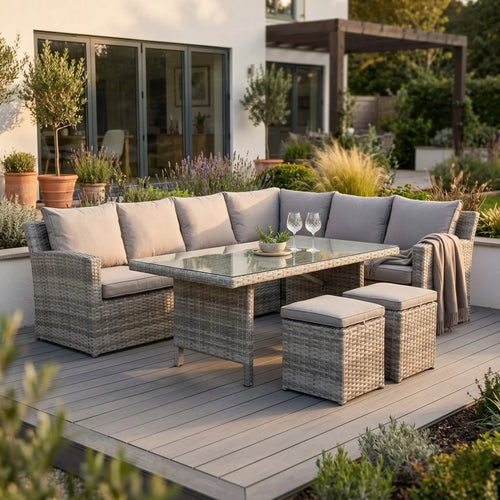
- Capri Outdoor Corner Lounge: grey PE wicker over an aluminium frame, used on the corner lounge, the base of a mid-height glass-top table and two cushioned stools that tuck under the table.
- Summerline Outdoor Corner Lounge with Coffee Table: light grey PE wicker over an aluminium frame, with cushions on all the seating and a matching wicker coffee table with a glass top.
- Sanbria Outdoor Stacking Dining Chair: a black wicker armchair with no cushions to store or dry. The seat, back, arms and legs are all woven, and the chairs stack.
- Chalfonte 7 Piece Outdoor Dining Set with Sanbria Chairs: six Sanbria chairs with the Chalfonte table, which has a dark brown powder-coated aluminium frame and a Duraboard top. Duraboard is a composite of wood fibre and plastic that looks like slatted timber and needs no oiling.
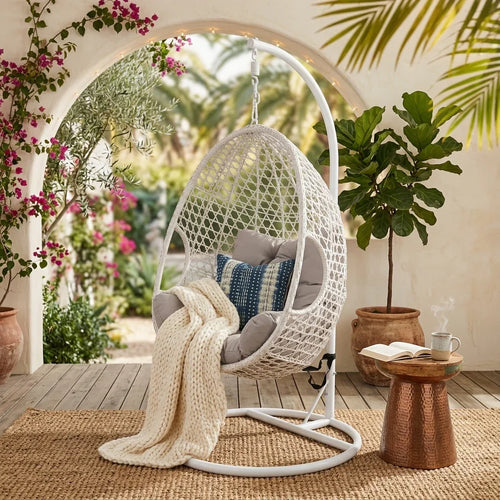
- Jimmy Outdoor Egg Pod Chair: a PE wicker shell on a 1.2mm powder-coated steel frame, with an Olefin fabric seat cushion. It comes with its own stand, so there is nothing to fix to a ceiling, and it is rated to 120kg. White frame, light grey cushion.
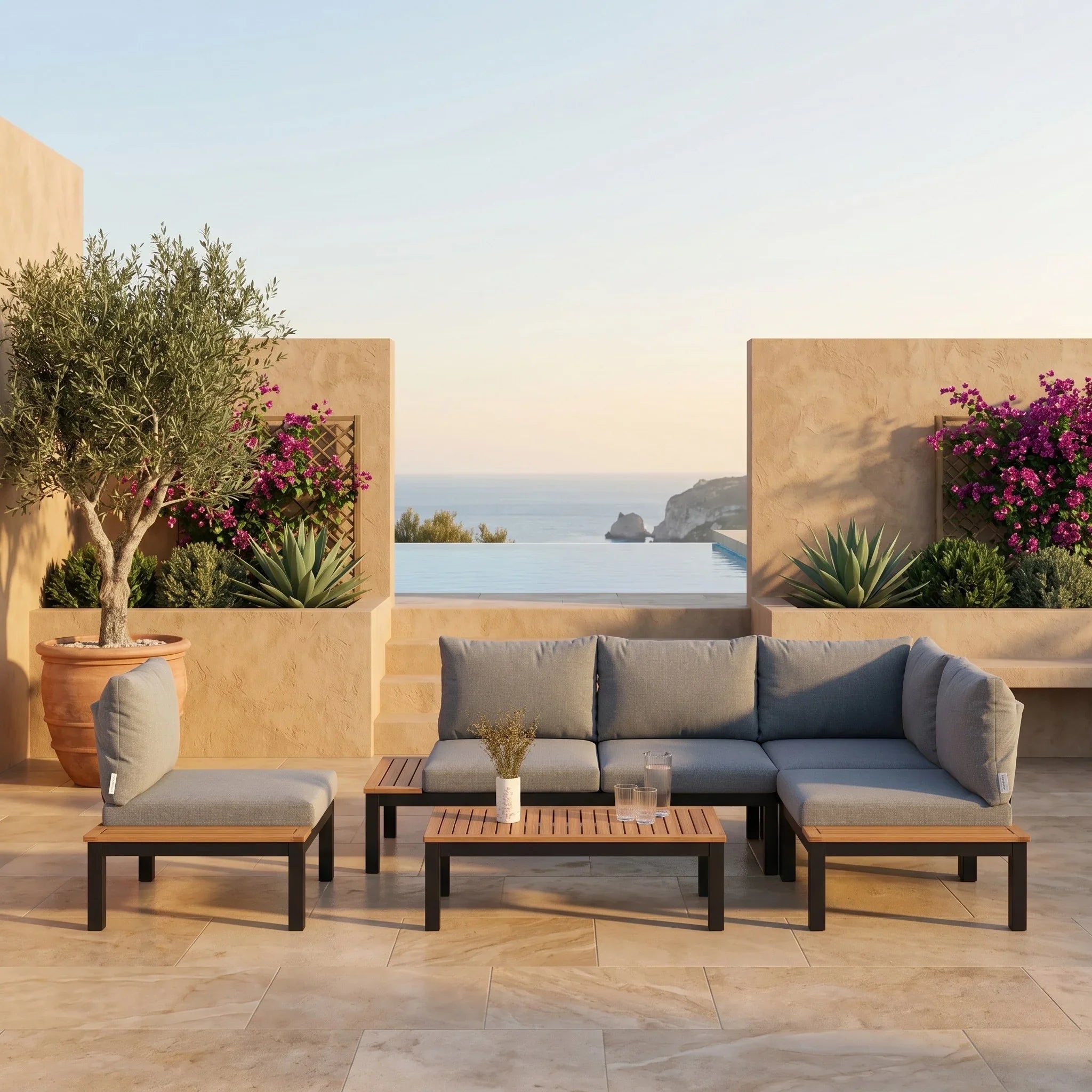
HDPE also turns up in furniture in a form that is not woven at all. The Maderia 4 Piece Outdoor Sofa Set has a charcoal powder-coated aluminium frame, and its armrest inserts and slatted coffee table top are a recycled HDPE plastic lumber that looks like timber. If that solid, timber-look style appeals more than a weave, our guide to polywood and recycled plastic outdoor furniture explains how that material behaves.

Caring for synthetic wicker
The strands themselves need very little. What causes trouble is what gets caught in the weave: leaf litter, seed husks, dust and pollen hold moisture against the strands and can grow mildew on a material that would not grow it by itself.
- Rinse regularly. A garden hose on a gentle setting flushes debris out of the weave. Do it after every storm, when the most debris gets driven in.
- Wash with mild soap. A damp cloth and mild soapy water, with a soft brush worked along each row, shifts the grime a hose leaves behind. Rinse and let it air dry.
- Skip the pressure washer. High pressure can damage strands and push water into the frame. Avoid steel wool, stiff brushes and harsh chemical cleaners, which can snag the weave or wear its surface.
- Look after the cushions separately. Spot clean them with mild soap, dry them fully, and store them indoors or under a breathable cover when the setting will not be used for a while.
- Dry before stacking or covering. Stacked chairs and covered wicker trap moisture between surfaces.
If dark spots have already appeared, our guide to removing mould and mildew from outdoor furniture covers wicker step by step. For how wicker fits alongside timber, aluminium and other materials, see our complete outdoor furniture guide. You can also browse every woven piece in outdoor lounges, outdoor dining sets and swing and egg chairs. We have five showrooms, so ask which store has the piece you like on display and come and press the weave yourself.

Wicker and rattan FAQs
Is resin wicker plastic?
Yes. Resin wicker, synthetic wicker and synthetic rattan are all plastic strands, usually polyethylene, made to look like natural cane. Outdoor-grade versions are made to resist UV and moisture, so they need no sealing or oiling.
What is plastic wicker called?
It goes by several names: PE wicker, PE rattan, resin wicker, synthetic wicker, all-weather wicker and faux wicker. They all describe plastic strands, usually polyethylene, woven in the wicker pattern over a metal frame. HDPE wicker is a denser form of the same plastic.
Is rattan a natural material?
Yes. Natural rattan is a climbing palm with long, solid, flexible stems that are woven into furniture. Synthetic rattan, sold as PE rattan or rattan-look, contains no plant fibre at all: it is plastic made to resemble rattan cane.
What colours does synthetic wicker come in?
Colours range from black, charcoal and grey through to white and warm, natural rattan tones. In our range, the Capri is grey, the Summerline light grey, the Sanbria black and the Jimmy egg chair white.