
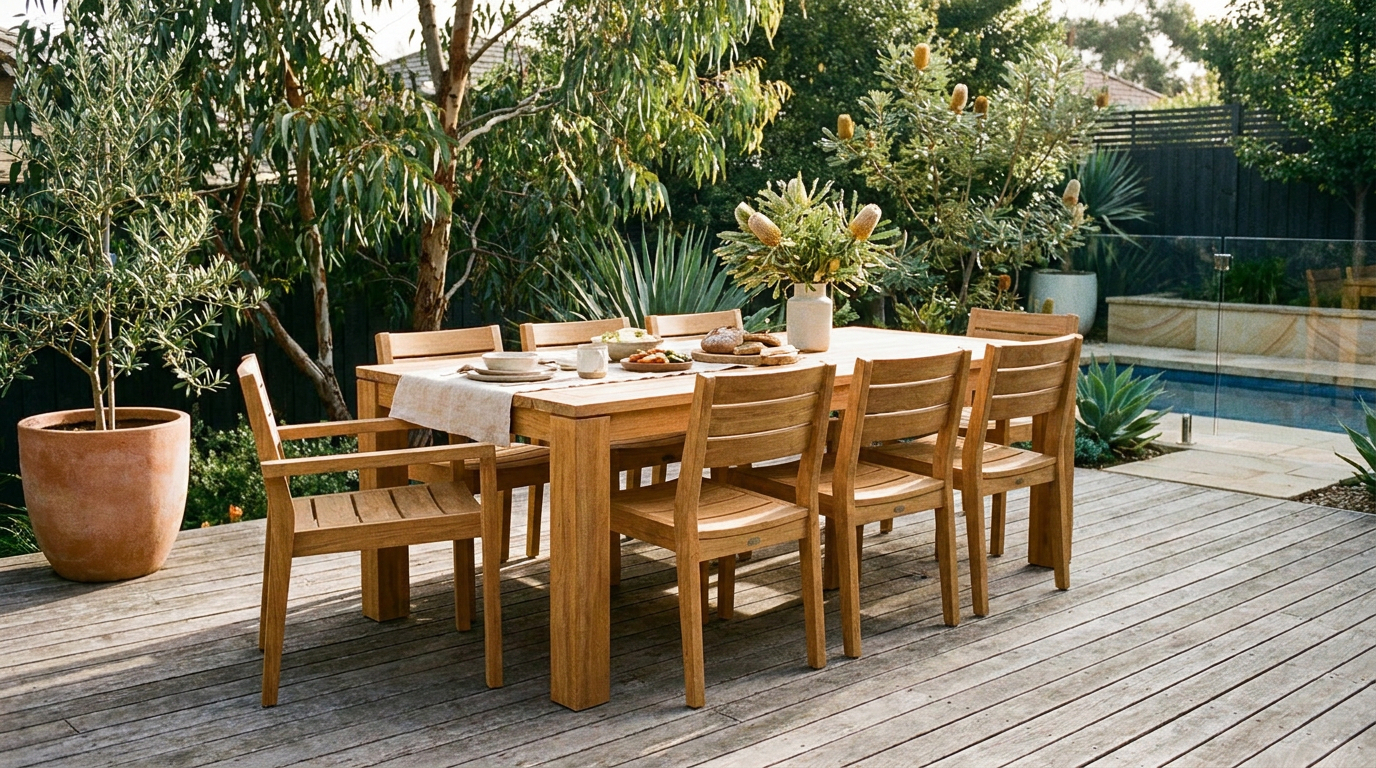
Materials · Teak
Teak is the premium tier of outdoor timber — and for Queensland homes that want a hardwood that lasts 20 to 50 years with minimal fuss, it's still the benchmark. Genuine Grade A teak handles UV, humidity, and storm season better than almost any other natural material, and is one of the few timbers that actually performs better near the coast than away from it. This article is part of our broader Queensland outdoor furniture materials guide, where we compare every common option side by side. Here we go deep on teak — what makes it work, the grades that matter, the colour decision, and how to care for it in a sub-tropical climate.

Why teak works in Queensland's climate
Teak (Tectona grandis) is a tropical hardwood native to South and Southeast Asia. Two structural properties make it exceptional outdoors: a high concentration of natural oils in the heartwood, and a dense, tight grain that resists moisture movement. Together, these traits mean teak doesn't warp, crack, swell, or rot the way most other timbers do when left exposed.
For Queensland specifically, that profile lines up with the four pressures we wrote about in our complete outdoor furniture guide for Brisbane and Queensland — UV intensity, humidity, storm season, and coastal salt air:
- UV. Teak fades from honey-gold to silver-grey on the surface, but the structural timber underneath is unaffected. Compare this with most softwoods, where UV breaks down lignin and turns surface fibres brittle.
- Humidity. The natural oils repel moisture, so teak doesn't swell or grow surface mould the way unsealed pine or treated softwoods do. Mildew can still appear on the surface in humid Brisbane summers, but it cleans off easily without damaging the timber.
- Storm season. A Grade A teak dining table is heavy enough to stay put through 80–90 km/h gusts, and the timber is dimensionally stable across rapid wet-dry cycles. You can leave teak out year-round in Brisbane without seasonal storage.
- Coastal salt air. This is where teak quietly outperforms metal alternatives. Salt accelerates corrosion on every metal except aluminium and 316-grade stainless. Teak has nothing for salt to attack — which is why bayside Queensland homes in Sandgate, Bundall, and Manly often choose teak over metal frames for tables and benches.
Grade A vs B vs C — the only buying decision that matters
"Teak" on a price tag tells you very little. The grade tells you almost everything. The grade refers to which part of the tree the timber was cut from, and that determines oil content, density, durability, and price.
| Grade | Source | Oil content | Outdoor durability | Price tier |
|---|---|---|---|---|
| Grade A | Heartwood from mature trees (30–50 years old) | High | 50+ years uncovered | $$$$ |
| Grade B | Outer heartwood + some sapwood | Moderate | 15–25 years with care | $$$ |
| Grade C | Sapwood from younger trees | Low | 5–10 years, prone to rot | $$ |
Grade A is what justifies teak's premium reputation. It's what should be in any teak dining table you intend to keep for a generation. Grade B is acceptable for furniture you'll cover or store seasonally — fine for indoor-outdoor pieces, less ideal as a permanent garden setting in Brisbane's storm season. Grade C is best avoided for outdoor use in Queensland — it lacks the oil density to handle our humidity and UV.
There is one honest truth about teak grading: it's a self-reported standard. Reputable Australian retailers and importers will name the grade and back it up; cheap imports often won't. If a teak set looks dramatically cheaper than comparable pieces and the seller can't or won't specify the grade, assume Grade C and price accordingly.
Signs you're looking at real Grade A
- Tight, close, even grain with no visible knots or sap pockets.
- Uniform honey-gold to deep amber colour — not patchy or streaky.
- Faint oily feel when you run a hand across freshly-machined surfaces.
- Solid weight — Grade A teak is dense; if it feels suspiciously light, it isn't.
- Mortice-and-tenon or precision machine joinery, not face-screwed butt joints.
- Stainless or brass fasteners (mild steel rusts and bleeds into the timber).
- Kiln-dried to roughly 8–12% moisture content for Australian conditions.
Golden teak or silver patina?
This is the only aesthetic decision that matters with teak — and it's the one most buyers don't realise they need to make until the wood starts changing colour on them.
New teak arrives a warm honey-brown. Left untreated outdoors, it gradually weathers to a uniform silver-grey over 12 to 18 months in Queensland sun. The surface fades; the structure doesn't. Many buyers love this evolution — it's the look of long-established teak benches in classic English gardens and Mediterranean villas. It's also genuinely zero-maintenance.
If you prefer the original honey-gold, a yearly application of a teak sealer or protector will hold the colour. (We say "sealer," not "oil" — see the care section below for why this distinction matters in Queensland.)
One reality worth knowing: once you start sealing, you've committed to keeping it up. Skipping a year leads to patchy fade. Most long-term teak owners eventually settle into letting the silver patina come — it's lower-effort, and the look genuinely improves with age.
Real teak vs lookalikes
"Teak" gets used as a marketing label for several other tropical hardwoods. None of these are bad timbers — some are excellent — but you should pay teak prices only for actual teak. Common substitutes you'll see in Australian outdoor furniture retail include:
- Acacia. Hard, oily, and decent outdoors with care. Sold as "acacia teak" or just "acacia hardwood." Generally 30–50% cheaper than equivalent Grade A teak.
- Eucalyptus. Australian-grown, durable, less oily than teak. Sometimes labelled "tropical hardwood." Great option for buyers who want a local sustainable choice.
- Merbau / Kwila. Extremely dense, classic for South East Queensland decking and benches. Bleeds tannin in the first year (stains paving) but stabilises afterwards.
- Plantation pine treated as "teak look." The cheapest and the worst — softwood disguised with a stain. Will not survive a Queensland summer.
If you want the side-by-side breakdown of teak against the most common Australian-relevant alternatives, our comparison of teak, acacia and eucalyptus for outdoor use covers price, durability, and aesthetic differences in detail.

Caring for teak in Queensland
The good news: teak is the lowest-maintenance natural timber available for outdoor use. The bad news: half the care advice you'll read online is wrong for Queensland's humidity. Here's what actually works in Brisbane and South East Queensland.
The annual clean (or twice yearly after storm season)
In Brisbane, the best schedule is one clean at the end of storm season (late April or May) and another in early spring (September). Method:
- Brush the surface with a stiff-bristled brush following the grain to remove dust, leaves, and cobwebs.
- Wash with warm water and a mild soap (a few drops of dishwashing liquid in a bucket is fine), again working with the grain.
- Rinse with a hose at low pressure. Do not pressure wash. High-pressure water pits the timber surface, leaving permanent marks.
- Allow to air-dry fully before any sealing or covering.
The "don't oil" rule
This is where Queensland advice diverges sharply from the US and UK guides you'll find in search results. Do not oil teak outdoors in a humid climate. Teak oil is a marketing legacy — the timber doesn't need topping up the way it's marketed to. Worse, in sub-tropical humidity, oil holds moisture against the surface and actively encourages mildew and dark patches.
If you want to preserve the golden colour, use a UV-stabilised teak sealer (sometimes labelled "teak protector"), not an oil. Sealers form a breathable surface barrier that slows fade without trapping moisture. Apply once a year following the cleaning step above, only when the timber is fully dry.
Mould and mildew on teak
Surface mould is normal in Queensland summers — even on Grade A teak. It looks alarming but cleans off easily with the soapy-water method above, sometimes with a small addition of household bleach (one part bleach to ten parts water) for stubborn patches. The timber underneath is unaffected.
Storm season
Teak handles Queensland storms well. The pieces are heavy enough to stay put in normal storm winds, and the timber is dimensionally stable across rapid wet-dry cycles. The thing to protect during storms is the cushions, not the teak. Bring cushions inside or store them in a covered box; the timber itself can stay where it is.
For a deeper guide to seasonal care across all outdoor furniture materials, including specific routines for teak through the November-to-April storm season, see our dedicated teak care guide for Queensland (publishing soon).
When teak isn't the right choice
For all its strengths, teak isn't always the right answer. Three situations where another material is the smarter buy:
You want a low-maintenance modern look
If you don't want a timber to evolve over time and would rather have furniture that looks identical in year ten as in year one, powder-coated aluminium is a better starting point. It's effectively maintenance-free, available in modern colourways, and significantly cheaper. Our deep-dive on aluminium outdoor furniture for Queensland's climate covers when this is the right call.
Budget pressure
Genuine Grade A teak isn't cheap. If your budget puts Grade A out of reach, you're often better off buying a quality acacia or eucalyptus piece than dropping to Grade B or C teak. Acacia hardwood at the same price point typically delivers better real-world durability than entry-grade teak.

You want plush cushioned lounges
Teak is at its best in dining tables, benches, and rigid seating. Modern outdoor lounges with deep, cushioned seating are usually built around aluminium frames with synthetic wicker or sling fabric — formats where teak's structural advantages don't really matter, and where the cushion specification matters far more. Our guide to outdoor fabrics including Sunbrella, Olefin and UV-resistant materials covers what to look for in cushions.
FAQs
-
Is teak good for Queensland's climate?
Yes — teak is one of the best natural timbers for South East Queensland's climate. Its high natural oil content and dense grain make it resistant to humidity, UV, and rot. Genuine Grade A teak can stay outdoors uncovered for 20 to 50 years with only basic cleaning. It's particularly well-suited to coastal Queensland homes (Sandgate, Bundall, Manly) because there's no metal to corrode in salt air.
-
Does teak outdoor furniture need to be oiled?
No — and in Queensland's humid climate, oiling teak is actively counterproductive. Teak's natural oils replenish themselves through the timber's structure; topical "teak oil" is a marketing legacy. In sub-tropical humidity, oil holds moisture against the surface and encourages mildew. If you want to preserve the original honey-gold colour, use a teak sealer or protector instead — these form a breathable barrier without trapping moisture.
-
Does teak fade in the Queensland sun?
Yes, but only on the surface. Untreated teak weathers from honey-gold to a silver-grey patina over 12 to 18 months in full Queensland sun. This is purely cosmetic — the structural timber underneath is unaffected, and the silver finish is widely considered an attractive part of teak's character. If you prefer to keep the original colour, applying a UV-stabilised teak sealer once a year will hold the warm tone.
-
How long does teak outdoor furniture last in Australia?
Genuine Grade A teak can last 50 years or more outdoors with basic care. Grade B teak typically lasts 15 to 25 years with seasonal covering. Grade C teak is significantly less durable — often 5 to 10 years before showing rot or splits. The grade matters far more than the country of origin or brand. A well-built Grade A teak dining table is genuinely a generational furniture purchase.
-
What's the difference between Grade A, B, and C teak?
The grade refers to which part of the tree the timber comes from. Grade A is heartwood from mature trees (30–50 years old) — high in natural oils, dense, dimensionally stable, and the standard for premium outdoor furniture. Grade B mixes heartwood with some sapwood — moderate oil content, lower durability, but usable for covered or seasonal pieces. Grade C is sapwood from younger trees — low oil content and not recommended for full outdoor use in Queensland's climate. Reputable Australian sellers will name the grade; if a seller can't or won't specify, assume Grade C.
-
Should I cover or move my teak furniture during storm season?
For the timber itself, no — Grade A and B teak handles Queensland storms well. The pieces are heavy enough to stay put in normal storm winds, and the timber is dimensionally stable across rapid wet-dry cycles. What you should bring inside or cover is the cushions, not the teak. If you live in a cyclone-rated area or have lightweight teak benches that could become projectiles in extreme winds (90+ km/h), then yes — secure or store them when severe storms are forecast.
Ready to choose teak?
Genuine Grade A teak is one of the best long-term investments you can make in outdoor furniture for a Queensland home. It's also the kind of purchase that benefits from seeing the timber in person — grain pattern, weight, finish, and joinery all matter, and product photography rarely shows the difference between Grade A and Grade C clearly. All five of our South East Queensland showrooms — Rocklea, North Ipswich, Sandgate, Bundall, and Beenleigh — carry our outdoor range, and our team can walk you through what to inspect on any teak piece. Free local delivery applies within about 10 km of our Rocklea warehouse on qualifying outright purchases.