
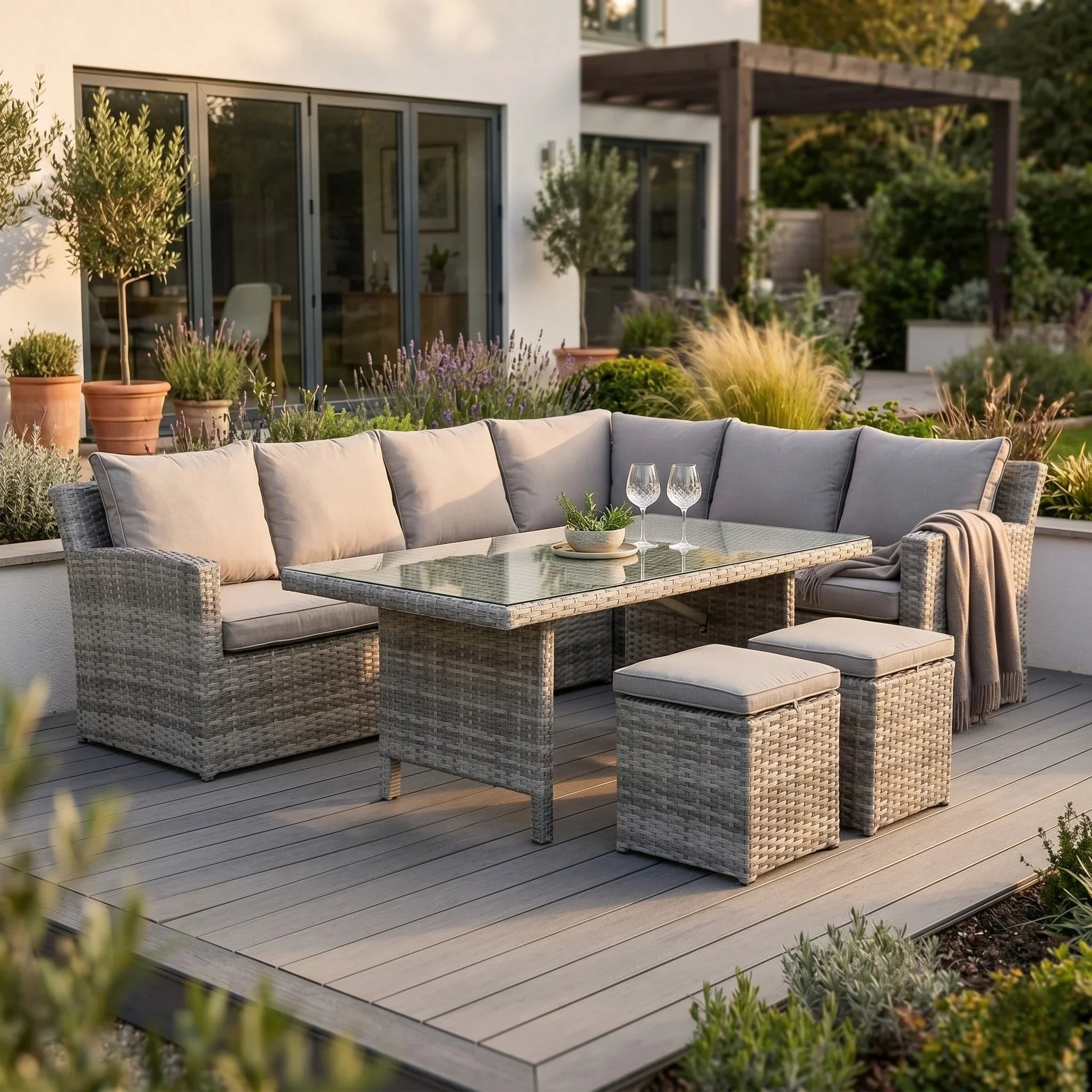
Materials · HDPE Wicker for Commercial Use
HDPE wicker is the dominant material for outdoor furniture in Australia's hospitality, holiday-rental, and commercial outdoor sectors — for good reason. It handles direct UV exposure, salt air, chlorine, and the wear-and-tear of high-traffic guest use better than almost any alternative. But the gap between residential-grade HDPE wicker and genuinely commercial-grade construction is large, and most product photography doesn't show it. This guide is written for buyers fitting out hospitality venues, resort properties, body corporate common areas, restaurant courtyards, and holiday rentals across Australia. For the consumer-facing introduction to synthetic wicker, see our synthetic wicker vs natural rattan guide. This article goes further, into the procurement-grade specifications.

What "commercial-grade" actually means
The term "commercial-grade" gets used loosely on outdoor furniture listings. In genuine commercial procurement, it means something specific. The piece is built to handle higher use intensity, last longer in service, and meet the consistency needed for FF&E (furniture, fixtures and equipment) installations across multiple guest rooms or common areas.
Compared to residential HDPE wicker, commercial-grade pieces typically show several differences:
- Higher use intensity. Residential furniture is sat on by 2–6 people regularly. Commercial furniture in a resort lounge or restaurant courtyard might be sat on by 50+ different people daily. Those users bring different body weights and settling behaviours, plus zero ownership-sense incentive to treat it gently.
- Longer service life expectations. Residential lifespans of 7–10 years are acceptable. Commercial lifespans need to hit similar duration despite the higher use intensity, which means stronger construction throughout.
- Consistency across multiple units. A 30-room resort needs 30 identical lounge sets, manufactured to the same specification at the same time. Commercial-grade manufacturers maintain repeatability standards that residential manufacturers don't.
- Easier maintenance for cleaning staff. Commercial pieces are designed for daily-or-more cleaning rotation by staff who don't own the furniture. Removable cushions, fast-drying construction, and easily-wiped surfaces matter more than they do residentially.
- Stricter compliance requirements. Fire ratings, slip ratings on outdoor stools and benches, weight ratings, and various building code considerations apply commercially in ways they don't residentially.
The buying lesson for procurement: residential-grade HDPE wicker can look beautiful for years on a low-use private patio. The same pieces deployed in a resort lounge or holiday-rental courtyard often fail within 18 months. The gap between the two use cases is wider than most product photography suggests. The broader Queensland climate considerations in our complete outdoor furniture guide for Brisbane and Queensland apply to both residential and commercial contexts. Commercial-grade construction is what survives those conditions, plus the extra intensity of guest-facing use.
Frame welding and structural standards
The internal frame is the foundation of commercial-grade HDPE wicker furniture. The weave is decorative; the frame determines whether the piece survives years of high-traffic use. Three structural decisions matter most.
Welded vs bolted aluminium
Residential HDPE wicker often uses bolted aluminium frames — sections of extrusion joined with stainless steel fasteners. This works well for residential use, but it concentrates stress at the bolt holes. Over years of repeated loading, that stress can develop into fatigue cracks. Commercial-grade HDPE wicker uses welded aluminium frames instead, where the joints are fused continuously rather than bolted together. A welded joint spreads load across the whole weld bead instead of concentrating it at a few fastener points. That's why commercial pieces last longer under high use intensity.
Frame gauge and wall thickness
Commercial-grade aluminium frames typically use thicker-walled extrusions than residential equivalents: 2–3mm wall thickness, compared with the 1–1.5mm common in budget residential pieces. That extra weight and cost is the difference between a frame that survives someone sitting down hard and one that develops a hairline crack at the legs. Our aluminium outdoor furniture buyer's guide for Queensland covers extruded vs cast vs hollow-tube construction in detail. Commercial-grade applications generally specify extruded aluminium with welded joints.
Steel-frame avoidance
Steel frames in HDPE wicker are a residential-only option and should be avoided in any commercial Australian context. Even galvanised steel rusts wherever the protective coating is breached, and that rust bleeds through the HDPE weave and stains it permanently. For commercial use in coastal or humid Australian conditions, aluminium is the only frame material that holds up.
Weave consistency benchmarks
HDPE wicker is hand-woven — every commercial-grade piece is built by skilled weavers wrapping plastic strands around the aluminium frame. The visible difference between commercial-grade and residential-grade weave is consistency, and consistency reflects manufacturer process control.
What consistent weave looks like
- Symmetrical row spacing. The horizontal rows of weave should sit at consistent intervals across the entire piece. Visible drift (rows getting closer or further apart along a section) indicates a less experienced weaver or rushed production.
- Even tension across the weave field. Run a hand across the seat or back surface — quality weave feels uniformly taut. Loose patches indicate inadequate tensioning during assembly; over-tight patches can stress the strand and cause early fatigue.
- No frayed or visible end-strands. The end of every strand should be wrapped multiple times around the frame and either heat-sealed or stapled. Visible strand ends, fray marks, or quick-glue points are signs of corner-cutting that will unravel within months under commercial use intensity.
- 4-rows-at-a-time technique. The most-recognised quality benchmark in the industry — referenced by brands like Harmonia Living — is weaving four rows at a time before moving to the next section. This avoids the drift that happens when weavers work long single rows instead. It's a process indicator commercial buyers can specify in tender documents.
Inspection at sample stage
For commercial procurement, request a sample piece before placing volume orders. The sample piece should be inspected for:
- Weave symmetry from multiple angles (top, side, underside)
- Strand-end finishing on the underside (hidden, secured, no visible glue)
- Frame weld quality — clean welds without spatter, visible during sample inspection if seat surfaces or underside are accessible
- Fastener specification — 316 stainless on coastal-bound orders; 304 acceptable for inland applications
- Weight against published specification — significant deviation usually signals construction differences
HDPE strand specifications
Beyond construction, the strand material itself has commercial-grade specifications worth understanding. "HDPE wicker" is a category, not a single product, and quality varies by manufacturer.

Strand thickness and gauge
Commercial-grade HDPE wicker strands are typically 1.8–2.5mm thick, made by a continuous extrusion process. Budget residential strands can be as thin as 0.8–1.2mm. They feel similar at a glance, but they lack the structural integrity for high-use applications. Thicker strands also resist abrasion better, which matters in hospitality settings where guests can scrape rings, watches, and other sharp objects across the surface without meaning to.
UV stabiliser content
HDPE without UV stabilisers turns brittle and chalky under prolonged Queensland or northern Australian sun. Commercial-grade HDPE specifies a UV stabiliser content, typically 0.3–0.6% by weight of TiO2 or carbon black, plus proprietary additive packages from quality manufacturers. Quality suppliers can back this up with UV testing data — typically 2,000+ hours of accelerated weathering tests (ASTM G155 or equivalent) with no significant fade or brittleness.
Recycled content versus virgin HDPE
Both 100% recycled HDPE and virgin-blend HDPE can be commercial-grade, depending on the manufacturer's process control. The marketing premium often goes to "100% recycled," but virgin-blend HDPE with controlled additive packages can be more consistent batch-to-batch. For commercial procurement, ask the manufacturer about both the recycled content percentage and their batch consistency standards. Either can be the right answer depending on the project's sustainability priorities.
Cross-section profile
HDPE strands come in several profile shapes: round, flat, half-moon, and pre-textured. Commercial-grade hospitality applications often specify pre-textured or natural-look profiles that hide normal wear better than pure round strands. The choice is partly aesthetic and partly practical — high-touch surfaces show abrasion patterns less obviously on textured strands.
Hospitality cushion systems
Cushion failure is the most common reason hospitality outdoor furniture gets replaced before its frame would fail. Commercial-grade cushion systems are specified differently from residential cushions in three areas.
Quick-dry reticulated foam (mandatory for hospitality)
Open-cell reticulated foam lets water drain straight through the cushion within minutes. That matters for hospitality, where cushions get rained on overnight and need to be usable by guests the next morning, without staff having to intervene. Standard closed-cell foam holds water for days and grows mould inside — a guest complaint waiting to happen within weeks of installation. Reticulated foam is non-negotiable for hospitality, regardless of climate. Our complete outdoor fabric guide covers the foam-and-fabric decision for residential use in detail; commercial applications generally specify the premium tier across both.
Marine-grade fabric and Tenara stitching
Sunbrella, Sunbrella Marine Plus, or equivalent solution-dyed acrylic fabrics are the commercial standard. Stitching should be UV-resistant Tenara thread (a PTFE-based marine-grade thread), not standard polyester. Standard polyester thread degrades under UV and salt exposure within 3–5 years. Tenara thread carries 10+ year warranties. The cost premium is small ($50–$100 per cushion set), making it one of the highest-value upgrades available. For coastal hospitality projects, this is also where the marine-grade considerations in our marine-grade outdoor furniture buyer's guide become critical to get right.
Removable, washable covers
Hospitality cleaning rotations require cushion covers that come off without tools and can be washed without specialist services. Commercial-grade specifications typically include heavy-duty YKK zippers (UV-stable plastic, not metal which corrodes), cover construction that survives 100+ wash cycles, and replacement cover availability so individual damaged covers can be swapped without replacing entire cushion sets.
Storage and handling
Hospitality applications need to consider where cushions go during extended bad weather, during seasonal closures, and during major events that close outdoor areas. Commercial cushion specifications often include matching storage bags and stackable cushion designs that minimise storage volume.
Commercial warranties and supplier expectations
The warranty terms a manufacturer offers signal what they expect their product to deliver. Commercial-grade specifications typically come with stronger warranty terms than residential equivalents.
| Component | Commercial-grade warranty | Residential-grade warranty |
|---|---|---|
| Aluminium frame | 10–15 years against structural failure | 5–7 years |
| HDPE wicker weave | 5–7 years against fade, brittleness, unravelling | 3–5 years |
| Cushion fabric (Sunbrella) | 5 years (manufacturer warranty) | 5 years (same — Sunbrella warranty doesn't differentiate) |
| Stitching (Tenara) | 10+ years | 2–5 years (typically polyester thread) |
| Hardware (316 stainless) | 10 years against corrosion | 2–5 years (often 304 stainless) |
For commercial procurement, ask for warranty documentation in writing before placing volume orders. Quality commercial manufacturers include written warranties as standard. If a manufacturer resists giving you a written warranty, or only offers vague terms like "lifetime" with no specific exclusions, that's usually a sign they're not a genuine commercial-grade supplier, whatever their marketing claims.
Commercial supplier vetting checklist: Can the manufacturer provide written warranty terms? Can they supply UV testing data on their HDPE strands? Can they confirm welded (not bolted) frame construction? Can they provide a sample piece before volume order? Can they commit to repeatability across the order quantity? If any answer is unclear or hedging, the supplier may not meet commercial procurement standards regardless of the price quote.
Volume pricing and procurement notes
Commercial HDPE wicker procurement operates on different economics from residential retail. A few practical notes for buyers fitting out hospitality projects.
Volume thresholds
Most commercial-grade outdoor furniture suppliers in Australia begin offering volume pricing at 10–15 unit equivalents (e.g., 10+ matching dining sets, or 15+ matching lounge chairs). Below this threshold, residential retail pricing usually applies. Above it, commercial discounts of 15–25% are typical, with custom-fabric and custom-finish options often becoming available.
Lead times
Commercial-grade HDPE wicker is typically built-to-order rather than stocked. Standard lead times for commercial orders run 8–14 weeks for in-production designs, longer for custom specifications or imported pieces. For project planning, factor 12+ weeks from order placement to delivery, plus installation time.
Delivery and installation
Quality commercial suppliers offer delivery, assembly, and installation as part of their project quotes. For larger installations across Queensland and South East Queensland, this typically includes coordinating with site contractors, scheduled delivery windows, and on-site assembly by trained crews. Free local delivery applies on eligible orders across Greater Brisbane and SEQ. Commercial volume orders often include extended delivery zones and white-glove installation as part of the project price.
Replacement parts and serviceability
For long-term service contracts, ask suppliers about replacement parts availability — individual cushion covers, hardware, and replacement weave panels for repair work after years in service. Commercial-grade suppliers typically maintain replacement part inventory for in-warranty periods. Budget suppliers often don't, which means damaged pieces have to be fully replaced rather than repaired.
Care contracts
Many commercial outdoor furniture installations benefit from annual or seasonal professional care contracts — deep cleaning, stitching inspection, hardware replacement, cushion rotation. Our Queensland care and maintenance guide covers the routine for residential applications; commercial applications typically require a more structured care schedule with documented compliance.
FAQs
-
What's the difference between residential and commercial-grade HDPE wicker?
Commercial-grade HDPE wicker is built to handle higher use intensity, longer service life under that intensity, and the consistency required for FF&E installations across multiple units. Specific differences include welded (not bolted) aluminium frames, thicker strand specifications (1.8–2.5mm vs 0.8–1.2mm budget residential), pre-textured strand profiles that hide wear, reticulated quick-dry foam, Tenara UV-resistant stitching, 316 stainless hardware, and longer written warranties (10–15 year frame, 5–7 year weave). The visible difference at a glance is small; the difference under daily commercial use is substantial.
-
How long does commercial-grade HDPE wicker furniture last?
In commercial hospitality use — resort lounges, restaurant courtyards, holiday rental common areas — quality commercial-grade HDPE wicker typically delivers 8–12 years of service life with regular maintenance. The aluminium frame typically outlasts the weave, which outlasts the cushions. Frame replacement is rare during the service life. Weave panels may need repair work after 7+ years of high use, and cushion covers typically need replacement at the 5–7 year mark on a high-use commercial piece. Residential-grade HDPE wicker deployed in commercial contexts often fails within 18 months.
-
What questions should I ask a commercial HDPE wicker supplier?
Before placing volume orders, ask your supplier to provide:
- Written warranty terms with specific exclusions (not vague "lifetime" claims)
- UV testing data on the HDPE strand specifications
- Confirmation of welded (not bolted) frame construction, with frame gauge specification
- A sample piece for inspection before the volume order
- Confirmation of consistency standards across the order quantity
- Lead time and delivery arrangements
- Replacement part availability for in-warranty periods
- References from existing commercial installations of similar scale
Suppliers that can't or won't provide these answers may not meet commercial procurement standards regardless of price.
-
Is commercial-grade HDPE wicker worth the extra cost over residential?
For hospitality, holiday rental, body corporate, and high-traffic commercial applications, yes. The cost premium for commercial-grade HDPE wicker over equivalent residential pieces typically runs 30–50%. But the service life under commercial use intensity is 4–6× longer than residential pieces deployed in the same context, so the lifecycle math overwhelmingly favours commercial-grade wherever the furniture sees more than residential use. For genuinely residential applications (private homes, low-traffic patios), residential-grade HDPE wicker is the right specification, and the commercial premium is overspecification.
-
What HDPE strand specifications matter most for Australian commercial use?
For Australian commercial applications, the most important HDPE specifications are:
- Strand thickness (1.8–2.5mm for commercial-grade)
- UV stabiliser content, with documented testing data (2,000+ hours under accelerated weathering tests)
- Strand cross-section profile (pre-textured or natural-look profiles hide wear better than pure round)
- Continuous extrusion manufacturing, rather than spliced strand sections
Recycled content percentage is relevant for sustainability claims but doesn't directly affect performance — both 100% recycled and virgin-blend HDPE can be commercial-grade depending on the manufacturer's process control.
-
What lead times should I plan for commercial HDPE wicker orders?
Commercial-grade HDPE wicker is typically built-to-order rather than stocked. Standard lead times run 8–14 weeks for in-production designs from established manufacturers, with longer windows (16+ weeks) for custom fabric specifications, custom finishes, or imported pieces requiring international shipping. Factor 12+ weeks from order placement to delivery, plus 1–2 weeks for assembly and installation depending on order scale. For tight project timelines, ask suppliers about expedited production options at order placement — quality suppliers can sometimes accelerate production for premium rates.
Specifying HDPE wicker for your project?
Commercial-grade HDPE wicker is a system specification. Frame welding, weave consistency, strand thickness, cushion construction, hardware grade, and warranty terms all matter together, not on their own. Quality manufacturers can document specifications across all these elements. Quality retailers can match procurement requirements to in-production designs, or facilitate custom specification work. All five of our South East Queensland showrooms — Rocklea, North Ipswich, Sandgate, Bundall, and Beenleigh — let project specifiers inspect construction firsthand, and our team can talk through volume requirements, lead times, and project-specific specifications. Contact our team for project-scope discussions, or visit a showroom to inspect quality cues across our outdoor wicker range.
Shop the range
Ready to buy? Browse the matching outdoor collections: