
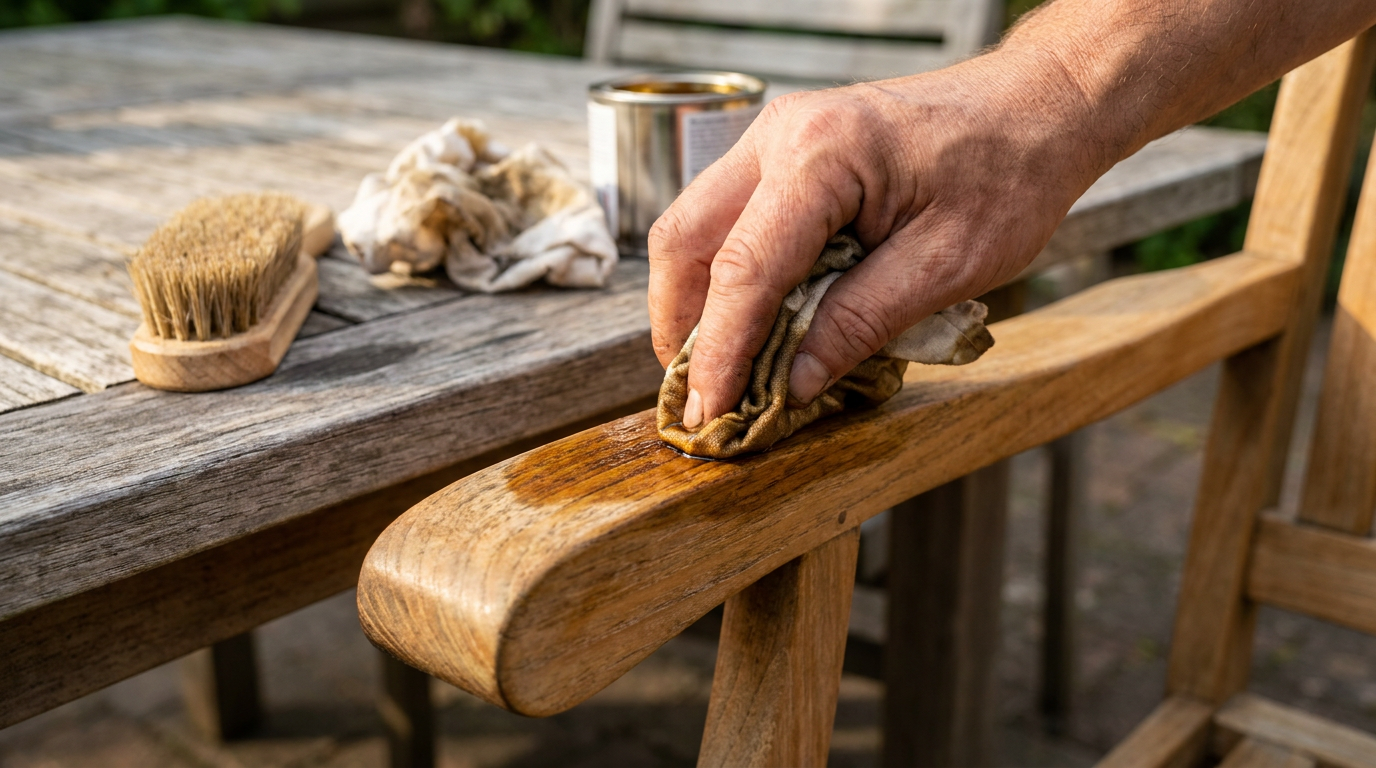
Care & Maintenance · Teak
Most teak care advice on the internet is wrong for Queensland conditions. The standard "oil it twice a year" recommendation comes from drier climates and creates exactly the wrong outcome here — topical timber oils trap moisture against the surface and create the warm, damp environment where mildew thrives in Brisbane humidity. The Queensland-correct routine is simpler than the wrong one: keep it clean, decide whether you want it to silver or stay golden, and use water-based UV sealer (not oil) only if you've chosen golden. This guide is part of our broader Queensland outdoor furniture care guide and pairs with our teak buyer's guide for buyers still deciding what to purchase. Here we cover the full care routine — the patina decision, the seasonal calendar, the mildew response, and the restoration path for teak that's been neglected.

The Queensland teak care reality
The most common teak care advice — applying topical "teak oil" every six months — is genuinely wrong for Brisbane and South East Queensland conditions. Understanding why matters, because it explains why so much teak in QLD ends up looking worse after years of well-intentioned care than teak that's been left completely alone.
Why "teak oil" is the wrong product here
The product sold as "teak oil" contains no actual oil from teak trees. It's typically linseed oil or tung oil mixed with solvents and varnish — a film-forming product designed to enhance grain appearance. In drier climates this works adequately. In Brisbane's 70%+ summer humidity, the oil traps moisture against the timber surface, the film attracts and holds organic debris (pollen, dust, leaf fragments, bird droppings), and the combination — trapped moisture + trapped organic matter + warm humid air — creates ideal mildew conditions. The dark grey or black spotting buyers spend years trying to remove is what trapped debris feeds, not the timber itself; teak doesn't grow mould, but trapped organic matter on its surface does. Most "blackened teak" in Queensland gardens is the consequence of well-intentioned oiling, not lack of care.
What's actually correct for QLD
Quality teak doesn't need any topical treatment to last. Grade A heartwood teak — the premium grade covered in our Queensland teak buyer's guide — has natural oils inside the wood that protect against rot, fungi, and insects for decades. The question isn't whether to treat it; it's whether you want to control the colour change as it ages. The same don't-oil rule applies to acacia and eucalyptus outdoor furniture, as covered in our hardwood comparison guide.
The patina decision — silver vs golden
This is the single decision that drives everything else in your teak care routine. Untreated teak doesn't stay golden-brown forever — it gradually weathers to a silver-grey patina under sun and rain exposure. Both states are genuinely beautiful and both are normal. The question is which look you prefer, because the answer determines how much care work you'll do.
Letting it silver — the zero-maintenance path
If you like the silver-grey weathered teak look, the correct care routine is the simplest possible: routine cleaning (mild soap, soft brush, water — once or twice a year), addressing mildew if it appears, post-storm debris clearance, and otherwise nothing. No sealers, no oils, no annual treatments. Quality Grade A teak left to silver naturally lasts 25+ years in Queensland conditions with minimal care.
The silvering process takes 6–18 months in QLD depending on sun exposure — covered patios silver more slowly than fully exposed pieces. The colour change is uniform if the cleaning routine is consistent; uneven silvering usually indicates uneven cleaning or partial shading.
Maintaining the golden-brown — the annual sealer commitment
If you want to keep teak at its golden honey colour, you'll need to apply a water-based UV sealer (not oil) approximately once a year in QLD conditions. Quality water-based teak sealers contain UV-stabilised pigments that slow colour fade without forming a moisture-trapping film. They allow the wood to breathe while preventing the gradual silvering. The annual reapplication is necessary because Brisbane UV (UVI 13+ in summer) breaks down sealer faster than equivalent US or UK conditions.
For new teak that you want to keep golden, the first sealer application should happen within the first month of outdoor exposure — before silvering starts. For teak that's already partially silvered, you'll need to clean and lightly sand to restore the underlying golden colour before sealing (covered in the restoration section below).
The honest comparison
| Let it silver | Maintain golden | |
|---|---|---|
| Annual time commitment | 1–2 hours per year (cleaning only) | 4–6 hours per year (clean + sand + seal) |
| Annual cost | $0 (just soap and water) | $60–$120 (water-based teak sealer) |
| Visual outcome | Silver-grey patina, even and natural | Golden-brown, fresh-looking |
| Lifespan | 25+ years on Grade A teak | 25+ years on Grade A teak |
| Forgiveness if neglected | Very forgiving — just keeps silvering | Less forgiving — sealer wears off, mixed appearance |
For most Queensland buyers, letting teak silver is the smarter choice — it suits the relaxed beach-house aesthetic that's common across SEQ, requires no annual commitment, and the silver-grey actually photographs beautifully against tropical greenery. The maintain-golden choice makes most sense for buyers who specifically want the new-teak look or for highly visible feature pieces in formal landscaping contexts.
Routine maintenance — the seasonal calendar
Queensland's climate breaks naturally into four phases for teak care purposes. Following the seasonal rhythm makes care simpler than treating it as a year-round constant.
October — pre-storm-season prep
The most important annual care window. October is dry, warm but not yet humid, and gives you several clear days for cleaning and sealing work before storm season begins. The pre-season checklist: full clean with mild soapy water (1 tablespoon dish soap per 4 litres warm water, soft-bristle brush, scrub gently with the grain, rinse, allow 24+ hours to dry); inspect for and address any mildew before sealing or before storm season delivers more debris; if maintaining golden, apply two thin coats of water-based teak sealer (4+ hours between coats) on a dry day with no rain forecast for 48 hours; and check stainless steel fasteners for tightness, replacing any that show corrosion.
November–March — storm-season minimal handling
The wet season. Don't apply sealers or do major cleaning during this period — humidity and rain compromise the work. Routine handling is quick rinses after dust storms or extended dry periods that end in rain (the first rain after dust accumulation is when staining can occur), post-storm debris clearance within 24 hours of any significant storm (see storm section below), and spot-cleaning for any spills or marks. Watch for early black spotting and address quickly — early-stage mildew in the wet season is much easier than waiting for the dry season.
April–May — post-wet-season deep clean
Once the wet season ends, the cumulative debris and any mildew that developed needs addressing. April-May provides drying weather and lower humidity than mid-summer. Run the full clean as per the October routine, do deep mildew treatment if needed (bleach-water protocol below), and apply optional touch-up sealer for golden-maintained pieces if the sealer is showing wear.
June–September — dry-season opportunity
The driest, lowest-humidity months. If you've been deferring restoration work or major sealing, this is the window. Otherwise the teak needs no attention beyond occasional debris clearance.
Mildew response and the bleach-water protocol
Mildew on teak appears as black or dark grey spotting, usually concentrated where debris has settled (slatted seat surfaces, table tops, corner crevices). The faster you act, the easier removal is. Three escalating intervention levels:
Level 1 — early-stage surface mildew
For mildew you've spotted within days or a couple of weeks, soapy water and a soft-bristle brush is usually enough. Apply with the grain, allow to sit for 5 minutes, rinse with clean water. Repeat once if needed. Don't let the surface stay wet for extended periods.
Level 2 — established mildew (the 1:10 bleach-water protocol)
For black spotting that's been there for weeks or months, household bleach diluted 1:10 with water is the most effective approach. Mix 1 part household bleach to 10 parts warm water (e.g., 100ml bleach to 1 litre water for a small batch). Pre-wet the wood with clean water — this prevents the bleach soaking too deep into the timber. Apply with a soft-bristle brush in the direction of the grain, working in sections; don't let the solution dry on the surface. Allow to sit for 5–10 minutes (don't scrub aggressively during this time — let the bleach do the work), then rinse thoroughly with clean water from a hose, multiple rinses to ensure no bleach residue remains. Allow to dry fully (24+ hours) before any sealer application.
Wear gloves and eye protection. Avoid contact with surrounding plants and grass — bleach kills foliage. A tarp under the furniture during cleaning protects pavers, decks, and lawn.
Level 3 — deep-set mildew requiring sanding
Black spots that survive a thorough bleach-water treatment have penetrated below the surface. Light sanding with 220-grit sandpaper, working with the grain, removes the affected layer and exposes clean timber underneath. After sanding, do a final clean with soapy water, rinse, allow to dry fully, then proceed with sealing if maintaining golden.
Avoid these mildew mistakes: Don't use vinegar instead of bleach for established mildew — vinegar is a mild antimicrobial but isn't strong enough for set-in QLD black spots. Don't use a wire brush — it damages the timber surface. Don't pressure-wash for mildew removal at high pressure — it can drive mould spores deeper and damage the wood fibres.
Pressure washing teak — when it's actually fine
Most online teak care advice flatly says "never pressure-wash teak." The honest answer is that low-power pressure washing with proper technique is genuinely fine and is sometimes the only practical way to handle deep ingrained dirt before sealing. The key is technique, not avoiding the tool entirely.
Safe pressure-washing technique
Use under 1,500 PSI (ideally 1,000–1,200 PSI for teak) with a 40-degree wide spray nozzle (never a focused 0-degree or 15-degree tip), keep minimum 30cm distance from the timber surface, always work with the grain in a steady passing motion (don't hold the spray on one spot), and allow 48+ hours drying time before any sealer work.
When pressure washing is the right choice
Pressure washing makes sense when you've got deep ingrained dirt that won't lift with brush-and-soap, when you're restoring neglected teak that's collected years of debris, or when you're prepping for sanding and sealing on a piece with complex slats and crevices that are hard to clean by hand. For routine cleaning, brush-and-soap is fine and pressure washing is overkill.
When to skip pressure washing
Don't pressure-wash already-mildewed teak (drives spores deeper), already-cracked or splintered teak (worsens the damage), or teak that's been recently sealed (strips the sealer unevenly). Don't pressure-wash if you don't have proper PSI control on your washer — a no-control unit at full pressure will damage even the toughest hardwood.
Restoring weathered or neglected teak

Teak that's been ignored for years isn't ruined — quality Grade A teak is genuinely durable and the structural timber underneath the surface weathering is usually intact. The restoration path depends on which final state you're aiming for.
Restoring to a uniform silver patina
The simpler path. If your teak has weathered unevenly, has surface dirt, and possibly some mildew but you're happy with the silver look: pressure-wash with proper technique (or extended brush-and-soap cleaning) to remove all surface dirt, address any mildew with the bleach-water protocol, allow to fully dry (1 week if possible), light sand with 220-grit if surface fibres are raised, then leave it. The silver patina will even out over the next 3–6 months as the freshly-cleaned surface ages.
Restoring to a fresh golden colour
The longer path. If you want to bring weathered grey teak back to its original honey-brown:
- Pressure-wash or thoroughly brush-clean the entire piece.
- Apply a commercial two-part teak cleaner (available at hardware stores, not the same as teak oil). The first part removes surface oxidation; the second part neutralises the cleaner.
- Rinse thoroughly between parts and after the final step.
- Allow to dry fully (1 week minimum in QLD).
- Sand with 120-grit then 220-grit, working with the grain. This removes the silvered outer layer and exposes the golden timber beneath.
- Apply two thin coats of water-based UV-stabilised teak sealer, allowing 4+ hours between coats.
- Continue annual sealer application from this point onward to maintain the golden colour.
When restoration isn't worth it
Genuinely structural damage — extensive cracking, joint failure, or rot in unprotected end-grain — usually isn't worth restoration cost compared to replacement. Quality teak rarely reaches this state in QLD if it's been outdoor-stored normally; if it's there, the piece is likely well past its design life.
Storm-season teak handling
Teak's weight works in its favour for Queensland storm season — quality outdoor teak dining tables and chairs typically don't need to be anchored or moved before storms. But the post-storm response matters more than most articles acknowledge: clear debris and rinse the teak within 24 hours of any significant storm. Wet organic matter (leaves, blossoms, bird droppings, mud) sitting on warm humid teak is the fastest mildew-development scenario in the QLD calendar. A 5-minute clear-and-rinse done same-day prevents weeks of cleaning work later. This sits within the broader outdoor furniture climate framework for Brisbane and Queensland. For coastal SEQ properties, the salt-air rinse protocol pairs with the standard post-storm care — see our marine-grade outdoor furniture guide. Cushions need separate handling — covered in our outdoor fabric guide.
FAQs
-
Should I oil my teak outdoor furniture in Queensland?
No. The product sold as "teak oil" contains no actual oil from teak trees — it's typically linseed or tung oil mixed with solvents and varnish. In Queensland's high humidity, topical timber oils trap moisture against the wood surface and create the warm, damp environment where mildew thrives. The result is the dark grey or black spotting that's harder to remove than the patina the oil was supposed to prevent. If you want to maintain teak's golden-brown colour, use a water-based UV-stabilised teak sealer instead — it forms a breathable barrier rather than a moisture-trapping film. Or simply let the teak silver naturally with no treatment at all.
-
What's the best way to clean teak outdoor furniture in Brisbane humidity?
Mild soapy water with a soft-bristle brush is the standard routine. Mix 1 tablespoon of dish soap per 4 litres of warm water, scrub with the grain, rinse thoroughly with a hose, and allow to dry completely. The Queensland-specific timing matters: do major cleaning work in October (pre-storm-season) and April–May (post-wet-season) when humidity is moderate and drying conditions are reliable. Avoid major cleaning during November–March wet season — the timber stays damp longer and cleaning work doesn't dry properly. For more stubborn marks, a 1:10 bleach-water solution applied with a soft brush handles most QLD-specific mildew issues.
-
How do I remove black spots and mildew from teak in Queensland?
For early-stage mildew, soapy water with a soft-bristle brush is usually enough — apply with the grain, let sit 5 minutes, rinse thoroughly. For established black spots, use a 1:10 bleach-water solution. Pre-wet the timber, apply the bleach solution with a soft brush working with the grain, allow to sit 5–10 minutes (don't scrub aggressively during this time), then rinse thoroughly with clean water. Wear gloves and eye protection, and protect surrounding plants from bleach contact. For deep-set black spots that survive bleach treatment, light sanding with 220-grit sandpaper removes the affected layer and exposes clean timber underneath.
-
Can I pressure-wash teak outdoor furniture?
Yes, with proper technique. Most generic care advice says "never pressure-wash teak" but low-power pressure washing is genuinely fine for restoration work and deep cleaning. Use under 1,500 PSI (ideally 1,000–1,200), a 40-degree wide spray nozzle (never a focused tip), minimum 30cm distance from the timber, and always work with the grain. Pressure washing makes sense for deep ingrained dirt, restoration of neglected teak, or pre-sealing prep on complex slatted pieces. For routine cleaning, brush-and-soap is sufficient and pressure washing is overkill. Don't pressure-wash already-mildewed teak (drives spores deeper) or recently-sealed teak (strips sealer unevenly).
-
How often should I seal teak outdoor furniture in Queensland?
If you want to maintain teak's golden-brown colour, apply water-based UV-stabilised teak sealer once a year in Queensland conditions — typically in October before storm season starts. Brisbane's UV intensity (UVI 13+ in summer) breaks down sealer faster than equivalent US or UK conditions, so the annual reapplication is necessary. If you're letting your teak silver naturally, no sealer is needed at all — just routine cleaning. Quality Grade A teak left to silver lasts 25+ years in QLD with zero sealing work. Sealer is purely an aesthetic choice for buyers who specifically want to keep the new-teak appearance, not a structural requirement.
-
How do I restore neglected or grey teak outdoor furniture?
It depends on which final state you want. To restore to a uniform silver patina (the easier path): pressure-wash or deep-clean to remove all dirt, address any mildew with the bleach-water protocol, allow to fully dry, light-sand if surface fibres are raised, and leave it. The silver patina will even out over 3–6 months. To restore to a fresh golden colour (the longer path): clean thoroughly, apply a commercial two-part teak cleaner (available at hardware stores), rinse, allow to dry fully for a week, sand with 120-grit then 220-grit working with the grain to expose the golden layer underneath, then apply two coats of water-based UV-stabilised teak sealer. Continue annual sealer application from that point. Quality Grade A teak rewards restoration work even after years of neglect.
Need quality teak or care products?
Quality teak outdoor furniture rewards the care you put into it — but the care routine is simpler than most articles suggest, and significantly simpler than the "oil it twice a year" advice that's wrong for Queensland conditions. Choose silver or golden, follow the seasonal calendar, address mildew quickly, and quality Grade A teak delivers 25+ years of outdoor service. All five of our South East Queensland showrooms — Rocklea, North Ipswich, Sandgate, Bundall, and Beenleigh — carry quality teak pieces and our team can walk you through grade specifics and care recommendations for your specific exposure. Free local delivery applies across Greater Brisbane and SEQ on eligible orders.
Shop the range
Ready to buy? Browse the matching outdoor collections: