
Care & Maintenance · Aluminium
Aluminium outdoor furniture in Brisbane handles routine care with significantly less work than timber or fabric pieces — the material itself doesn't rust, doesn't grow mould, and is naturally low-maintenance. But that low-maintenance promise depends on three habits most owners skip: routine soft-cloth cleaning before dirt embeds, the October pre-summer wax application, and the foot-cap drainage check before storm season. This guide covers those three habits plus the fixes for the four common problems (powder-coat chips, oxidation bloom, calcium spots, contact-point damage). For the buying-side decisions on aluminium outdoor furniture in QLD, see our aluminium outdoor furniture buyer's guide for Queensland; this article is the care-side companion. Part of our broader Queensland outdoor furniture care guide.
Why aluminium is genuinely low-maintenance in QLD
Aluminium itself is one of the most QLD-suitable outdoor furniture materials available. Three properties make it genuinely low-maintenance compared to alternatives:
- It doesn't rust. Aluminium contains no iron, so the rust mechanism that affects steel doesn't apply. What aluminium does is form a thin protective oxide layer on its surface that prevents further corrosion — the metal essentially protects itself.
- It doesn't grow mould. The non-porous metal surface gives mould nothing to feed on. Surface mildew that does appear is feeding on debris collected on the metal, not the metal itself — so cleaning the debris removes the mildew.
- It's lightweight enough to move easily. When QLD storms or wet-season conditions call for repositioning, lightweight aluminium pieces are easy to handle. The same property is the storm-vulnerability tradeoff covered in our Queensland storm protection guide.
The vulnerable component is the powder-coat finish
The aluminium itself is fine; the powder-coat finish is what needs care. Once the powder-coat is breached at a chip or scratch, salt and moisture can attack the underlying aluminium even though the bulk metal is naturally corrosion-resistant. Quality marine-grade powder-coat with proper preparation handles SEQ conditions for 10+ years; budget paint-on finishes can fail within 2–3 years. The buying-side specification context is covered in our aluminium outdoor furniture guide; this article focuses on the care-side practices that protect whatever finish quality you have.
The routine cleaning protocol
Routine cleaning is the foundation. Done weekly during heavy use periods and monthly otherwise, it prevents the embedded-dirt buildup that drives most powder-coat damage.

Weekly cleaning during heavy use
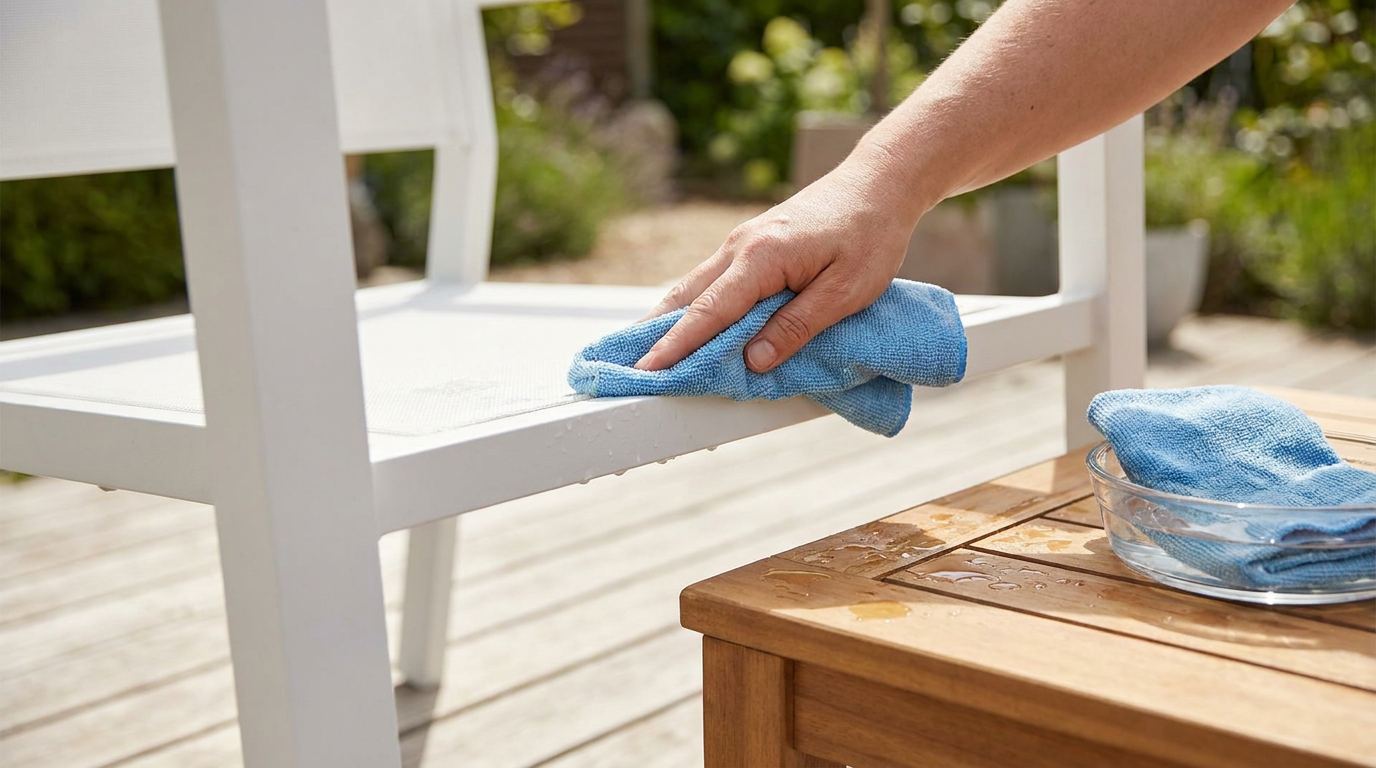
During months of regular outdoor use, a quick weekly wipe-down prevents most maintenance problems. Use a soft microfibre cloth with warm water and a few drops of mild dish soap (Dawn or Method work well; avoid heavy-duty degreasers). Wipe all surfaces including undersides, leg sections, and crevices around joinery. Rinse with a garden hose at low pressure, then dry with a clean microfibre cloth to prevent water spots — particularly important on darker powder-coat finishes where water spots show clearly.
Monthly deeper clean
Once a month — or after any notable weather event — do a deeper version of the routine. Same mild soap solution, but use a soft-bristled brush (a soft toothbrush works for fastener recesses) to lift dirt from joints, crevices, and any surface that's been collecting debris. Rinse thoroughly. The goal is to catch dirt and pollen before they embed into the powder-coat texture; pollen especially can leave staining if left on white or cream powder-coat for weeks.
The drying step matters more than competitors say
Most online articles mention drying as an afterthought. In QLD humidity it actually matters — powder-coat aluminium left wet attracts dust and develops water spots faster than aluminium dried promptly. A clean microfibre cloth and 30 seconds of effort makes a real difference to the long-term appearance. Don't put cushions back on, don't stack chairs, don't apply wax until the surface is fully dry.
The QLD seasonal calendar
Routine cleaning is the constant; the seasonal calendar dictates when to do the higher-effort interventions. Brisbane's climate breaks naturally into four phases, aligned with the broader QLD seasonal framework covered in our complete outdoor furniture guide for Brisbane and Queensland:
October — pre-summer prep window
The single most important annual care window. October combines dry weather, moderate humidity, and 4–6 weeks before storm season starts. The October checklist for aluminium outdoor furniture: full deep clean as per the monthly protocol; inspect powder-coat for any chips, scratches, or early failure points; touch up any chips with manufacturer-recommended touch-up paint; check stainless steel fasteners for movement and corrosion; remove foot caps from hollow-frame legs and drain any accumulated water; apply automotive wax with UV protection (the underused QLD habit, covered in detail below). Total time for a 6-piece dining set: 1.5–2 hours.
November–March — storm-season minimal handling
The wet season. Routine weekly cleaning continues; deep work pauses. Don't apply wax during this period — humidity affects cure quality. Watch for any powder-coat damage from storm-borne debris and address promptly with touch-up paint. Post-storm, check for water that may have entered hollow frame legs through breached foot caps; drain if needed. The storm-prep routine is covered in our storm protection guide.
April–May — post-wet-season recovery
Once the wet season ends, do a thorough deep clean to address any cumulative debris and inspect for damage that developed during storm season. April–May provides drying conditions and lower humidity than mid-summer. Optional touch-up wax application if the October coat is showing wear, particularly on highly exposed surfaces.
June–September — dry-season opportunity
Lowest-humidity months. Routine cleaning continues; if you missed the October wax application, this is a viable secondary window. Most aluminium furniture needs minimal intervention beyond routine care during winter — the bulk of care happens in October and the post-wet-season recovery period.
Extruded vs cast vs hollow — care nuances by construction
Most online articles bundle "aluminium patio furniture" as a single category. Three different construction types respond differently to cleaning and care, and recognising which type you have helps you apply the right care approach.
Extruded aluminium (lightweight, hollow profile)
The most common construction in budget and mid-range outdoor furniture. Hollow extruded sections joined with bolts or welds. Typically lightweight (3–5 kg per chair), uniform tube or square-profile shapes. Care nuance: water can enter hollow legs through breached foot caps and accumulate inside the frame. Remove foot caps annually (October prep window) to drain any accumulated water — this is genuinely important in QLD humidity, where trapped water inside frame legs accelerates internal corrosion that's invisible until the frame fails.
Cast aluminium (heavier, solid profile)
The material in higher-end outdoor furniture, particularly traditional and decorative styles. Aluminium poured into moulds creates more substantial pieces (5–8 kg per chair) with detailed shapes. Care nuance: cast aluminium typically has a textured or detailed surface where dirt accumulates in crevices. The monthly soft-bristle-brush cleaning matters more than for extruded pieces. Touch-up paint application on chips needs care to match the textured finish — flat painting on a textured surface is visible.
Hollow-tube aluminium with welded joints
The construction in commercial-grade and quality residential pieces. Welded (not bolted) aluminium sections eliminate moisture intrusion at joints. Care nuance: simpler than the other constructions because there are fewer water-trap points. Routine cleaning protocol fully applies; the foot-cap drainage check is still relevant if there are sealed hollow sections.
The four common problems and fixes
Most aluminium outdoor furniture problems fall into four categories. Each has a specific fix.
1. Powder-coat chips and scratches
Small chips and scratches expose the underlying aluminium to salt and moisture. Address them promptly to prevent corrosion from working under the surrounding finish. The fix: clean the affected area thoroughly with mild soap and water, allow to dry fully, lightly sand the chip edges with very fine 600+ grit sandpaper to feather the boundary, then apply manufacturer-recommended touch-up paint with a small artist's brush. Allow 24+ hours to cure. Most reputable manufacturers supply colour-matched touch-up paint — contact your supplier or check the original packaging. Touch-up paint for aluminium outdoor furniture isn't the same as automotive touch-up paint; specify outdoor-furniture grade.
2. Oxidation bloom (white powdery surface deposits)
White or chalky surface deposits on aluminium are oxidation — the protective oxide layer becoming visible after extended weathering. Light oxidation: make a paste of baking soda and warm water (3:1), apply with a soft cloth in circular motions, rinse thoroughly, dry. Heavier oxidation: use a specialised aluminium polish or fine automotive polish on a soft cloth, working in small sections. Avoid abrasive pads or steel wool — they'll remove the powder-coat along with the oxidation. Coastal SEQ properties see oxidation more frequently due to salt-air interaction; the protocols in our salt air and corrosion guide cover the broader coastal care framework.
3. Calcium spots (white mineral deposits)
White spotting that looks similar to oxidation but won't shift with baking soda paste is usually calcium deposits from hard water — common with garden-hose rinsing in some Brisbane suburbs. The fix: a 10% white vinegar / 90% water solution, applied with a soft cloth, allowed to sit 1–2 minutes, then rinsed thoroughly. Test on an inconspicuous area first to confirm the solution doesn't affect your specific finish. For persistent calcium buildup, dedicated calcium-and-lime removers from hardware stores work but should also be tested on inconspicuous areas first.
4. Contact-point damage from cushions or stacking
The hidden problem most articles never mention. Cushions left on aluminium frames in QLD humidity trap moisture between cushion and frame, accelerating powder-coat damage at contact points. Stacking chairs in storage causes similar damage at the points where chair legs sit on the seat below. The visible result is dulled or compromised powder-coat in patches that don't match the surrounding finish. Prevention: lift cushions occasionally to allow airflow underneath; use foam pads or cloth between stacked chair contact points; bring cushions inside during extended wet periods rather than leaving them on the frame in humidity. The cushion-on-aluminium consideration pairs with the broader cushion-handling content in our outdoor fabric guide.
The hidden water-drainage problem: Hollow aluminium frame legs can collect water through breached foot caps over time. Trapped water inside the frame accelerates internal corrosion that's invisible until the frame structurally fails. Annual foot-cap removal and drainage (October prep window) prevents this entirely. Most aluminium frame failures in QLD trace to this single overlooked maintenance step.
The October wax application — the underused QLD habit
Most generic care content mentions waxing aluminium furniture as an optional maintenance step. In QLD conditions specifically, an annual wax application in October pays off significantly — it adds a UV barrier, repels salt and moisture, and slows the powder-coat dulling that drives most mid-life finish failures.
Product choice
Quality automotive paste wax with UV protection is the right product. Products like Meguiar's Quik Wax, Turtle Wax with carnauba, or equivalent automotive-grade waxes work well on outdoor furniture powder-coat. Avoid furniture polishes and traditional furniture waxes — they're formulated for indoor use and don't provide UV protection. Avoid spray waxes claiming "all-surface" use without specific UV protection language.
Application technique
The piece must be fully clean and dry before wax application. Apply a small amount of wax to a clean microfibre cloth (not directly to the furniture surface), work in sections with circular motions, then buff with a separate clean microfibre cloth before the wax fully dries. The goal is a thin even coating; heavy application creates visible streaks and looks worse than no wax at all.
Timing and coverage
Apply in October before peak summer UV begins. Allow 24+ hours of dry weather for the wax to cure properly before any rain exposure. For most pieces, one annual application suffices; coastal SEQ properties or pieces in fully-exposed positions benefit from a second application in April after the wet season. A typical 6-piece dining set takes 30–45 minutes to wax with proper technique.
What waxing actually does
Quality paste wax with UV protectant adds three things: a UV barrier that slows powder-coat fade and chalking; a hydrophobic surface that sheds water and reduces water spotting; and a barrier against salt deposition that makes the routine cleaning easier. None of these is dramatic individually — but cumulatively, waxed aluminium furniture in QLD typically maintains a fresher appearance for 3–5 years longer than equivalent unwaxed pieces. The cost is $15–$30 of automotive wax and 30–45 minutes per year.
What not to use — the safety list
The wrong cleaner can damage aluminium powder-coat permanently. The list of things to avoid is short but important:
- Strong acids — particularly hydrofluoric acid, sulphuric acid, or any acid-based cleaner not explicitly safe for aluminium. Strong acids react with the metal and create permanent etching or discolouration.
- Strong alkalines — sodium hydroxide (caustic soda), oven cleaners, and heavy-duty degreasers can dull or damage the powder-coat finish over time.
- Bleach (sodium hypochlorite) — the powerful oxidising elements in bleach can dull aluminium powder-coat or cause permanent damage, particularly on darker finishes. Don't use bleach on aluminium outdoor furniture even at the dilutions appropriate for other materials.
- Abrasive cleaners and pads — Comet, Ajax, scouring powders, and abrasive sponges scratch the powder-coat surface. The damage isn't always immediately visible but accumulates with repeated use.
- Steel wool — even fine steel wool leaves microscopic steel particles embedded in the powder-coat surface. Those particles rust later, leaving rust-coloured spotting on the aluminium that's much harder to address than the original problem.
- Pressure washers at high pressure — over 1,500 PSI can drive water past the powder-coat and into seams or joints. Low-pressure rinsing (under 1,500 PSI, ideally under 1,000) is fine; aggressive pressure-washing causes problems.
- Wire brushes — for the same reason as steel wool. Use soft-bristled brushes only.
- Magic eraser melamine pads — the mild abrasive can dull powder-coat finish over repeated use. Reserve for genuinely stubborn marks where the finish damage is acceptable.
The mild-soap-and-water default
For 95% of aluminium outdoor furniture cleaning needs in QLD, mild dish soap (Dawn, Method, or equivalent) with warm water and a soft cloth or soft-bristled brush handles the work without any of the risks above. Reserve specialised cleaners for specific problems (oxidation, calcium spots) and reach for them only when the problem doesn't respond to the default protocol.
FAQs
-
How often should I clean aluminium outdoor furniture?
Weekly during heavy use periods, monthly during periods of less use. Weekly cleaning is a quick wipe-down with mild soap and water using a soft microfibre cloth, focusing on visible dirt and any pollen accumulation. Monthly cleaning is the deeper version — same products plus a soft-bristled brush for joints and crevices. Add the October pre-summer prep window for the annual deep clean plus wax application, plus April–May post-wet-season recovery cleaning. Coastal SEQ properties may need more frequent rinsing during onshore wind periods to remove salt deposits — see our salt air and corrosion guide for the exposure-tier framework.
-
Can I use a pressure washer on aluminium outdoor furniture?
At low pressure, yes — under 1,500 PSI, ideally under 1,000 PSI for routine cleaning. Use a wide spray nozzle (40-degree minimum), keep at least 30cm distance from the surface, and work with the grain of any joints. Higher pressure can drive water past the powder-coat into seams and joints, where it accumulates and accelerates corrosion. For routine cleaning, garden-hose rinsing at low pressure is sufficient and pressure washing is overkill. Reserve pressure washing for the deeper post-wet-season clean or for restoration work on neglected pieces. Don't pressure-wash already-damaged powder-coat — water will work under the lifting finish and accelerate the damage.
-
How do I remove oxidation from aluminium outdoor furniture?
For light oxidation (white powdery surface deposits), make a paste of baking soda and warm water (3 parts baking soda to 1 part water), apply with a soft cloth in circular motions, rinse thoroughly, then dry. For heavier oxidation, use a specialised aluminium polish or fine automotive polish on a soft cloth, working in small sections. Avoid abrasive pads, steel wool, or wire brushes — they'll remove the powder-coat along with the oxidation. After successful oxidation removal, apply a coat of automotive wax with UV protection to slow the return. Coastal SEQ properties see oxidation more frequently due to salt-air interaction; routine fresh-water rinsing prevents most oxidation development before it requires removal.
-
Why is my powder-coat aluminium chipping or peeling?
Powder-coat damage usually has three causes: physical impact (chair legs hitting walls, dropped items, transport damage); poor preparation during manufacturing (powder-coat that wasn't properly bonded to the aluminium underneath, which fails at edges and high-stress points); or salt-air corrosion working under a chipped or scratched finish. For small chips with bonded surrounding finish, manufacturer touch-up paint addresses the problem. For widespread peeling, lifting, or bubbling, the powder-coat has likely failed across the piece — full restoration (sandblasting and re-powder-coating) or replacement is the practical answer. Quality marine-grade powder-coat with proper preparation handles SEQ conditions for 10+ years; if your piece is failing within 2–3 years, it's likely budget paint-on finish that wasn't a true powder-coat application.
-
Should I wax aluminium outdoor furniture?
Yes, particularly in QLD conditions. An annual wax application with quality automotive paste wax with UV protection — products like Meguiar's Quik Wax, Turtle Wax with carnauba, or equivalent — adds three meaningful protections: a UV barrier that slows powder-coat fade, a hydrophobic surface that sheds water and reduces water spotting, and a barrier against salt deposition that makes routine cleaning easier. Apply in October before peak summer UV begins. The piece must be fully clean and dry before application. Use thin even coats applied with a microfibre cloth; buff with a separate clean cloth before the wax fully dries. A typical 6-piece dining set takes 30–45 minutes; the cost is $15–$30 of automotive wax. Cumulative effect: waxed aluminium furniture in QLD typically maintains fresher appearance 3–5 years longer than unwaxed.
-
How do I clean cast aluminium outdoor furniture differently from extruded?
The basic protocol is the same — mild soap, warm water, soft cloth or soft-bristled brush, rinse, dry. The differences are in the details. Cast aluminium typically has textured or detailed surfaces where dirt accumulates in crevices, so the monthly soft-bristled brush cleaning matters more than for extruded pieces. Cast aluminium touch-up paint application needs care to match the textured finish — flat painting on a textured surface is visible from any angle. Extruded aluminium typically has hollow legs where water can accumulate through breached foot caps; the annual foot-cap removal and drainage check matters more than for solid cast pieces. Both constructions benefit equally from the annual October wax application.
Quality aluminium outdoor furniture for QLD conditions
Quality aluminium outdoor furniture rewards the routine care you put into it — but the care routine is genuinely lighter than for timber or fabric pieces, and the long-term result is one of the most QLD-suitable outdoor furniture choices available. All five of our South East Queensland showrooms — Rocklea, North Ipswich, Sandgate, Bundall, and Beenleigh — carry quality aluminium outdoor pieces matched to QLD conditions, and our team can talk through the construction grade specifics and care recommendations for any piece in our range. Free local delivery applies across Greater Brisbane and SEQ on eligible orders.
Shop the range
Ready to buy? Browse the matching outdoor collections: