
Colour & Pairing · The Furniture Canvas
There are three honest answers to "what colour dining chairs go with a wooden table": buy the chairs designed for that table, contrast on purpose, or mix two seat types deliberately. Here is how our showroom team decides.

The short version. Read the timber's undertone first. Warm honey and oak tops take cream, tan, olive and camel; cool or grey-brown tops take charcoal, grey, navy and white. Then commit to one strategy — matching range, deliberate contrast, or a considered mix.
In this guide
Read the timber's undertone first
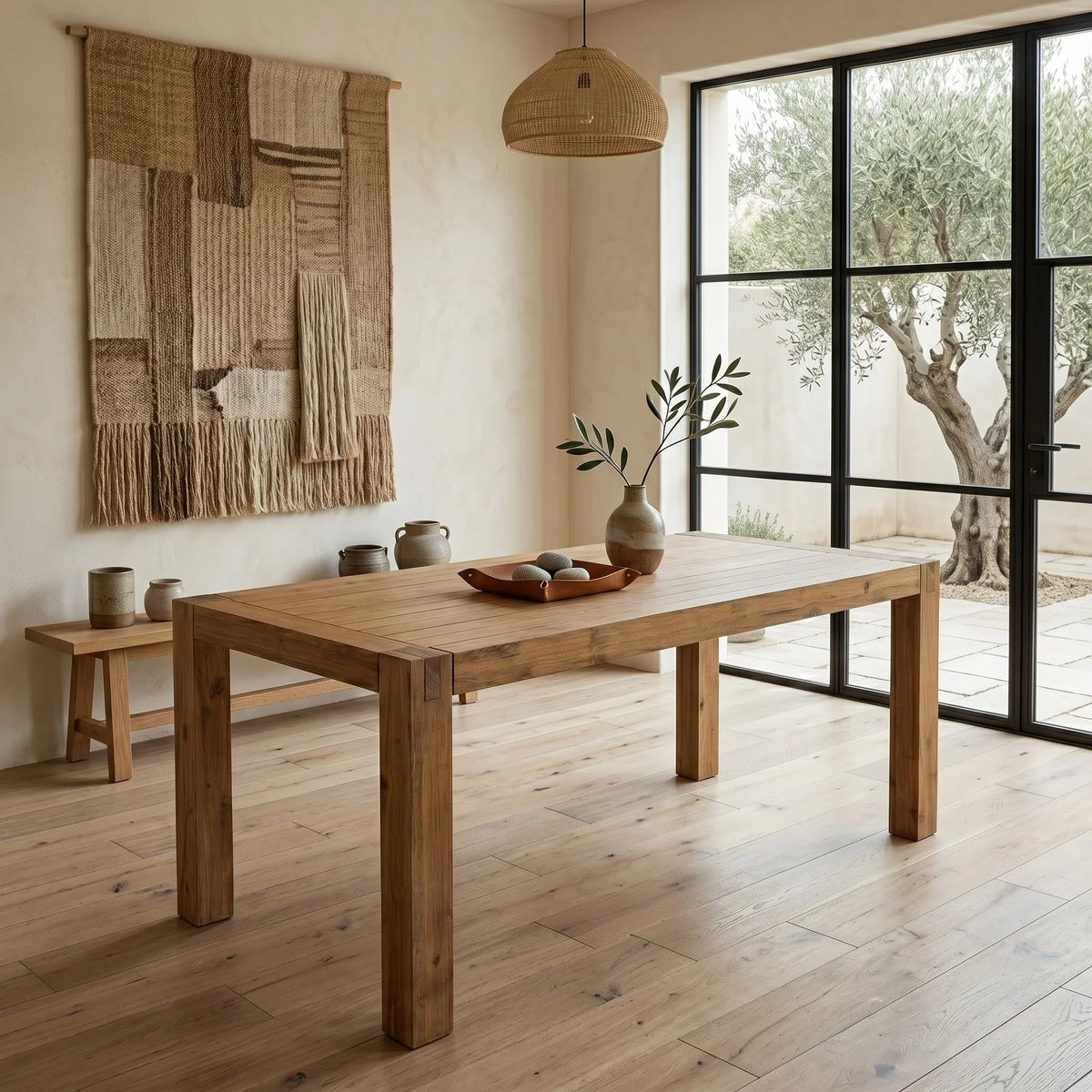
Before you look at a single chair, work out whether your tabletop runs warm or cool. It is the most useful idea here and almost nobody does it. Timber is never simply "brown" — warm timbers lean golden, honey or faintly red; cool timbers lean grey, ashy or taupe, and two tables both described as oak can sit at opposite ends of that range.
Lay plain white A4 paper flat on the tabletop in daylight; against true neutral the bias jumps out. Golden or slightly orange means warm, dusty or slightly green means cool. Can't tell? It's a neutral mid-brown, and your choice is wide open. Undertone, not depth of colour, is what makes a chair look like it belongs.
A Queensland note. Do the test at the time of day you actually eat. Late western light pushes timber warmer than it looks at 10am, so a chair chosen under showroom lighting reads differently over dinner.
Strategy one: the matching set
The least fashionable answer is the most reliable: buy the chair designed alongside the table. Our range has real matched pairs, not just "goes-with" suggestions. The Jayden Dining Table and the Jayden Dining Chair are one range in the same timber colourway; the Homestead Dining Table and the Homestead Dining Chair are the same story. Buying within a range removes the guesswork on both timber tone and proportion.

Assemble that look from separate ranges and it goes wrong twice. Timber finishes rarely land on the same tone, and a near-miss is worse than obvious contrast — the eye reads it as a mistake. And a chair back too tall for the tabletop looks wrong even when the colour is perfect.
Strategy two: deliberate contrast
This is what most people actually want — a timber table with upholstered or black chairs. The principle: contrast in colour, agree in temperature. The chair should differ clearly from the top in depth or material, but stay on the same side of the warm/cool line.
Faux leather is the workhorse. The Davidson Dining Chair brings a decorative silhouette; the Drome Dining Chair a black-and-gold colourway that reads like jewellery against plain timber. Both separate the seating from the table so the table becomes the hero.
Two guardrails. Keep the contrast decisive — a chair two shades off the top reads as a failed match, so go clearly lighter, darker, or a different material. And repeat the chair colour somewhere small: a pendant, a frame, a sideboard leg. One appearance is an accident; two is a scheme. Browse the dining chair range with that in mind.
Strategy three: mix the seating
Mixing means a bench along one side with chairs opposite, or two different chairs at the ends. Done well it's the warmest of the three looks; done carelessly it reads as furniture that arrived at different times.
The rule that separates them: one element must repeat across every seat. Pick one thing all the seating shares — timber tone, leg finish, upholstery colour or frame material — and let everything else differ. A bench and upholstered chairs work when the bench timber matches the table; it looks accidental when three variables move at once. Our dining chair collection includes bench seating, so you can stand the two together and check before committing to eight of anything.

Chair colours for each timber tone
Warm honey, light oak and golden timber
The top is already doing the warming, so the chairs can be quiet: cream, oatmeal, soft white, tan or camel faux leather, olive and warm greige. Black works if the profile is slim — a heavy black chair on a light warm top feels severe in a small room. Avoid cool blue-grey, which goes flat against golden timber.
Mid-brown and neutral timber
The most forgiving top there is. Charcoal, grey, cream, tan, black and most mid-tones work, so let the room decide rather than the table — match the strongest of your flooring, window frames and cabinetry.
Dark walnut, espresso and deep brown
Dark timber needs relief or the corner of the room closes in. Cream, oatmeal, light grey and pale timber chairs all lift it. All-dark can look excellent, but it needs a big, bright room and pale walls.
The Dell Dining Table is a useful example: a rustic table listed in both black and brown, so one piece holds a dark element and a timber one. When the table already contains black, a black-legged chair reads as a repeat, not an import.
Black chairs — and when they're wrong
Black is the default answer for good reason: it behaves like an outline rather than a colour, disappears against most flooring, and ties to the black already in the room — window frames, tapware, a pendant.
It's genuinely wrong in three situations. In a small or dim room, black chairs carry real visual mass and eight of them make the space read smaller. On a very dark tabletop with nothing pale nearby, table and chairs merge into one block. And in a coastal or Hamptons scheme, black is a hard edge in a palette built on white, pale timber and blue-grey. There's a subtler failure too: if black appears nowhere else, the chairs look imported from another house. Count the black objects visible from the table — fewer than two, and either add one or choose a different chair.
Fabric, legs and visual weight
A dining chair lives where food is served, so fabric is practical before it is aesthetic — and the frame under it has to agree with the table.
- Faux leather wipes clean. That's why it dominates family tables — a spill sits on the surface long enough to wipe off, and there's no pile to crush. See our faux leather dining chairs.
- Tight weaves beat loose ones. Flat, tightly woven fabric gives crumbs nowhere to lodge; open textures, chunky bouclé, deep buttoning and raised piping all trap them.
- Mid tones hide the most. Very pale fabric shows every mark; very dark shows dust and lint. Texture in the weave is the most forgiving surface under a family.
Weight matters as much as colour. A chunky table with thick square legs, a trestle base or a solid pedestal needs chairs with real presence — a thin wire-frame chair looks like scaffolding beside it. The Homestead Dining Table and its matched chair show two weights agreeing. The reverse is just as true: a table on slim, tapered legs is swamped by over-stuffed carvers. Check the frame too — corner legs restrict where chairs sit, and arms only tuck in if they clear the apron.
Hamptons and coastal pairings
Hamptons is the one scheme where chair colour is close to prescribed: white or off-white frames, pale timber, linen and rattan textures, with soft blue-grey as the accent rather than the base. Against a warm honey or pale timber table it's effortless; against espresso it needs work — bring white back in volume, or the chairs look stranded.
The Jericho Dining Chair is our Hamptons-style timber chair, and it sits in the Hamptons dining chairs collection alongside the Jayden and Homestead chairs. That overlap is the shortcut: chairs that work as a matched set also read correctly in a coastal scheme. Keep timber tones within one family and let texture carry the interest — coastal schemes fail by adding a competing timber tone, not by lacking colour.

How many chairs, and the air around them
No numbers table here: the number that matters is what your room allows, not what the table is rated for.
- Seated people need to get out. If someone must tuck right in for another to pass behind, the room is over-seated.
- Chair backs shouldn't touch. If the backs meet when every chair is tucked in, that side has one chair too many.
- Under-seat rather than over-seat. A table that seats the family comfortably every night and borrows spares at Christmas beats one crowded all year.
- Round tables are more generous. With no corners or fixed settings, a round table absorbs an extra person gracefully.

Shop the range
Pair your table and chairs in one place:
Beside a kitchen island, decide chairs and stools together — our guide to matching barstools to your home decor covers that overlap, and for a darker palette, black and gold dining furniture is the next read. Ask which of our five showrooms has these wooden dining tables on display: Rocklea, Virginia, North Ipswich, Bundall and Beenleigh.
Dining chair pairing FAQs
Do dining chairs have to match the wooden table?
No, but they must relate to it deliberately: buy the chair made for that table, contrast clearly, or mix two seat types with one shared element. What fails is a near-match — the eye reads it as a mistake.
How do I tell if my timber table is warm or cool?
Lay plain white A4 paper flat on the tabletop in daylight. Against true white, warm timber looks golden or faintly orange and cool timber grey or ashy. If you can't pick a bias, it's a neutral mid-brown — the most flexible top of all.
Are black dining chairs always a safe choice?
Usually, but not always. Black is wrong in a small or dim room where its mass closes the space in, on a very dark tabletop with nothing pale nearby, and in a coastal or Hamptons scheme where it is too hard an edge.
Which dining chair fabric suits a family that eats at the table?
Faux leather, because spills sit on the surface long enough to wipe off and there is no pile to crush. If you prefer fabric, choose a tight, flat weave and a mid tone.
Can I buy a dining table and matching chairs from the same range?
Yes. Some ranges span both categories — the Jayden Dining Table has a Jayden Dining Chair in the same timber colourway, and the Homestead Dining Table has a matching Homestead Dining Chair. That removes the guesswork on timber tone and proportion.
What chair colour suits a dark walnut or espresso dining table?
Dark timber needs relief, so cream, oatmeal, light grey and pale timber chairs all lift it. A dark chair on a dark table can look excellent, but it needs a large, bright room and pale walls.
Can I mix a bench with dining chairs?
Yes, as long as one element repeats across every seat — timber tone, leg finish, frame material or upholstery colour. It looks deliberate when the bench timber matches the table.
Written by the A2Z Furniture team — five South-East Queensland showrooms, family-owned and operated since 2013. Last updated September 2026.