
Buying Guide · Dining & Lounge
Outdoor dining sets and outdoor lounge configurations are the two highest-revenue, highest-consequence purchases most outdoor buyers make in Australia. Decisions wrong in either category compound to significant lifecycle cost — a poorly-chosen $5,000 dining set replaced after 3 years versus a well-chosen $5,000 set lasting 15 years is the difference between a $25,000 long-term spend and a $5,000 one. This guide covers the specific decisions for each category (seat count, table material, chair style for dining; configuration type, modular vs fixed, fabric for lounge), the modular versus fixed framework most articles skip, the frame material matrices for each category, and the coordination decisions for buyers needing both. For the broader Australian buying framework, see our outdoor furniture buying guide for Australia.
Dining and lounge — the foundational outdoor furniture decisions
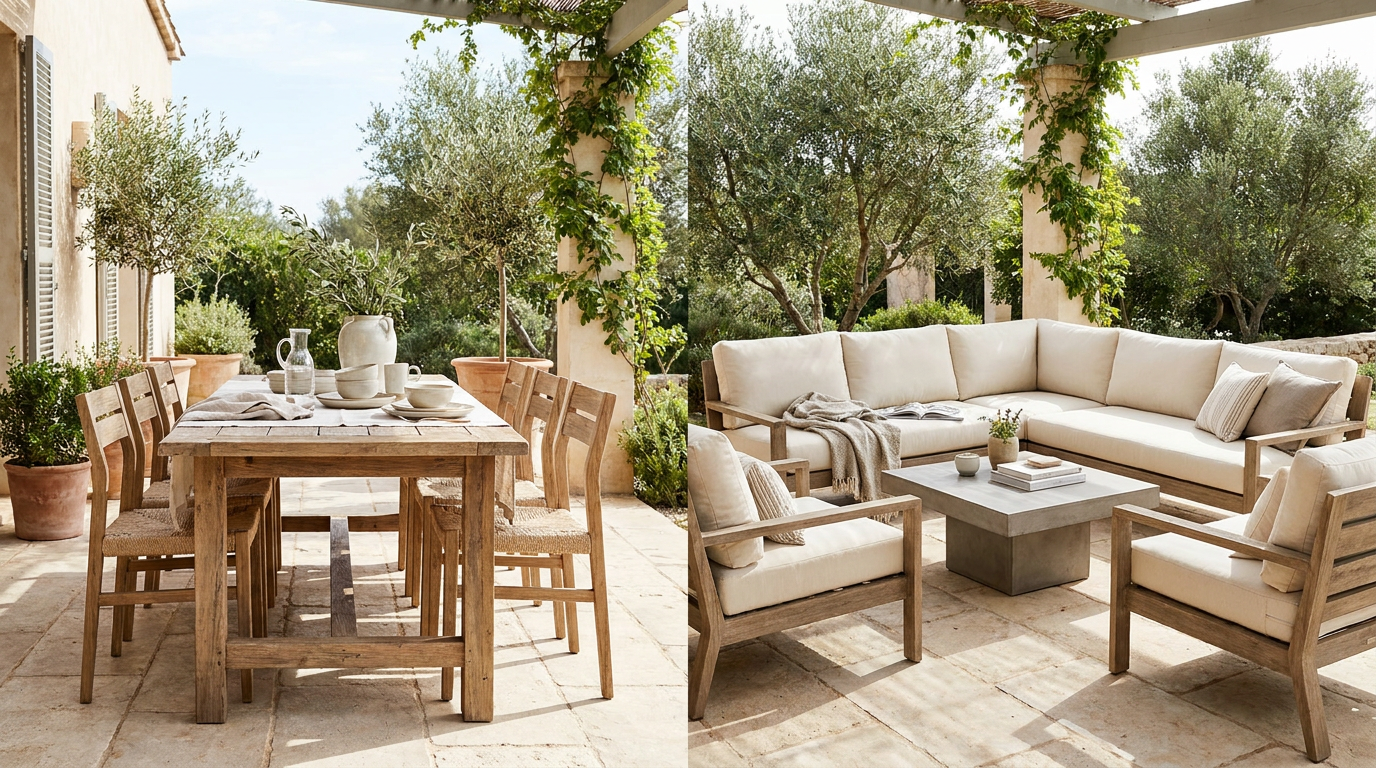
Most Australian outdoor furniture buyers eventually need both a dining configuration and a lounge configuration — they serve genuinely different uses. Dining sets support shared meals, family entertaining, and gatherings around food. Lounge configurations support relaxation, casual conversation, drinks, reading, and general unwinding. The two categories don't substitute for each other; outdoor spaces with only one feel functionally incomplete for properties that genuinely use the outdoor space.
The sequencing decision — which to buy first
Buyers who entertain regularly (dinner parties, family meals, hosting groups) typically benefit from buying the dining set first — it serves the most-frequent entertaining function and sets the property's style direction. Buyers who use outdoor space primarily for relaxation (reading, drinking coffee, casual conversation, sunbathing) typically benefit from buying the lounge configuration first. Properties with both daily use cases often benefit from buying simultaneously to ensure coordination from day one.
The investment scale
Quality outdoor dining sets in Australia typically run $1,500–$8,000 across the mid-range to premium tiers; quality lounge configurations $2,500–$15,000. Properties needing both should plan $4,000–$20,000+ across the categories. The lifecycle cost favours quality — budget pieces requiring replacement every 2–3 summers compound to multiples of the initial saving over 10–15 years. Quality pieces with proper care last 8–25 years across the tier ranges.
Choosing your outdoor dining set
Three decisions determine the right dining set: seat count, table material and shape, chair style.
Seat count and set size
| Seat count | Typical table dimensions | Floor area needed | Best for |
|---|---|---|---|
| 2-seater (bistro) | 0.6–0.8m diameter round | 2m × 2m minimum | Apartment balconies, small courtyards, breakfast nooks |
| 4-seater | 1.2–1.4m diameter round, or 1.4m × 0.9m rectangular | 3m × 3m (square) or 3.2m × 3.2m (round) minimum | Couples, small families, compact patios |
| 6-seater | 2m × 1m rectangular | 3.8m × 3m minimum | Standard family entertaining, mid-sized patios |
| 8-seater | 2.4m × 1m rectangular | 4.2m × 3m minimum | Larger families, regular entertaining |
| 10+ seater | 2.8m+ × 1m rectangular, often with extension | 4.6m+ × 3m minimum | Entertainer homes, frequent large gatherings |
Per-person table allowance: 60cm of table edge per person is the comfort minimum; 70–80cm is more relaxed. Round tables seat 4–6 in less floor area than rectangular tables of equivalent capacity. Extendable tables solve the everyday-versus-entertaining trade-off — collapsed for daily use, extended for gatherings. The full sizing framework is in our how to measure and size outdoor furniture guide.
Table material and shape
Dining tables face heavy daily use, food and drink spills, sun exposure on the tabletop, and weight loading from food service. Material decisions reflect these demands:
- Quality teak — warm timber aesthetic, ages to silver patina, naturally weather-resistant, premium aesthetic. Requires occasional oiling to maintain colour or accept the silvering.
- Powder-coated aluminium — lightweight, maintenance-free, available in multiple finishes (white, charcoal, espresso). Best for buyers prioritising low maintenance over warmth of timber.
- Ceramic top with aluminium frame — heat-resistant, scratch-resistant, easy to clean, contemporary aesthetic. Dark ceramic tops can heat up significantly in direct sun (umbrella shade matters); white or light tops can create glare.
- Tempered glass top — sleek modern look but shows fingerprints and dust quickly outdoors; requires more cleaning than other tops.
- HDPE polywood — weather-resistant, fade-resistant, no maintenance, modern aesthetic. Good for full-exposure positions.
Shape considerations: round tables work better in narrow spaces and smaller seat counts (4–6); rectangular tables maximise capacity in given floor area for 6+ seaters; square tables work well at 4-seater and 8-seater extension scales. The hardwood comparison framework that informs timber table choice is in our hardwood comparison guide.
Chair style — armchair, armless, mix-and-match
Chair style decisions affect both daily comfort and visual proportion. Armchairs offer more comfort for extended use but take more space and typically can't push fully under the table. Armless chairs (or chairs with arms below table apron height) push under cleanly but offer less comfort for long meals.
The mix-and-match approach — armchairs at the table ends (where the carver positions are typically used by hosts) and armless chairs along the sides — captures the comfort advantage at the head positions and the space-efficiency advantage along the sides. Bench seating along one side of a rectangular table works for casual family settings and reduces visual clutter; bench seating loses the back support most armless chairs provide.
Confirm armrest height against the table's apron frame. Standard outdoor tables have aprons at 66–70cm from floor; armrests above this height won't tuck under the table cleanly. The standard outdoor seat height is 45cm, table height 74–76cm, giving 28–32cm seat-to-tabletop clearance for chair pull-out.
Choosing your outdoor lounge configuration
Lounge configurations are about relaxation and conversation. The decisions: configuration type, seat count, comfort priorities.
Configuration types
| Configuration | Floor area needed | Conversation style |
|---|---|---|
| 2-piece (sofa + armchair, or armchair pair) | 2.5m × 3m minimum | Intimate, 2–3 person conversation |
| 3-piece (2-seater sofa + 2 armchairs) | 3m × 3m minimum | Standard family or small group |
| 4-piece (3-seater sofa + 2 armchairs + coffee table) | 3m × 3.5m minimum | Hosting-friendly, 5–7 person comfortable |
| L-shape modular sectional | 3.5m × 4m minimum | Large group conversation, watching media together |
| U-shape modular sectional | 4m × 4m minimum | Entertainer scale, large groups, focal-point seating |
| Daybed (single feature piece) | 2.5m × 2.5m for daybed alone, plus circulation | Solo or pair relaxation focus, sun-exposure positioning |
Comfort decisions
Lounge furniture is judged on long-term comfort, not initial appearance. Sit in candidate pieces for at least 5–10 minutes before purchasing — comfort issues that don't appear in 30-second showroom tests become apparent over longer use. Test for: seat depth (50–55cm typical, deeper for resort-style lounging); back angle (slight recline beats vertical for relaxation); cushion firmness (medium-firm holds shape better than soft over years of use); arm height matched to your shoulder line for relaxed support.
Higher-end lounge pieces use reticulated quick-dry foam interiors that drain rapidly after rain rather than absorbing water. Budget pieces often use traditional Dacron foam that holds water and can develop mould interior. Quality fabric pairings (covered in the cushions section below) compound the difference.
Modular vs fixed — the configuration decision
The single most important lounge decision after seat count is whether to buy a modular configuration (separate pieces that combine and reconfigure) or a fixed configuration (one-piece sectional or rigidly joined sofa). Most articles barely address this; it's one of the most consequential outdoor lounge decisions.

Decision criteria — modular vs fixed
| Situation | Modular advantage | Fixed advantage |
|---|---|---|
| Constrained delivery access | Strong — pieces ship and move separately through narrow doorways and lifts | Weak — large rigid sectionals often won't fit through standard 80–90cm doorways |
| Future configuration changes | Strong — reconfigure for different uses, gatherings, future home moves | Weak — committed to single configuration |
| Replacement parts availability | Strong — individual cushions and pieces replaceable | Variable — depends on manufacturer support, limited by frame design |
| Visual cohesion | Variable — gaps between pieces visible, requires alignment discipline | Strong — seamless single-unit aesthetic |
| Maximum comfort | Variable — gaps between pieces interrupt extended-lounging positions | Strong — continuous seating supports stretching out and lounging across |
| Storage flexibility | Strong — disassembles for off-season storage or storm-season relocation | Weak — single large piece needs equivalent storage space |
The hybrid that suits most Australian buyers
Multi-piece sets — separate sofa plus separate armchairs plus separate coffee table — split the difference. They ship and move more easily than rigid sectionals, allow some reconfiguration, support replacement of individual pieces, but sacrifice some of the seamless-conversation advantage of true modular sectionals. For most Australian buyers without specific access constraints or specific reconfiguration needs, multi-piece sets are the practical default.
True modular sectionals (where individual seat units connect via clips or brackets) are the right answer for: buyers facing apartment access constraints (covered in our Brisbane apartments and small spaces guide), buyers expecting future home moves or property changes, and entertainer homes wanting U-shape or L-shape flexibility for different gathering sizes.
Fixed sectionals (one-piece or rigidly joined) are the right answer for: properties with confirmed access (delivery dimensions verified), buyers prioritising seamless visual cohesion and maximum lounging comfort, and substantial alfresco zones where the configuration won't change.
Frame materials across both categories
Frame material decisions differ between dining and lounge applications because the use cases are different. The cross-reference matrix:
| Material | Dining table application | Dining chair application | Lounge frame application |
|---|---|---|---|
| Marine-grade powder-coated aluminium | Best — versatile, lightweight, low-maintenance | Best — comfortable, durable, multiple finishes | Best — frame longevity, multiple cushion compatibility |
| Quality teak | Best — premium aesthetic, ages gracefully, durable | Good — premium look, heavier than aluminium | Good — premium aesthetic, requires care |
| Synthetic HDPE wicker | Limited — typically integrated with aluminium frame | Good — comfortable, resort-style aesthetic | Best — resort-style lounge configurations, comfortable |
| HDPE polywood | Good — modern aesthetic, full-exposure tolerant | Good — durable, modern look, no maintenance | Limited — less common as lounge frame material |
| Powder-coated steel | Good — heavier, weighted feel | Good — substantial feel, traditional aesthetic | Limited — usually for specific traditional styles |
The material recommendations across both categories converge on aluminium and teak as primary frame defaults, with synthetic HDPE wicker the right answer for resort-style lounge aesthetics. The full aluminium framework is in our aluminium outdoor furniture guide; the broader Brisbane and Queensland framework is in our complete outdoor furniture guide for Brisbane and Queensland.
The cross-category material reality: Buyers needing both dining and lounge benefit from choosing frame materials that coordinate visually. Powder-coated aluminium in matching finish (white, charcoal, espresso) across both categories supports visual cohesion across the property. Mixing teak dining with aluminium lounge can work but requires more aesthetic discipline; mixing teak dining with synthetic wicker lounge often works because the textures complement.
Cushions and fabrics — what actually matters
Cushion quality determines how outdoor furniture feels day-to-day and how long it lasts visually. Three factors matter: fabric specification, foam quality, and removability.
Fabric specifications
Outdoor cushion fabric falls into three quality tiers. Quality solution-dyed acrylic (Sunbrella, Outdura, or equivalent) is the premium specification — UV-resistant for 5–8+ years, fade-resistant, water-resistant, easy to clean. The colour is dyed throughout the fibre rather than printed on the surface, so fading happens slowly and evenly. Quality solution-dyed olefin sits at the mid-range — similar UV resistance, slightly different texture and price point. Standard polyester is the budget tier — fades and degrades within 1–3 summers in Australian conditions, particularly in pool zones and full-exposure positions. The full fabric framework is in our outdoor fabric guide.
Foam quality
Cushion interiors matter as much as fabric. Reticulated quick-dry foam has open-cell structure that drains rapidly after rain — water flows through rather than absorbing. Traditional Dacron foam absorbs water and can develop mould interior in extended wet exposure. Quality outdoor cushions use reticulated quick-dry foam at 8–12cm thickness; budget cushions often use thinner traditional foam that compresses faster and holds water.
Removable covers
Removable cushion covers are practically essential for Australian outdoor furniture. They allow machine washing for cleaning food spills, sunscreen residue, and general wear; they support replacement of single damaged covers without replacing entire cushions; they enable seasonal storage of the covers separately from the cushion interiors. Cushions without removable covers commit the buyer to full cushion replacement when any single cover is damaged — a significantly higher lifecycle cost.
The full cushion-handling framework, including cleaning protocols and storage, is in our outdoor cushion care guide.
Coordinating dining and lounge in the same property
Properties with both a dining set and a lounge configuration face a coordination decision: should the two categories match, or should each be optimised independently?
The matched-across-categories approach
Single style direction applied to both — same frame finish (e.g. white powder-coated aluminium throughout), complementary cushion palette (sandy neutrals, navy accents), consistent material direction. Visual benefit: the property reads as cohesive when both categories are simultaneously visible (common from elevated indoor positions looking out across the alfresco). Practical benefit: simpler buying decision, often available as coordinated ranges from a single retailer.
The category-specific approach
Each category gets the materials and configurations that suit its specific demands. Dining gets quality teak top with aluminium chairs; lounge gets synthetic HDPE wicker for resort-style comfort. Visual benefit: each category performs and looks appropriate for its function. Practical drawback: requires more aesthetic discipline to maintain visual coherence.
The hybrid recommendation
Most Australian buyers benefit from shared colour palette and shared material temperature across categories with function-appropriate configurations within each. A property might choose warm white frames as the consistent finish — applied to dining table, dining chairs, and lounge sofa — with cushion colours coordinating across categories but configurations matching each function. The same coordination framework applies more broadly across multi-zone properties (pool, alfresco, outdoor kitchen) — covered in detail in our pool, alfresco and outdoor kitchen furniture guide.
The space-specific routing
Different Brisbane home types call for different category emphasis. Apartments often skew toward smaller dining configurations with compact lounge pairs; suburban patios and decks support full coordinated dining and lounge zones; entertainer homes need both at substantial scale. The space-by-space framework is in our outdoor furniture by space guide.
FAQs
-
How do I choose between an outdoor dining set and an outdoor lounge?
Most Australian outdoor buyers eventually need both — they serve genuinely different uses. Dining sets support shared meals and entertaining; lounge configurations support relaxation, conversation, and unwinding. The sequencing question matters more than the choice. Buyers who entertain regularly typically benefit from buying the dining set first; buyers who use outdoor space primarily for relaxation typically benefit from the lounge first. Properties with daily use of both often benefit from buying simultaneously to ensure coordination from day one. Budget allocation typically splits 40-60% dining to 60-40% lounge across mid-range to premium tiers.
-
How many people should my outdoor dining set seat?
Match seat count to your typical entertaining pattern plus modest expansion capacity. Couples without regular hosting typically suit 4-seater configurations (1.2-1.4m round or 1.4m × 0.9m rectangular tables, 3m × 3m floor area). Standard family entertaining suits 6-seaters (2m × 1m rectangular, 3.8m × 3m floor area). Regular larger gatherings or family-of-six setups suit 8-seaters (2.4m × 1m, 4.2m × 3m floor area). For occasional larger entertaining, an extendable table that collapses to smaller everyday configuration captures both use cases. Allow 60cm minimum table edge per person; 70-80cm is more comfortable for relaxed dining.
-
What's the best material for an outdoor dining table in Australia?
Quality teak is the premium answer — warm timber aesthetic, ages gracefully to silver patina, naturally weather-resistant, durable for 20+ years with care. Powder-coated aluminium is the most versatile answer — lightweight, maintenance-free, available in multiple finishes (white, charcoal, espresso). Ceramic top with aluminium frame is contemporary and easy to clean but watch heat absorption on dark tops in direct sun. Tempered glass shows fingerprints and dust quickly outdoors. HDPE polywood works for full-exposure modern looks. The right choice depends on your aesthetic preference and maintenance tolerance — teak for warmth at higher maintenance, aluminium for low maintenance with multiple style options, ceramic for contemporary easy-clean.
-
Should I buy a modular outdoor sofa or a fixed configuration?
True modular sectionals win on access (separate pieces fit through narrow doorways and lifts), reconfiguration flexibility, replacement parts, and storage. Fixed sectionals win on visual cohesion (seamless single-unit aesthetic) and lounging comfort (continuous seating supports stretching out). Multi-piece sets — separate sofa plus armchairs plus coffee table — split the difference and suit most Australian buyers without specific access constraints. Choose true modular for apartments, future home moves, and entertainer homes wanting U-shape or L-shape flexibility. Choose fixed for confirmed access, prioritising seamless aesthetic, and substantial alfresco zones where configuration won't change. Multi-piece sets are the practical default for most.
-
What cushion fabric should I look for on outdoor furniture?
Quality solution-dyed acrylic (Sunbrella, Outdura, or equivalent) is the premium specification — UV-resistant for 5-8+ years, fade-resistant, water-resistant, easy to clean. The colour is dyed throughout the fibre rather than printed on the surface, so fading happens slowly and evenly. Quality solution-dyed olefin sits at the mid-range — similar UV resistance at slightly different price point. Standard polyester is the budget tier — fades and degrades within 1-3 summers in Australian conditions. Always check the fabric specification before purchase. Removable covers are practically essential — they allow machine washing, replacement of damaged covers without replacing entire cushions, and seasonal storage flexibility. Quality cushions also use reticulated quick-dry foam interiors that drain rapidly after rain.
-
Should I buy a coordinated set or mix and match?
Most Australian buyers benefit from a hybrid approach: shared colour palette and shared material temperature across categories with function-appropriate configurations within each. A property might choose warm white frames as the consistent finish across dining and lounge, with cushion colours coordinating but configurations matching each function. Pure coordinated buying (matching dining + lounge as a single coordinated range) simplifies the decision and ensures cohesion but limits configuration choice. Pure mix-and-match maximises optimisation per category but requires aesthetic discipline. The hybrid approach captures the cohesion benefit of coordination while maintaining configuration flexibility. Within dining specifically, mixing chair styles works — armchairs at table ends, armless chairs along sides, or bench seating on one side for casual settings.
Quality outdoor dining sets and lounges for Australian homes
Outdoor dining and lounge decisions reward careful framework — seat count matched to your entertaining pattern, table material matched to your aesthetic and maintenance tolerance, lounge configuration matched to your access and future flexibility needs, frame materials coordinated across both categories. All five of our South East Queensland showrooms — Rocklea, North Ipswich, Sandgate, Bundall, and Beenleigh — carry quality outdoor dining sets from 4-seater through entertainer scale, plus lounge configurations from compact 2-piece through full modular sectionals. Our team can talk through the specific decisions for your space, entertaining patterns, and budget tier, and you can sit in candidate pieces before committing — comfort verification matters more than photography for substantial purchases. Free local delivery applies across Greater Brisbane and SEQ on eligible orders.