
Measure the clear floor you can use, not the whole deck, then take out the space people need to move. As a rule of thumb, allow about 90 cm behind every dining chair, a walkway of at least 60 cm and a clear zone in front of every door. What remains is the footprint your setting must fit.
- If you're buying a dining set: allow about 90 cm from the table edge on every seated side.
- If you're buying a lounge: leave 40 to 45 cm to the coffee table and 60 cm to walk past.
- If access is tight: pick a setting that comes in separate pieces.
- If you're unsure it fits: tape the footprint on the floor and live with it for a day.
In this guide
- Step 1: measure the space you can actually use
- Step 2: chair pull-out space for an outdoor dining set
- Step 3: walkways and spacing for an outdoor lounge
- Step 4: check the furniture can get there
- Step 5: plan where it goes in a storm
- Step 6: the tape test before you buy
- Measuring outdoor furniture FAQs
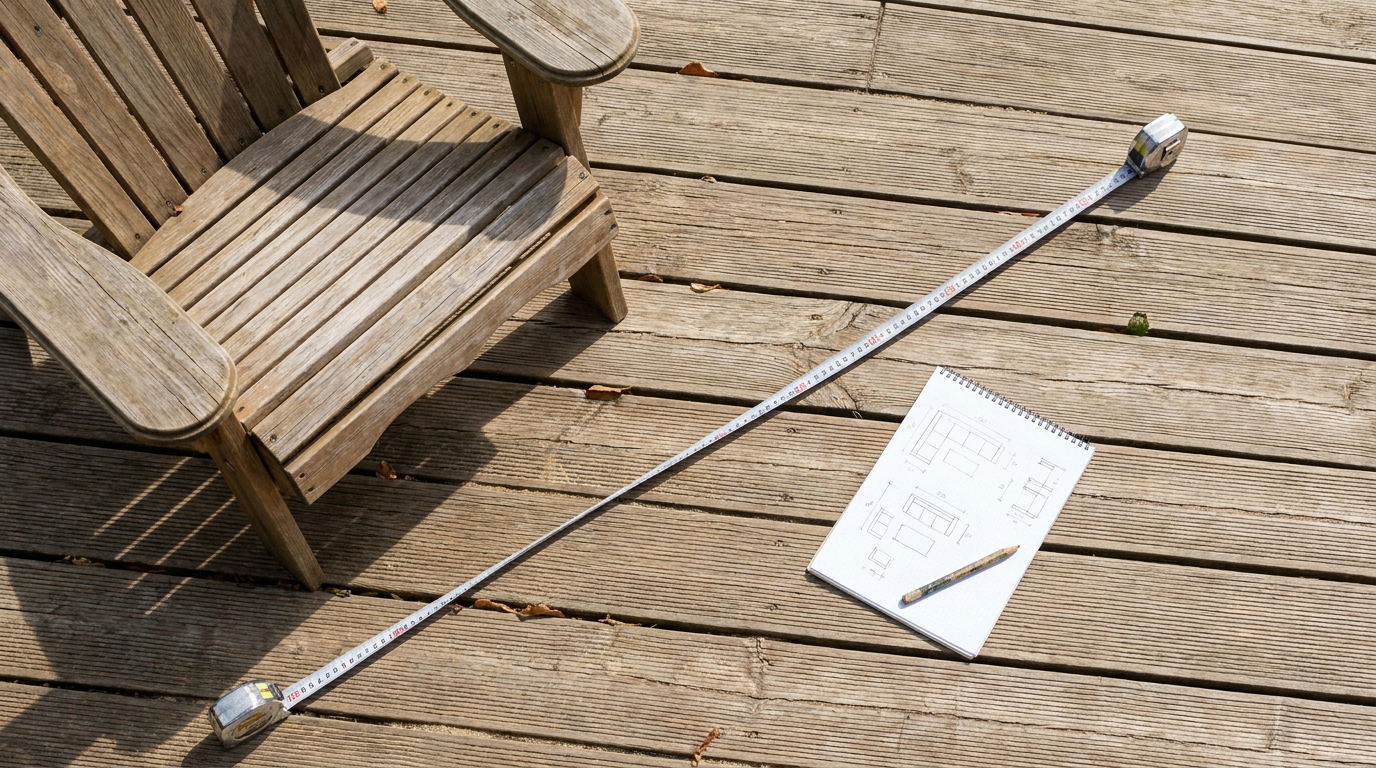
Step 1: measure the space you can actually use
The most common sizing mistake we see is measuring the deck or patio from edge to edge and buying for that number. Once you take out a sliding door, a post, a barbecue and the path to the yard, the area you can furnish is often much smaller and an awkward shape.
Sketch the space, then measure and note:
- Overall length and width of the floor, in centimetres.
- Every fixed obstacle, with its distance from two walls: posts, downpipes, planter boxes, the barbecue, a pool fence, an air-conditioning unit, garden taps and steps.
- Every door and window, including which way it opens. A sliding door needs its track and the path through it kept clear; a hinged door needs its full swing.
- The traffic routes. Draw an arrow for each path people take: house to barbecue, house to yard, house to clothesline. These lanes are not available for furniture.
Shade the traffic lanes and door zones on your sketch. What is left is your real furnishing area.
Pieces in this guide

Step 2: chair pull-out space for an outdoor dining set
A dining setting needs far more room than its table. Chairs slide back when people sit down and stand up, and someone usually needs to squeeze past a seated guest to get to the barbecue. As a rule of thumb, allow about 90 cm from the table edge to any wall, railing, step or obstacle on every side where a chair sits. That covers the chair itself plus room to push it out. On a side where nobody sits, against a wall for example, you can bring the table closer.
So the floor you need is roughly the table's length plus 90 cm at each end where chairs go, by the table's width plus 90 cm on each long side. Do the sum with the actual dimensions on the product page, not a guess.

Two things that change the sum
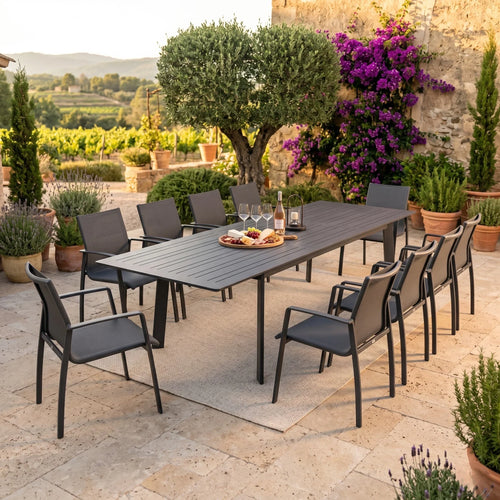
- Extendable tables. Measure for the table at full length, then check whether it still works closed for everyday use. The Rapa Outdoor 11 Piece Extendable Dining Set pairs an extendable powder-coated aluminium table with ten stackable chairs padded with quick-dry foam under textilene fabric. The table extends from 2 metres to 3 metres, so plan the chair clearance around the 3-metre length, then check the space still works with the table closed for everyday dinners.
- Stacking chairs. If the full set of chairs only comes out for guests, you only need everyday clearance for the chairs you leave out. The Chalfonte 7 Piece Outdoor Dining Set with Sanbria Chairs pairs the Chalfonte Rectangular Outdoor Table (a dark brown powder-coated aluminium frame with a Duraboard composite top that looks like timber but needs no oiling) with six Sanbria armchairs in PE wicker. The chairs have no cushions and they stack, so the ones you don't need can come off the floor between gatherings.
Browse the full range of outdoor dining sets with these numbers in hand and you can rule out the wrong sizes in seconds.
Step 3: walkways and spacing for an outdoor lounge
Lounge settings are more forgiving than dining, because nobody pushes a sofa back to stand up. What matters is the space between pieces and the path around them. As a rule of thumb:
- Sofa to coffee table: about 40 to 45 cm. Close enough to reach a drink, far enough to get your knees past.
- Walkway past the lounge: at least 60 cm. On the main path between the house and the yard, aim closer to 90 cm so people are not stepping over feet.
- In front of doors: keep the whole door opening clear, plus room to step through and turn.

Corner lounges need two measurements, not one
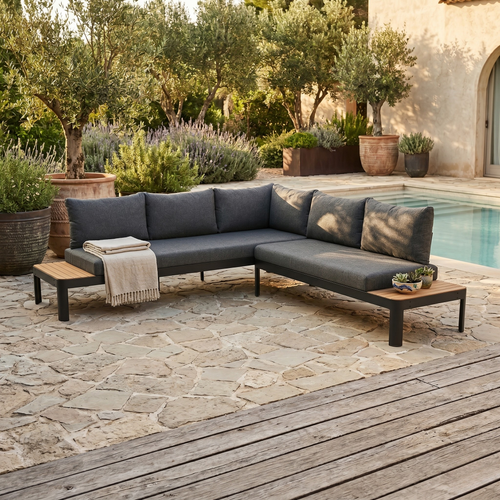
A corner lounge looks compact in a photo because it tucks into a corner, but it fills two walls. Measure both directions from the corner, then check neither arm runs across a door, a window you open, or a path. The Portals Outdoor Corner Lounge is an L-shape on a black powder-coated aluminium frame with Olefin fabric cushions, and it has solid teak side panels built into both outer ends that work as side tables. Because those surfaces are built in, you don't need floor space for separate side tables, but measure to the outside of each teak end, not just the cushions.
Smaller spaces: build up from pieces
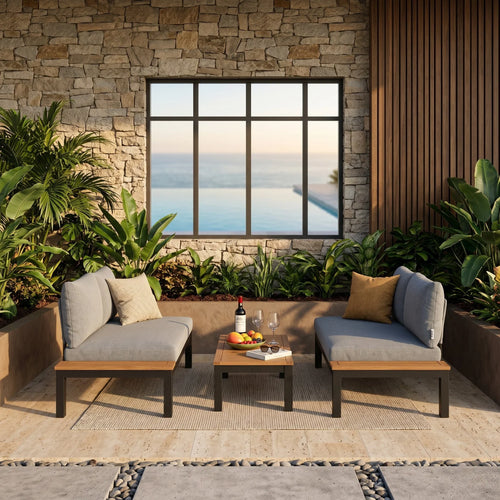
Where a full corner lounge would block a path, a compact sofa plus a table often seats nearly as many people and leaves the walkway open. The Portals 2 Seater Outdoor Lounge uses the same black aluminium frame and Olefin cushions in a two-seat size, with a teak side table built into one end. The Hydra 3 Piece Outdoor Set is two 2-seater sofas and a coffee table, all on a black powder-coated aluminium frame with polyester cushions. Each sofa has a slatted eucalyptus side table built into one end and the coffee table has a eucalyptus top. The two sofas can face each other across the table or sit side by side along one wall, whichever keeps the walkway open.

See the full range of outdoor lounges, from two-seaters to corner settings, and compare each product's dimensions against your sketch, or browse the whole outdoor furniture range.
Step 4: check the furniture can get there
A setting that fits the space but cannot reach it is the most frustrating outcome of all. Walk the route from the street to the outdoor area and measure every pinch point:
- Doorways: the clear width with the door fully open, not the frame size. Internal doors are often narrower than the front door.
- Corners and hallways: a long sofa may pass through a doorway straight on but fail to turn into the next room. Measure the hallway width and the diagonal of the piece.
- Side gates and paths: if the furniture will go around the house rather than through it, check gate width, path width, steps and any tight turn past a water tank or garden bed.
- Lifts: for apartments, measure the lift door width and the inside of the car, and check whether the building has booking rules for moving furniture.
Furniture made in separate pieces, such as a three-piece lounge or a dining set with individual chairs, is much easier to move through a tight route than one large piece. If your access is tight, that is often the deciding factor. For balconies and apartments specifically, our guide to outdoor furniture for apartments and small spaces covers lifts, wind and weight in more detail.
Step 5: plan where it goes in a storm
This is the step most people skip, and in South-East Queensland it matters. When a summer storm warning comes through, cushions and lighter pieces need somewhere to go: a garage corner, a shed, a laundry or under a solid roof away from the wind. Measure that storage spot as well.
- Cushions: lay them out and measure the stack. Several deep lounge cushions take up more room than most people expect.
- Chairs: stacking chairs need only the footprint of one chair plus the height of the stack. Non-stacking chairs each need their own space.
If you have very little storage, lean towards stacking chairs and fewer, lighter pieces. Cushions that can come inside to dry out on humid weeks are also less likely to grow mould.
Step 6: the tape test before you buy
Numbers on paper never quite show how a space will feel. The simplest check is to mark the furniture's footprint on the floor with painter's tape, chalk or flattened cardboard boxes cut to size, using the dimensions from the product page.
- Walk the route from the back door to the barbecue and the yard. If you have to step around the tape, so will your guests.
- Sit where the chairs will be and push back a kitchen chair to see whether the 90 cm is really there.
- Look from inside. Stand at the kitchen bench or the lounge room and check the setting does not block the view or the light.
- Open every door fully with the tape down.
It takes half an hour and catches most sizing problems early. If you would like a second opinion, bring your sketch and measurements into any of our five showrooms (Rocklea, Virginia, North Ipswich, Bundall and Beenleigh) and the team can talk through what fits.
| What to measure | Where | Why it matters |
|---|---|---|
| Usable floor area | Floor minus posts, doors, barbecue and paths | Sets the largest footprint you can furnish |
| Chair pull-out space | Every side of a dining table where someone sits | Stops chairs hitting walls, rails and steps |
| Walkways | House to barbecue, house to yard, past the lounge | Keeps people moving without stepping over guests |
| Access route | Doorways, corners, gates, stairs, lifts | Confirms the furniture can physically arrive |
| Storage spot | Garage, shed or indoor corner | Gives cushions and light pieces somewhere to go in a storm |
Measuring outdoor furniture FAQs
How far should a coffee table be from an outdoor sofa?
As a rule of thumb, about 40 to 45 cm works for most people: close enough to reach a drink, with room for your knees and feet.
How much room does an outdoor corner lounge need?
Measure both directions from the corner, because an L-shaped lounge fills two walls. Check that neither arm runs across a door, a window you open or a path, and measure to the outside of any built-in side tables or panels, not just the cushions.
Is a 2 seater and a coffee table better than a corner lounge in a small space?
Often, yes. Where a full corner lounge would block a path, a compact sofa plus a table often seats nearly as many people and leaves the walkway open. Two 2-seaters, like the Hydra 3 Piece Outdoor Set, can face each other across the table or sit side by side along one wall.
How do I size an extendable outdoor dining table?
Plan the chair clearance around the table at full length, then check the closed size still works for everyday use. Stacking chairs help, because the extra chairs only need floor space on the days you extend the table.