
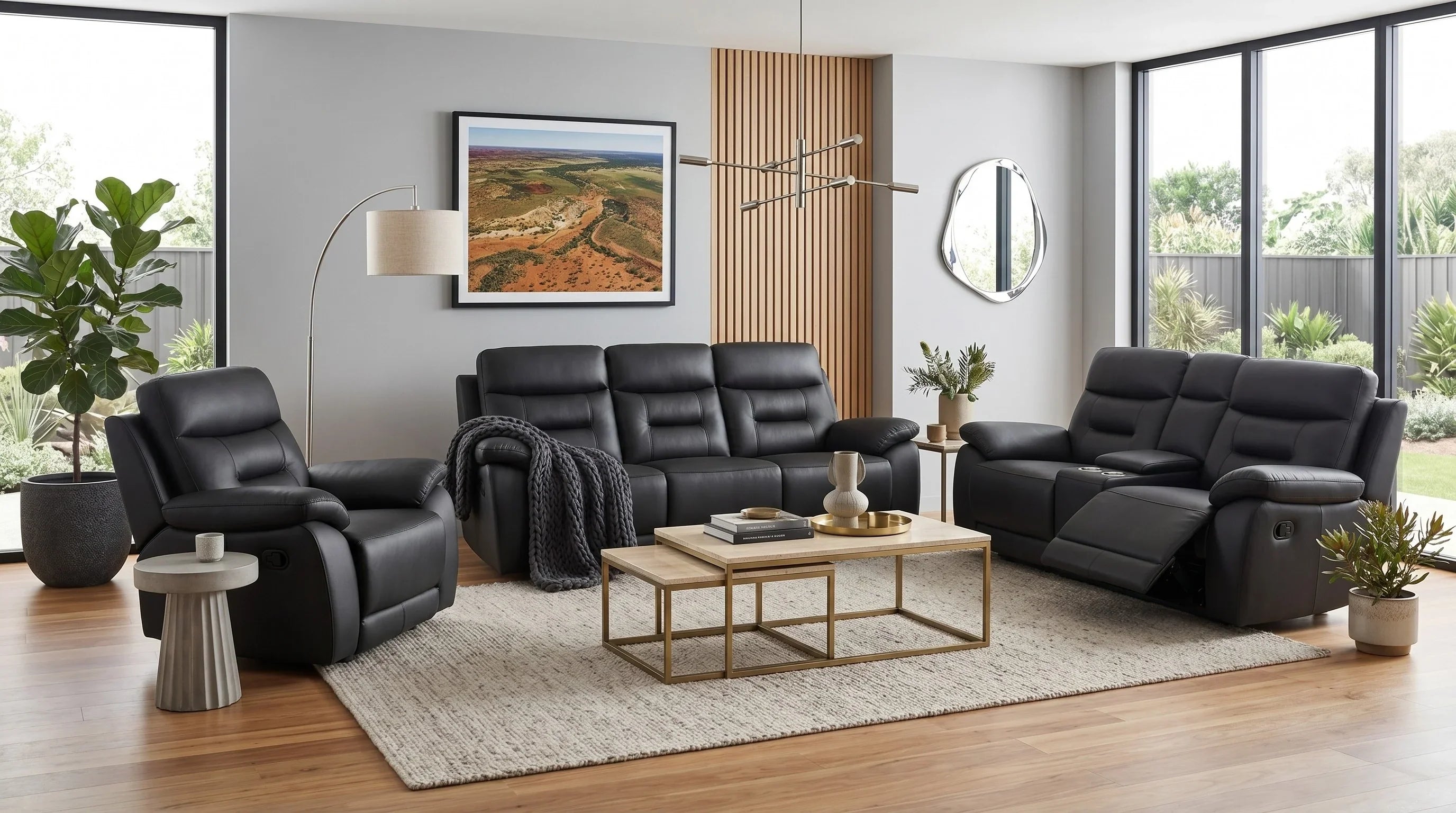
A recliner is the single biggest comfort upgrade most Australian living rooms will ever get — and also the easiest piece of furniture to get wrong. The difference between a recliner that lasts a decade and one that fails inside two years usually comes down to a few decisions buyers don't even know they're making at the point of purchase. This guide is the version we wished existed when we opened our first showroom back in 2013 — written by the team across our five South-East Queensland showrooms, designed to help you make every one of those decisions before you spend a cent.

The short version
- Four decisions matter most: configuration (size and seating count), mechanism (manual or electric), material (leather, Air Leather, fabric or suede), and size & fit (does it physically work in your room).
- Queensland's climate changes the rules. Humidity, salt air on the coast, and intense UV mean some materials that work in Melbourne underperform in Brisbane. Air Leather and treated fabrics are often a smarter pick than top-grain leather for Queensland homes.
- Wall clearance is the most-missed measurement. A standard recliner needs about 30 cm behind it to fully recline. Wall-hugger mechanisms reduce that to under 10 cm.
- Matched suites usually beat individual pieces for living rooms used by 2+ people regularly. They're built to coordinate visually and almost always cost less than buying pieces separately.
- Test in person before you commit. A recliner that feels great for five minutes can feel wrong after an hour — you can't catch that online.
What's in this guide
- What is a recliner?
- Types by configuration
- Recliner mechanisms explained
- Materials and upholstery
- Recliners in Australian homes
- Health and ergonomics
- Care and maintenance basics
- How to choose: the 4-decision framework
- Where to buy in Brisbane & Gold Coast
- Common mistakes Australian buyers make
- Recliner buying FAQs
What is a recliner?
A recliner is any seat designed so that the backrest tilts back and the footrest extends — usually together, sometimes independently — from a comfortable upright position to something close to flat. That sounds obvious, but it's worth being precise because the term covers everything from a $399 single armchair to a $7,000 dual-motor four-seater home theatre. The mechanism is what defines the category. The configuration, material, and price are what differentiate the products inside it.
The first modern recliner is usually traced to 1929, when two American cousins built a wooden porch chair that could tilt. Australian homes were slower to adopt — recliners stayed a niche armchair format here through the 1980s — but they're now a default option in the lounges category, and a category-defining one in the home theatre segment.
Three forces drove the shift: bigger flat-screen TVs (which made stretched-out viewing more natural), longer working hours (which raised demand for deeper end-of-day decompression), and dramatically better mechanisms (cheaper, quieter, more reliable than the metal-spring assemblies of two decades ago). The result is that in 2026, choosing a new lounge in Australia often means choosing between a fixed-back sofa and a reclining one — and most buyers default to reclining.
Types by configuration
The first decision you need to make is how many seats and what shape — what we call the configuration. It's the single biggest variable in both price and room layout, and it's the one most buyers underweight when they walk into a showroom. Here are the six configurations you'll see across our full recliner range, and what each is genuinely good for.

Single recliner chairs (recliner armchairs)
The simplest and usually the cheapest entry point. One seat, designed for one person at a time, footprint roughly the size of a standard armchair. Single chairs are a good fit for a second-living zone, a reading corner, or alongside a fixed-back sofa as the "comfort chair" of the room. They're also the format most often chosen for nursery feeding, where the swivel-and-rock combination matters more than seat count. Browse single recliner chairs if you're after one of these.
2-seater recliner lounges
Two reclining seats side by side. Sometimes called loveseat recliners. The 2-seater is the sweet-spot configuration for couples in apartments and townhouses, and for second living rooms in larger homes. Both seats recline; the middle is usually a fixed cup-holder console or a shared armrest. If you're choosing between a 2-seater and a 3-seater, the deciding factor is rarely seat count — it's whether you regularly host a third person on the lounge. If yes, go three. If no, the 2-seater gives you about 60 cm of saved floor space. Our 2-seater recliner range covers manual and electric in both leather and fabric.
3-seater recliner lounges
The most-sold recliner configuration in Australia, by a wide margin. Three seats; the two end seats recline; the middle seat is sometimes a fixed third seat with a drop-down console, and sometimes a third reclining seat (this varies by model, so always confirm before purchase). 3-seaters are the default lounge format for the primary living room. They suit families of three to four with occasional guest overflow. See our 3-seater recliner lounges.
Corner lounges with recliners (sectional recliners)
Two reclining lounges joined at right angles, usually with a corner wedge seat. Sometimes called sectional recliners. Corner configurations are the highest-capacity layout for a single room — typically four to six seats — and they're particularly effective in open-plan living rooms where the corner anchors the conversational space. The trade-off is footprint: a corner lounge needs more floor area than people expect, especially once recliners are extended. Configuration is also more complex (left-hand-facing vs right-hand-facing, with the chaise side determined by where the long lounge falls when you're sitting facing it). Our corner recliner lounges cover both LHF and RHF orientations.
Home theatre recliners (theatre seating)
Purpose-built rows of reclining seats designed for media rooms. Usually 3, 4, or 5 seats in a straight row, often with full LED-ringed cup holders, integrated tray tables, USB charging, and sometimes ambient lighting. Theatre recliners trade aesthetic flexibility for entertainment-room features — they look like cinema seats because that's what they're optimised for. If you have a dedicated media room, this format is hard to beat. If your "home theatre" doubles as a regular living room, a standard 3-seater or corner lounge might serve you better. See our home theatre recliner range.
Recliner packages (lounge suites)
A package is two or three matched pieces sold together — typically a 3-seater plus two armchairs (3+1+1), or a 3-seater plus a 2-seater (3+2), or all three (3+2+1). The pieces share the same design language, materials, and mechanism style. Packages almost always cost less than buying the same pieces individually, and they're significantly easier to style because the design coordination is built in. The downside is rigidity — you're committed to the same look across multiple pieces. Our recliner packages are a popular pick for living rooms used by larger households.
Which configuration is right for you? The honest answer is the one that handles your peak use — the most people you typically have on the lounge at once — not your average use. Most regret comes from buying for the average and discovering peak Sunday family-movie nights don't fit. For the full sizing framework, see our measure-for-a-recliner guide.
Recliner mechanisms explained
If configuration is the biggest decision, mechanism is the second biggest. There are eight distinct mechanisms in common use across the Australian market in 2026, and they're not interchangeable — each does something slightly different, and the right pick depends on how you actually use a recliner day to day. The full breakdown is in our recliner mechanisms guide; here's the working summary.
Manual lever recline
The classic. A single lever on the side of the seat releases the recline. Pull, lean back, the footrest extends. To close, you push the backrest forward and the footrest folds back under. Manual lever mechanisms are mechanically simple, reliable, easy to service, and significantly cheaper than electric — which is why they remain the volume seller. The trade-off is that you have to physically operate the mechanism, which becomes a limitation for older buyers or anyone with shoulder or back issues.
Manual push-back recline
No lever. You push back against the backrest to recline. Lighter than a lever mechanism, and the chair often looks more like a traditional armchair because there's no visible handle. The downside is less control over recline depth, and push-back chairs typically don't have an extending footrest — you stretch your legs out instead.
Electric (power) recline
A small motor moves the mechanism in response to button controls. Smooth, quiet, infinitely position-adjustable, and effortless to operate. Electric recliners are about 20-40% more expensive than the equivalent manual model, and they require power within reach — but for most Australian buyers, the convenience pays off. They also enable a few features manuals can't have: precise mid-position parking, USB charging, programmable memory positions, and external battery pack compatibility for cord-free placement and power-cut operation. We cover the full electric mechanism story, including how the battery accessory works, in how electric recliners actually work.
Single motor vs dual motor
A single-motor electric recliner moves the backrest and footrest together as one motion — exactly what a manual recliner does, just powered. A dual-motor recliner adds a second motor dedicated to the adjustable headrest, letting you tune neck and head support independently of the main recline angle. The first motor still handles the reclining motion (backrest and footrest move together); the second motor handles the headrest tilt only. For TV watching, reading, and anyone whose preferred neck angle differs from their preferred recline angle, the dual-motor upgrade is genuinely useful — full breakdown in single motor vs dual motor.
Rocking recliners
A standard recline mechanism plus a base that rocks when the chair is upright. The rocking only works when the recliner is closed (in upright position) — once you start reclining, the rocking locks out. Rocking recliners are the dominant format in nursery rooms because the rocking helps settle infants without compromising the option to recline for the adult. We stock the format in our rocking recliner range.
Swivel recliners
A standard recline mechanism plus a 360° swivel base. The swivel lets you rotate the whole chair to face anywhere in the room — useful when one chair needs to face both a TV and a dining table, or when you want to angle towards a window. Swivel is almost always offered as a single-chair format, not as a multi-seat lounge. Some models combine swivel with rocking (the Sunshine Rocker & Swivel is one of these), giving you three mechanisms in one chair.
Wall-hugger recliners
A re-engineered mechanism that lets the chair recline by sliding forward instead of tilting backwards. This reduces the wall clearance requirement from ~30 cm to under 10 cm. Wall-huggers are the right choice for apartments, townhouses, or any room where the recliner has to sit close to a wall. The trade-off is that wall-hugger frames are slightly heavier and a few hundred dollars more expensive than the standard mechanism.
Lift recliners (rise & recline)
A motorised mechanism that tilts the entire chair forwards and upwards, helping the sitter to stand from a seated position. Lift recliners are a mobility aid — primarily used by older buyers or anyone with knee or hip issues — and they're not a feature most general buyers need. We don't currently stock lift recliners; if you're shopping for one, it's worth looking at specialist mobility retailers rather than general furniture stores.
Manual vs electric in one sentence: if budget is the binding constraint, choose manual; if the recliner will be used by more than one person regularly, choose electric. For the long version with full trade-offs, see electric vs manual recliners.
Materials and upholstery

The material on the surface of a recliner is the part that gets the most use, the most wear, and the most spills. It's also the most-misunderstood category in recliner shopping. Here's the working breakdown of what's available across our leather recliner range and the broader fabric and synthetic options.
Top-grain leather
The premium upholstery option. Real cowhide, sanded to remove imperfections, then dyed and finished. Top-grain leather is breathable, develops a patina over years of use, and properly cared for will outlast almost any fabric. The trade-offs in Australia are real: leather absorbs heat in summer, can crack if left in direct sun, and benefits from conditioning every six months in humid climates like Brisbane and the Gold Coast. Expect to pay 30-50% more than the fabric equivalent.
Air Leather (performance leather)
A high-grade synthetic that mimics the feel of real leather. Air Leather is significantly more durable than basic PU leather, doesn't absorb water, and handles Queensland humidity better than top-grain leather. It also runs cooler than top-grain leather in summer. That said, Air Leather isn't immune to wear: extended heat exposure can shorten its lifespan, and like any synthetic surface it can peel at high-stress contact points over years of heavy use. The key advantage is that it lasts considerably longer than basic PU leather while costing less than top-grain — a strong middle option for Queensland homes. The Sunshine Rocker & Swivel is one of our Air Leather pieces.
PU leather (faux leather, bonded leather)
Budget synthetic leather. Lower price point, OK appearance for a few years, but PU leather typically peels and cracks within five to seven years, especially in humid environments. We stock PU leather selectively and only on products where the construction supports it; we don't generally recommend it for high-use primary lounges.
Suede
Soft, brushed leather finish — usually applied to mid-tier matched suites. Suede has a tactile, warm feel that buyers either love or don't, and it sits visually between leather and fabric. It's slightly less forgiving of spills than fabric (stains can mark the nap) but easier to spot-clean than top-grain leather. Suede is a less common upholstery in our current range; if you're set on the look, our showroom team can point you to which models include it.
Fabric upholstery
The broadest category — covers everything from cotton blends through to performance fabrics like the Rhino fabric used on our Boston range. Modern fabrics are dramatically better than the upholstery options of even a decade ago: most premium recliner fabrics are now stain-resistant, fade-resistant, and pet-claw-resistant by default. Fabric runs cooler than leather in Queensland summers, is generally cheaper, and offers far more colour and pattern variety. The downside is that deep stains can be harder to fully remove than from leather. For a fuller materials comparison including QLD climate notes, see recliner materials in Queensland's climate.
Microfibre and microfiber blends
A subset of fabric — synthetic microfibres engineered for stain resistance. Microfibre is increasingly common on family recliners because it handles spills better than woven fabric and doesn't show wear as quickly. Visually it sits somewhere between fabric and suede.
For Queensland's climate specifically: Air Leather and treated performance fabrics generally outperform top-grain leather over five-to-ten-year horizons. The humidity that wears down genuine leather (cracking, mould risk, conditioning demands) doesn't affect the synthetic alternatives in the same way. Top-grain leather is still a beautiful option for Brisbane homes — it just needs more proactive care. See caring for leather recliners in Queensland.
Recliners in Australian homes
Recliners aren't a one-size-fits-anywhere category — the same piece that works beautifully in a 4-bedroom Queenslander can fail in a small Brisbane apartment, and vice versa. Here's where the format fits across the room types most common in South-East Queensland. For deeper layout guidance see our layout guide for Australian living rooms.
Brisbane apartments and small living rooms
Apartments demand wall-hugger mechanisms and careful configuration choice. A 3-seater recliner can fit a small Brisbane apartment but only if the wall clearance is engineered (wall-hugger) and the room geometry allows the footrest to fully extend without colliding with a coffee table. Most apartment buyers we see end up choosing between a 2-seater and a single armchair plus a fixed lounge — see recliners for Brisbane apartments for the full sizing rules.
Family living rooms (suburban Brisbane, Gold Coast, Ipswich)
The biggest segment of our customers. Family living rooms usually want a 3-seater or a corner configuration, with a focus on durability (kids, pets, spills) and shared use. Material choice matters more than mechanism here — performance fabric or Air Leather almost always outlasts top-grain leather in households with primary-school-aged children.
Home theatres and media rooms
If the room is dedicated to viewing — no shared use as a general living room — purpose-built theatre recliners are hard to beat. Built-in cup holders, USB charging, ambient lighting, and headrests engineered for screen viewing all justify the format. For dual-use rooms (media plus general living), a standard 3-seater or corner lounge with the right headrest geometry is usually better.
Nursery rooms
A specific use case with specific requirements: rocking motion for settling, swivel for managing feeds and access, and a recline depth that allows for longer sessions. Single-chair recliners that combine all three mechanisms — like the Sunshine Rocker & Swivel — are the right format. Fabric or Air Leather are generally easier to clean for the inevitable feed accidents than top-grain leather. We've written the full Brisbane parents' guide at best recliner chair for nursery feeding.
Open-plan Queenslander homes
Queenslander-style homes — and the open-plan extensions that have become standard since the 1990s — work well with corner configurations because the corner anchors a defined seating zone within an otherwise open space. A 3-seater + single chair combination also works for the same reason: it defines the living area without enclosing it the way a corner does. Mid-tier materials (Air Leather, performance fabric) handle the higher airflow and humidity exposure characteristic of these homes better than top-grain leather.
Health and ergonomics
The "is a recliner good for your back?" question is the single most-searched recliner question in Australia, and the honest answer is "it depends entirely on the recliner and how you sit in it." Properly designed recliners — those with adjustable lumbar support, a head/neck geometry that doesn't push the head forward, and a seat depth that fits the sitter — can genuinely reduce back, hip, and leg pressure compared to a standard sofa. Badly designed ones can make existing problems worse. Our recliner health and ergonomics guide covers this in depth; here are the high-level takeaways.
Lower back support
The key factor is whether the recliner's lumbar support matches the natural curve of your lower spine when you're upright. Cheap recliners often have flat backs that force the lower spine into a flexed position over hours of use, which aggravates existing back pain. Better recliners have purpose-shaped lumbar zones built into the backrest itself, often with adjustable headrest support on dual-motor models — together these let you find a position that genuinely supports the spine rather than just feeling soft. If back pain is a primary reason you're buying, this is the feature to test for. Detail at recliners and back pain.
Hip and leg circulation
The pressure points to watch for are the back-of-knee and the seat front edge. A seat that's too deep (so your knees don't bend at the front edge) or too high (so your feet don't reach the ground when upright) creates pressure on the back of the thighs and reduces circulation. The fix is to match seat geometry to the sitter — taller sitters need longer seats, shorter sitters need shorter ones. Recliners, hips and leg circulation goes into this in more detail.
Neck and headrest design
The headrest is the single biggest factor in whether a recliner aggravates neck pain. A flat, fixed headrest forces the neck into chin-forward posture, especially when reclined for watching TV. Adjustable headrests — found on most dual-motor electric models — solve this entirely. For longer reads, see why your headrest matters.
Sitting properly
The best recliner in the world will hurt if you sit in it badly. Three rules: feet supported (either on the footrest extended, or flat on the ground), lower back fully in contact with the lumbar support (not slumped forward), and head supported by the headrest (not propped forward by the chin). We've written a full posture guide at how to sit in a recliner properly.
Care and maintenance basics

Recliners don't need much maintenance, but the maintenance they do need is climate-specific in Queensland. The two main areas are upholstery care (which depends on the material) and mechanism care (which is mostly about keeping moving parts clean and lubricated). Our full care guide covers all of it; here's the working basics.
Top-grain leather
Wipe weekly with a dry microfibre cloth. Condition every six months with a quality leather conditioner — we recommend the Guardsman Leather Care Kit for real leather. Keep direct sun off the leather where possible; UV-faded leather is one of the most common Queensland furniture problems. Spills should be blotted (not rubbed) immediately, then dried with a clean cloth.
Air Leather and PU leather
Easier than top-grain. Wipe with a damp cloth as needed. Use the Guardsman ProGuard Care Kit (which is formulated for synthetic upholstery) rather than the leather kit — the conditioners in a real-leather kit can damage synthetic finishes over time. Air Leather doesn't need the six-monthly conditioning routine of top-grain.
Fabric upholstery
Vacuum monthly. Spot-clean spills with cold water and a mild detergent — most modern recliner fabrics are stain-resistant, so quick action usually clears almost everything. Avoid bleaches and harsh solvents which can damage the fabric backing. For deep cleaning every few years, a professional upholstery clean is usually worth the cost.
Mechanism care
Recliner mechanisms are designed to be largely maintenance-free, but the moving parts benefit from a light spray of silicone lubricant once a year (don't use WD-40 long-term — it attracts dust). Listen for new squeaks, watch for resistance in the recline action, and tighten any visible bolts annually. Most mechanism failures in our experience come from forcing a mechanism that's started to bind — if something doesn't feel right, address it before it breaks.
How to choose: the 4-decision framework
The honest way to choose a recliner is to make four decisions in order. Get the order right and the rest of the buying process is mostly about preference. Get it wrong and you'll be paralysed by options. Each decision narrows the field — by the time you've made all four, you're choosing between roughly five to ten specific models. The detailed framework is at how to choose a recliner; here's the working order.
Decision 1: Configuration
How many people sit on the lounge regularly? What's the peak? Does it need to anchor a room (corner) or fit into one (2-seater, wall-hugger)? Get this right first because configuration determines roughly 60% of the price and 100% of the room geometry.
Decision 2: Mechanism
Manual or electric? If you have older sitters, anyone with shoulder or back issues, or you genuinely value the convenience — electric. Otherwise manual is fine and saves real money. If electric, single motor or dual motor — single is enough for most buyers; dual is worthwhile for daily long-session use where adjustability matters.
Decision 3: Material
Leather, Air Leather, fabric, or suede? Consider climate (Queensland humidity), use intensity (kids and pets push you toward synthetics and performance fabrics), and aesthetic preference. Most Brisbane buyers do well with Air Leather or treated performance fabric. Top-grain leather is beautiful but high-maintenance in this climate.
Decision 4: Size and fit
This is the measurement check. Does the recliner physically fit your room when fully reclined? Is there 30 cm clearance behind it (unless wall-hugger)? Does it clear your coffee table when the footrest extends? Does the seat depth fit the primary sitter? This is where we send most online shoppers back to the room with a tape measure before committing.
Where to buy a recliner in Brisbane & Gold Coast
Online recliner shopping has its place — for second-living-zone armchairs, replacement matching pieces, or known products you've sat in before — but for a primary lounge purchase, in-person testing usually pays off. A recliner that feels great for five minutes can feel wrong after an hour. The only reliable way to catch that is to sit in it for ten or fifteen minutes in a showroom. We've written the full where to buy a recliner in Brisbane & Gold Coast guide, including a side-by-side of our five showroom locations.
Our showrooms across South-East Queensland are in Rocklea (the flagship), Beenleigh (south Brisbane), North Ipswich (west), Sandgate (north Brisbane), and Bundall (Gold Coast). All five carry the full recliner range; the flagship at Rocklea has the largest in-stock range of any single location. You can plan your visit, check hours, and find directions at our showroom locations page. Once you've picked the right recliner, our free local delivery covers a 10 km radius around the Rocklea store; delivery to other parts of South-East Queensland is available for a fee.
Common mistakes Australian buyers make
Five common pitfalls. The longer list is at common recliner buying mistakes; these are the ones that come up most often in our showrooms.
- Buying the average, not the peak. A 2-seater that fits Monday through Saturday and fails on Sunday family movie night is the wrong 2-seater.
- Skipping wall clearance. The 30 cm clearance figure is consistently underestimated. Wall-hugger mechanisms exist to solve this — if your room is tight, use them.
- Buying top-grain leather without committing to the care routine. Top-grain in Queensland needs six-monthly conditioning. If that won't happen, Air Leather is a better pick.
- Underspending on mechanism for high-use lounges. A $200 saving on mechanism quality is almost always wiped out by an early failure. The mechanism is what you actually use every day; it's not the place to economise.
- Not sitting in it long enough. Five minutes in a showroom is not enough. Sit in the recliner for at least 15 minutes — read on your phone, watch the surroundings, get comfortable. Most discomfort issues only emerge after the first ten minutes.
Recliner buying FAQs
Are recliners good for your back?
The short answer is yes, when the recliner has proper lumbar support, an adjustable headrest, and seat geometry that fits the sitter. Recliners can reduce spinal pressure compared to a fixed sofa by distributing weight across a wider contact area. The longer answer — including when recliners can make back pain worse — is in our recliners and back pain guide.
Electric or manual recliner — which is better?
Manual is cheaper, mechanically simpler, and easier to service. Electric is smoother, more position-flexible, and friendlier to anyone with shoulder, neck or back issues. For most single-household Australian buyers, manual is enough if budget is tight; electric is worth the 20-40% price uplift if the recliner gets daily use by more than one person. Full comparison in electric vs manual recliners.
How much space does a recliner need?
A standard recliner needs about 30 cm of wall clearance behind it to recline fully, plus enough space in front of the footrest (typically 60-80 cm when extended) to avoid colliding with a coffee table. Wall-hugger mechanisms reduce the rear clearance to under 10 cm. Always measure your room with both clearances in mind before committing. The full measurement guide is at how to measure for a recliner.
Are recliners worth the money?
For primary living-room use, almost always — a good recliner is the most-used piece of furniture in most Australian homes, and amortised over a 10-year ownership it works out to around 40 cents per day for most buyers. The exception is buyers who use their lounge primarily for hosting (where guests prefer fixed seating) or who genuinely don't recline. Our are recliners worth it guide works through the value calculation.
How long should a recliner last?
Quality recliners from established brands should last 8-15 years with normal use. Mechanisms are usually the first thing to go — manual lever assemblies typically outlast electric motors by a few years, but well-built electric mechanisms also last a decade or more. Upholstery longevity depends heavily on material: top-grain leather can last 15+ years with proper care, Air Leather typically 10-12 years, mid-tier fabrics 8-10 years. Mechanism warranty terms are a useful proxy for expected lifespan.
What's the difference between a recliner lounge and a recliner lounge suite?
A recliner lounge is a single piece (a 3-seater, 2-seater, or single chair). A recliner lounge suite — sometimes called a package — is multiple matching pieces sold together, typically a 3-seater plus two armchairs (3+1+1) or a 3-seater plus 2-seater (3+2). Suites usually cost less than the same pieces bought individually and coordinate visually by design. See our recliner suite deals.
Where can I buy a recliner in Brisbane?
We have five A2Z Furniture showrooms across South-East Queensland — Rocklea (flagship), Beenleigh, North Ipswich, Sandgate, and Bundall on the Gold Coast — all carrying the full recliner range. The Rocklea flagship has the broadest in-stock selection. For other Brisbane retailers and a five-showroom comparison, see where to buy a recliner in Brisbane and Gold Coast.
How do I care for a leather recliner in Queensland's climate?
Top-grain leather in Brisbane and Gold Coast humidity needs conditioning every six months with a quality leather conditioner — we recommend the Guardsman Leather Care Kit. Keep direct sun off the leather (UV fading is the biggest single risk for indoor leather here), wipe weekly with a dry microfibre cloth, and address spills immediately by blotting rather than rubbing. Air Leather and synthetic upholstery don't need this routine — they're significantly lower-maintenance in this climate. Full instructions at caring for leather recliners in Queensland.
Can electric recliners be operated manually in a power cut?
A2Z's electric recliners don't include a built-in manual override or battery backup — the chair runs from mains power by default. The solution we offer for power-cut situations (and for rooms where running a cord to the chair isn't convenient) is an external rechargeable battery pack, sold separately, that plugs into the chair's power input and operates the mechanism without mains. Worth considering as an accessory at purchase if power-cut operation matters to you. The full explainer is at how electric recliners actually work (and what happens in a power cut).
Are recliners safe for nursery feeding?
Single-chair recliners that combine rocking and swivel — like the Sunshine Rocker & Swivel — are a popular and safe choice for nursery feeding, settling, and night-time use. The rocking mechanism only operates in the upright position (when the chair is closed), so there's no risk of the chair rocking while reclined with a sleeping infant. Material choice matters — fabric or Air Leather is generally easier to clean than top-grain leather. Full guidance for Brisbane parents is at best recliner chair for nursery feeding.
Ready to find the right recliner?
Browse our full recliner collection online, or come and test recliners in person at any of our five A2Z showrooms across Brisbane, Gold Coast, and Ipswich.