
Recliner Buying Guide · The Comfort Zone
A recliner is the piece of furniture most people assume won't fit in an apartment — and the truth has more to do with picking the right size than giving up on the idea. A standard recliner needs around 30 cm of clear wall behind it to recline fully, which is exactly the kind of space a Brisbane apartment often doesn't have. The fix isn't a special mechanism; it's choosing a compact configuration — a single chair or a 2-seater — and measuring your room honestly before you buy. This guide covers how.

The short version. A standard recliner needs about 30 cm of clear wall behind it to recline fully — measure that before anything else. For a tight apartment, the reliable path is a smaller footprint: a single recliner chair (85–105 cm wide) or a compact 2-seater (150–165 cm wide), not a full 3-seater squeezed into a room it doesn't suit. Plan for the fully-reclined depth, not just the upright footprint, and check delivery access — lift, stairwell and doorway widths — before you order.
In this guide
Why small spaces need a different approach
The mistake that sinks most apartment recliner purchases isn't the chair's size — it's its geometry when open. A recliner takes up far more room reclined than closed. A chair that's roughly 95 cm deep upright can extend to 150–160 cm deep when fully reclined, and the backrest also needs around 30 cm of clearance to tilt back into. In a house with a deep living room, that extra space is invisible. In an apartment, it's the difference between a chair that reclines fully and one that stops halfway against the wall.
So the small-space approach comes down to two decisions made up front: configuration (how many seats, and how wide) and an honest measurement of what the room can actually take. Get those right and the rest is layout. Before you shortlist anything, it's worth taking five quick measurements of your room — wall length, rear clearance, front clearance, doorway and delivery path. We walk through all five in our room-sizing walkthrough.
Choosing the right size for a small living room
The table below shows the realistic footprint of each configuration and how it suits compact rooms — figures are upright; add 50–70 cm of depth for the fully-reclined position.
| Format | Typical width | Best for |
|---|---|---|
| Single recliner chair | 85–105 cm | Studios, one-bed units, reading corners, a second seat beside a sofa |
| Compact 2-seater recliner | 150–165 cm | Couples in a small living room — the best comfort-to-floor-space ratio |
| Standard 3-seater recliner | 195–220 cm | Larger apartments and open-plan rooms with a full wall to spare |
| Corner/modular recliner | 270 cm+ each side | Usually too large for true small spaces — measure carefully first |
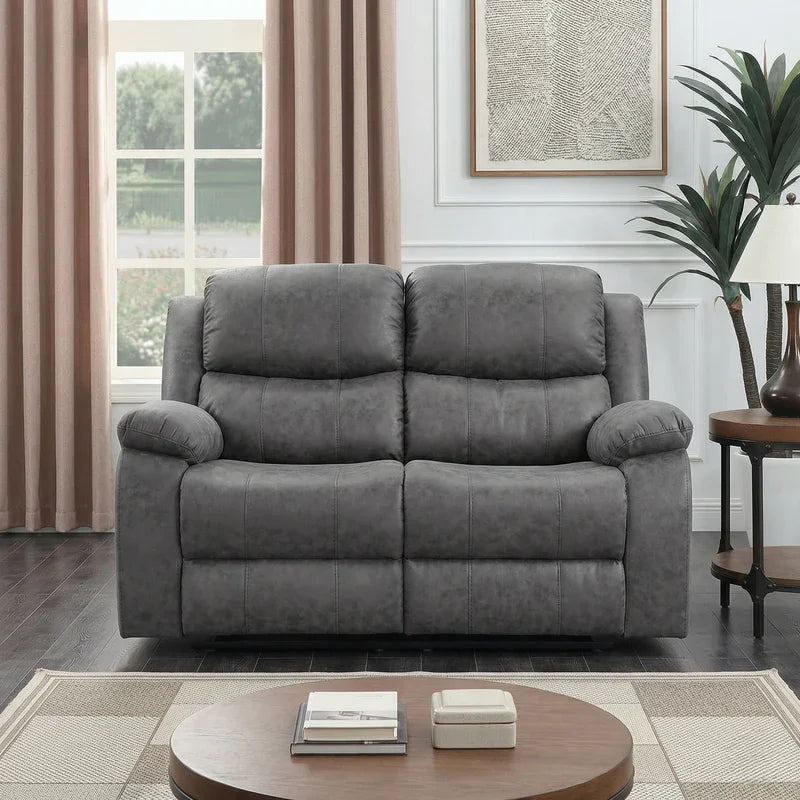
For most apartments, the sweet spot is either a single chair or a compact 2-seater. A single recliner chair is the most floor-efficient way to get full recline comfort, and it doubles as a reading or feeding chair. A 2-seater recliner gives a couple two reclining seats on roughly the same wall a standard sofa would use. Stepping up to a 3-seater only makes sense if you genuinely have the wall length and the reclined-depth walkway to support it.

Measuring your clearance honestly
There's no substitute for a tape measure here. Before you shortlist a chair, measure three things in the room: the clear wall length where the recliner will sit, the depth of clear floor behind the backrest, and the depth of clear floor in front for the footrest. A standard recliner mechanism needs roughly 30 cm of clearance behind it to tilt the backrest back, and the reclined chair itself grows 50–70 cm deeper than its upright footprint. If either of those clearances isn't there, the honest fix is a smaller configuration — a single chair instead of a 2-seater, or a 2-seater instead of a 3-seater — rather than forcing a larger chair into a room that can't take its full recline.
Rule of thumb: if you can't find 30 cm of clear space behind where the chair will sit and 60–70 cm in front, size down rather than compromise on the recline. A chair that can't fully open isn't doing its job, no matter how good it looks closed. The mechanics of how recline works are covered in our breakdown of recliner mechanisms and materials.
Layout tricks that buy you space
Once the configuration is settled, layout does the rest. A few moves that consistently help in compact rooms:
- Angle a single chair into a corner. A recliner set at 45° across a corner often uses dead space the rest of the room can't, and the reclined footrest points into the open floor rather than a walkway.
- Keep 60–70 cm of clear floor in front for the footrest, and ideally 90 cm-plus if anyone needs to walk past while it's reclined. A coffee table on castors that can be nudged aside is worth more than a fixed one.
- Choose lighter upholstery tones for small rooms. They read as less bulky than a dark mass of the same dimensions — a visual trick, but a real one.
- Use a 2-seater instead of a 3-seater-plus-armchair combination. One well-chosen piece almost always beats two pieces fighting for the same square metres.
- Leave the full clearance behind the backrest, even if it looks like wasted space on paper. A recliner pushed hard against a wall with no allowance simply won't open all the way.
If you're weighing the room as a whole — where the recliner sits relative to the TV, traffic flow and other furniture — our guide to recliners by room covers placement in more detail.
Delivery access: the apartment-specific catch
The measurement apartment buyers most often forget isn't in the living room — it's the path to it. Recliners are bulky, and even though they typically arrive in 2–3 pieces (the seat-and-base unit plus backrest panels), the largest single piece can still be 60–80 cm on its narrowest side. Before ordering, check:
- The building entry and your front door — width and height of the opening.
- Lift dimensions — both the door width and the internal height. A small lift can force a stairs-only delivery.
- Stairwell turns and landings — the tightest point on the route, not just the stair width.
- Internal doorways the chair must pass through to reach the room.
A2Z tip: if any point on the delivery route is tight, tell us when you order — the team can plan around it. Free local delivery covers homes within a 10 km radius of our Rocklea showroom, ground floor only; addresses beyond that are quoted individually. Flagging a narrow lift or a tight stair before delivery day saves everyone a wasted trip.
Shop the range
Sized for small spaces — browse the compact formats:
What to buy: configurations that work in small spaces
Pulling it together, here's the practical shortlist for a Brisbane apartment or small living room:
- One person, tightest spaces: a single recliner chair. Browse the single recliner chairs range.
- A couple: a compact 2-seater. See the 2-seater recliners.
- Want powered recline with smooth, precise control: look at the electric recliner range in a single or 2-seater size.
- Not sure which format: start from the full recliner collection and filter by size.
If you're still deciding between mechanism types and materials as well as size, the four core buying decisions — configuration, mechanism, material and fit — are laid out in our recliner-choosing framework, and the big-picture overview lives in the complete recliner guide.

Small-apartment recliner FAQs
Can you fit a recliner in a small apartment?
Yes — the key is choosing a configuration scaled to the room and measuring the clearances honestly. A standard recliner needs about 30 cm of clear space behind it to recline fully. A single recliner chair or a compact 2-seater fits comfortably in most Brisbane apartments and small living rooms.
How much clearance does a recliner need behind it?
Around 30 cm of clear wall space is the standard rule of thumb for the backrest to tilt back fully. Measure this before you shortlist any recliner — if you don't have it, size down to a single chair or a compact 2-seater rather than forcing a larger piece into the room.
What's the smallest recliner that's still comfortable for an adult?
A single recliner chair, roughly 85–105 cm wide and 90–105 cm deep upright, is the smallest format that still gives proper seat depth, a full footrest and a complete recline. Below that size you're into children's recliners or non-reclining armchairs.
How much space do I need in front of a recliner?
Leave at least 60–70 cm of clear floor in front for the footrest to extend, and ideally 90 cm or more if someone needs to walk past while the chair is reclined. The chair grows about 50–70 cm deeper when fully open, so plan the walkway around the reclined depth, not the upright footprint.
Will a recliner fit through my apartment's lift and doorways?
Usually yes, because recliners are typically delivered in 2–3 pieces and the largest single piece is often 60–80 cm on its narrowest side. The points to check are your lift's internal dimensions, the tightest stairwell turn, and the entry doorway width. If any are tight, let us know when ordering so delivery can be planned accordingly.
Written by the A2Z Furniture team — five South-East Queensland showrooms, family-owned and operated since 2013. Last updated July 2026.