
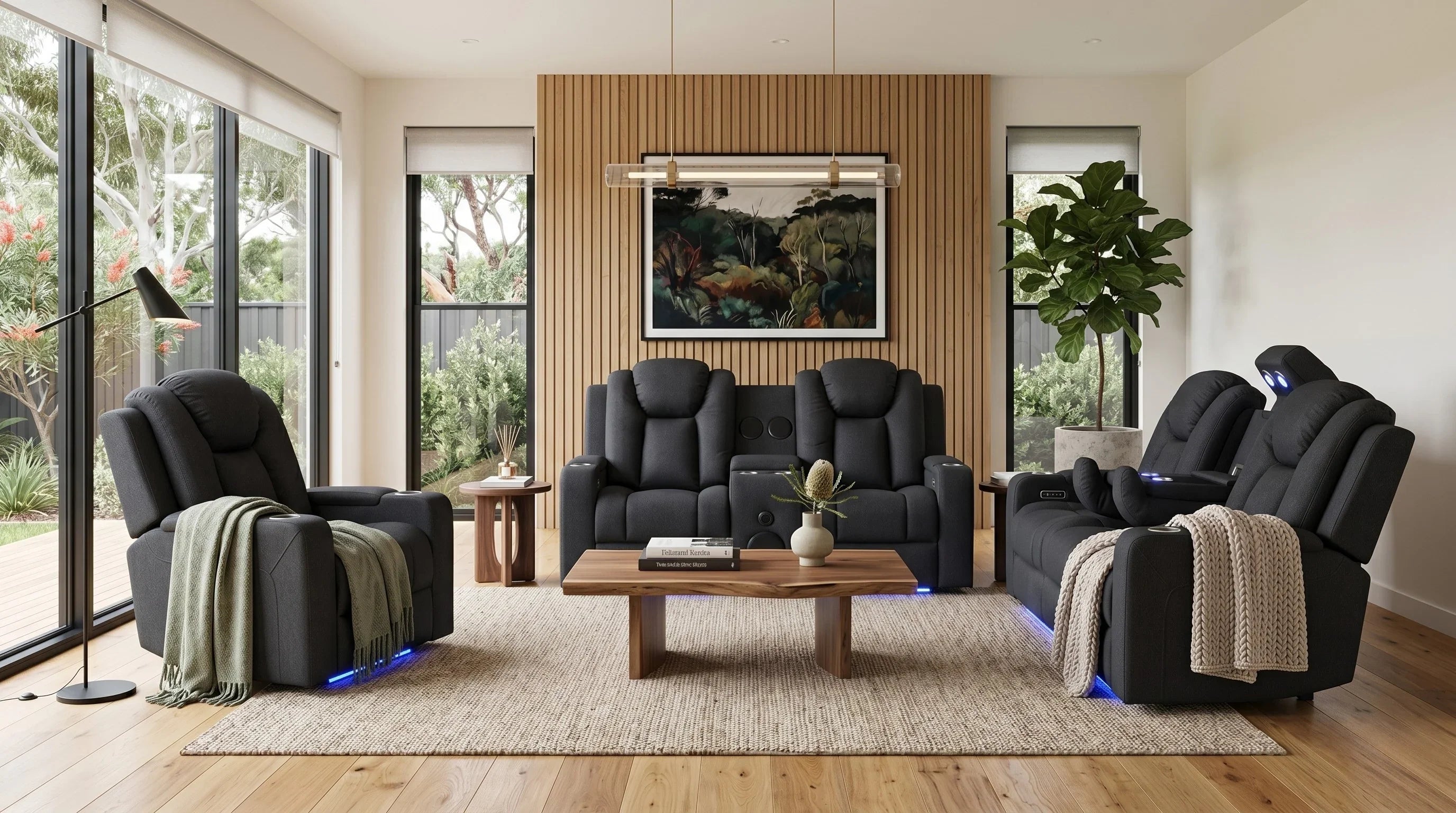
Recliner Buying Guide · The Comfort Zone
Every recliner sits at the intersection of two decisions: the mechanism that makes it recline, and the material you actually touch every day. Get either wrong and the piece doesn't work — a beautiful leather lounge with a cheap mechanism disappoints in a few years; a brilliant dual-motor electric in the wrong upholstery becomes a heat trap in a Brisbane summer. This guide walks through every mechanism and every material in the A2Z recliner range, what each is genuinely good for, and how the two decisions interact.

The short version. Mechanism choice is how the recliner moves: manual lever-pull is the cheapest and most serviceable, manual push-back is the simplest, electric is the smoothest, and specialty bases (rocking, swivel) solve specific problems. "Dual motor" in the A2Z range means one motor for the main recline plus a second motor for the adjustable headrest — not two independent motors. Material choice is how the recliner ages: genuine leather rewards proper care, Air Leather is the climate-forgiving middle option, and performance fabric is the high-use family pick. In Queensland's humidity, Air Leather and treated fabrics usually outperform genuine leather over a five-to-ten-year horizon.
In this guide
Manual recliner mechanisms

Manual recliners are the volume-selling format in Australia, and there's a reason for that. They're mechanically simpler, significantly cheaper than the electric equivalent, easier to service over the long run, and have nothing to go wrong electronically. Two manual variants are in common use across our manual recliner range.
Lever-pull recline
The classic. A side-mounted lever releases the mechanism — pull it, lean back, and the footrest extends together with the backrest tilt. To close, you lean forward and push the footrest back under with your weight. Lever mechanisms have been in continuous use since the 1930s and have evolved into reliable, near-silent assemblies. The main trade-off is the physical effort required to operate — fine for most adults, harder for older sitters or anyone with shoulder, neck or back issues. You'll find lever-pull across single chairs in our recliner armchair range and in 2-seater and 3-seater configurations like the Bentley.
Push-back recline
No lever. You push backwards against the backrest and the chair reclines under your body weight. It's a lighter mechanism, often with a cleaner visual silhouette because there's no visible lever hardware, and almost always cheaper than lever-pull. The trade-offs are real, though: push-back chairs typically don't have an extending footrest (you stretch your legs out instead), and the recline depth is less controllable — you commit to whatever angle your weight produces. Push-back is more common on single recliner chairs than on multi-seat lounges.
Why manual still dominates
For most buyers, manual mechanisms are the right answer. They cost roughly 20–40% less than the electric equivalent, last longer (no motors to fail), are easier to service if something does go wrong, and don't require power within reach of the chair. Electric mechanisms are worth the upgrade for specific use cases — covered in detail in our electric vs manual breakdown — but the default for first-time recliner buyers in Australia is still manual, and that's not a compromise.
Electric recliner mechanisms
Electric mechanisms replace the physical lever with one or more motors controlled by buttons — usually mounted on a side panel, in the armrest, or inside the cup holder on theatre-style models. Three things change when you move from manual to electric: the operation is effortless (the recliner does the work, not you), the position is continuously adjustable (you can park mid-recline), and a small set of features become possible that manual mechanisms can't deliver. The full mechanical explainer is in how electric recliners actually work.
Single motor electric
One motor drives the main recline motion — the backrest tilts and the footrest extends together, as a single coordinated motion. This is essentially the manual lever-pull experience, just powered. Single-motor electric is the entry point to powered reclining and the most common electric configuration. Browse our electric recliner lineup for the range.
Dual motor electric
This is where the terminology gets misleading across the broader market. In the A2Z range, "dual motor" means one motor for the main recline (still moving backrest and footrest together, like the manual format) plus a second motor dedicated to the adjustable headrest. The headrest tilts independently of the rest of the chair, which lets you tune neck and head support without compromising your preferred recline angle. The Boston Dual Motor 3-Seater and 2-Seater are the lead examples in our range.
Some manufacturers use "dual motor" to mean two independent motors for the backrest and footrest — that's a different feature set, and it's not what A2Z's products do. If you've read marketing copy elsewhere that talks about putting your feet up while keeping your back upright, that's the independent-motor architecture, not ours. We've explained the distinction in detail at single motor vs dual motor recliners.
What "dual motor" buys you in practice
- Independent headrest tilt for TV-watching positions where the right recline angle doesn't put your head in the right neck angle.
- USB charging typically built into the side panel.
- Theatre-model extras on the home-theatre range — LED cup holders, tray tables and ambient lighting on the seats designed for media rooms.
- External battery pack compatibility — a separately-purchased rechargeable battery pack can be plugged into the chair's power input, enabling cord-free placement and operation during a power outage. Useful for any room where running mains power to the chair's position isn't practical.
Power cut and cord-free operation
The most common concern with electric recliners is what happens during a power outage. A2Z's electric recliners don't include a built-in manual override or battery backup — once they're reclined and mains power goes out, they stay reclined until power returns. The accessory solution is an external rechargeable battery pack (sold separately) that plugs into the chair's power input and operates the mechanism without mains power. The same accessory has a second use: cord-free placement, so the chair isn't locked to a wall outlet's position. Worth considering at purchase if either situation applies to your room or your power reliability.
Specialty mechanisms — rocker and swivel
Beyond the manual-or-electric choice, two specialty bases add capabilities that solve specific problems. They're not alternatives to the main mechanism — they're additions stacked on top of it.
Rocking recliners (rocker base)
Standard recline mechanism plus a base that rocks when the chair is upright. The rocking motion locks out as soon as you start reclining — a safety feature, not a limitation — so you can rock with a sleeping infant or settle into a feed, then transition to a fully reclined position when the rocking is no longer needed. This is the dominant mechanism for nursery rooms; the rocker also works for general comfort in any context where gentle motion soothes (reading, winding down, recovery). Browse our rocking recliner range for the format.
Swivel recliners (rotating base)
Standard recline mechanism plus a rotating base. The swivel lets you turn the chair to face anywhere in the room — useful when a chair needs to face both a TV and a dining table, when you want to angle toward a window, or when access from multiple directions matters. Swivel is almost always offered on the single-chair format only, not on multi-seat lounges. Some models combine swivel with rocking — the Sunshine Rocker & Swivel is one, pairing rocking, swivel and recline in a single chair. You'll find these in our single recliner chair range.
Tight room? Measure, don't compromise. A standard recliner needs about 30 cm of clearance behind it to recline fully. In a small Brisbane apartment or a narrow living room, the reliable path isn't a gimmick mechanism — it's a smaller footprint. A compact 2-seater or a single recliner chair placed with honest clearance almost always works better than forcing a large suite into a room that can't take it. The full sizing rules are in recliners for Brisbane apartments.
Material categories — the second axis
The mechanism makes the recliner move. The material is what you touch, feel, sweat into, and live with every day for the next decade. Four material families are in common use across the A2Z recliner range, with significant durability and price differences between them. The choice interacts with the room you're furnishing — see the room-by-room placement breakdown — and with the climate you're in, which is where Queensland-specific considerations come in.
Leather upholstery — genuine & Air Leather

"Leather" in a recliner showroom usually means one of two very different materials — genuine hide or Air Leather. Knowing which is which prevents the most common upholstery regret in recliner buying. (A third — basic PU leather — is common at the budget end of the market, but it's not something A2Z uses on its recliner lounges; more on why below.)
Genuine leather
Real cowhide, dyed and finished. Genuine leather is breathable, develops a patina with age, and properly maintained will outlast almost any synthetic alternative. The trade-offs in Australia are real: leather absorbs heat in summer, can crack and fade if left in direct sun, and benefits from conditioning every six months in humid climates. Expect to pay more than the fabric equivalent. The Lemington, Milano and Latrobe ranges, and several pieces across our leather recliner range, are genuine leather.
Air Leather (performance leather)
A high-grade synthetic engineered to mimic the feel of real leather, with one defining feature: fine perforations across the surface let it breathe. That's what keeps it cooler against the skin than a sealed synthetic through a Queensland summer. Air Leather doesn't absorb water and handles humidity better than genuine leather — both advantages for high-use Australian homes.
Air Leather isn't immune to wear, though. Extended heat exposure can shorten its lifespan, and like any synthetic surface it can peel at high-stress contact points after years of heavy use. The key advantage is that it costs less than genuine leather while still giving the leather look — a strong middle option for buyers who want that look without the maintenance commitment. The Sunshine, Stanhill, Sutton, Bradley and Bunbury ranges are Air Leather examples in our current lineup.
A note on PU (faux) leather
You'll see "PU leather," "faux leather," or "bonded leather" right across the budget end of the market. It's the cheapest synthetic — acceptable for a few years, but it typically peels and cracks within five to seven years, and faster in Queensland humidity. A2Z doesn't use PU on its recliner lounges: where we offer a leather look, it's Air Leather, which outlasts basic PU and breathes far better in the heat. We flag PU only so you can recognise it elsewhere — if a "leather" recliner feels rubbery and the price looks too good to be true, it's almost certainly PU.
How to tell them apart by feel: genuine leather is supple and slightly warm, with subtle inconsistencies in the grain because it's a natural material. Air Leather is firmer, cooler to the touch, finely perforated, and uniform in grain because it's manufactured. Basic PU — the budget synthetic A2Z doesn't use — feels rubbery and slightly plastic, especially in the headrest area where heat accumulates. If a salesperson elsewhere calls something "real leather" and it feels rubbery, ask which grade specifically.
Shop the range
Browse by the decision you've already made:
Fabric and suede upholstery
Performance fabric
The broadest material category, ranging from cotton blends through to engineered performance fabrics like the Rhino fabric used on the Boston range. Modern recliner fabrics are dramatically better than the upholstery options of even a decade ago: most premium fabrics are now stain-resistant, fade-resistant, and pet-claw-resistant by default. Fabric runs cooler than leather in Queensland summers, is generally cheaper than leather of any grade, and offers far more colour and pattern variety. The trade-off is that deep stains can be harder to fully remove than from leather, and the most porous fabrics absorb water (a real consideration for nursery feeding).
Suede
Soft, brushed finish — usually applied to mid-tier matched suites. Suede has a tactile, warm feel that buyers either love or don't, and it sits visually between leather and fabric. It's slightly less forgiving of spills than fabric (stains can mark the nap) but easier to spot-clean than genuine leather. Suede is a less common option in our current range — our showroom team can point you to which specific models are available in suede if you're set on the look.
Microfibre and chenille
A subset of fabric — synthetic weaves engineered for stain resistance and a soft hand. Microfibre and chenille are increasingly common on family recliners because they handle spills better than plain woven fabric and don't show wear as quickly. Visually they sit somewhere between fabric and suede, and on price they're usually comparable to mid-tier fabric.
Queensland climate considerations

Queensland's climate changes the durability ranking of every material in this guide. Humidity (Brisbane averages 70%+ relative humidity in summer), UV intensity (some of the highest in the world), and salt air on the Gold Coast all affect upholstery life — but not equally across materials.
- Genuine leather: hardest hit. Needs conditioning every six months, suffers UV fading if exposed to direct sun, and can develop mould risk in poorly-ventilated rooms. Beautiful when looked after, expensive when neglected.
- Air Leather: handles humidity well. Direct UV exposure can still affect colour over years, and heat at contact points can affect lifespan — but it's the most practical "leather look" option for QLD homes.
- Performance fabric: generally fine. Premium fabrics are usually treated against UV fading and humidity-related issues. Avoid the lowest-tier fabrics for primary lounges.
The full climate-specific material ranking is in our best recliner materials for Queensland's climate guide, and the care routines are in recliner care & maintenance for Queensland homes.
Combining mechanism and material
The mechanism and material decisions don't sit in isolation — they interact. A few combinations work particularly well, and a few are best avoided for high-use rooms.
| Use case | Mechanism pick | Material pick | Why |
|---|---|---|---|
| Brisbane apartment, two adults | Manual or single-motor electric, compact 2-seater | Air Leather or fabric | Smaller footprint, low-maintenance, honest wall clearance |
| Family living room, kids + pets | Manual or single-motor electric | Performance fabric or Air Leather | Spill resistance, lower-stakes upholstery, generous configuration |
| Dedicated home theatre | Dual-motor electric, theatre row | Air Leather or genuine leather | Cinema aesthetic, headrest adjustability, premium feel |
| Nursery feeding chair | Rocker + swivel + manual recline | Air Leather or fabric | Three-mechanism functionality, wipe-clean upholstery |
| Older sitter, back/shoulder issues | Dual-motor electric | Air Leather or performance fabric | Effortless operation, adjustable headrest, low-friction material |
| Premium primary lounge, low daily wear | Dual-motor electric | Genuine leather | The full premium combination; rewards the care routine |
The four-decision framework for narrowing the whole process — configuration, mechanism, material, size — is laid out in our 4-decision framework. And the broader picture — including how mechanism and material affect long-term comfort — is in our health and ergonomics guide.
Mechanism & material FAQs
What does "dual motor" mean in A2Z recliners?
In the A2Z range, dual motor means one motor for the main recline (backrest and footrest move together, as in a manual recliner) plus a second motor dedicated to the adjustable headrest. The headrest tilts independently of the rest of the chair, letting you tune neck position without compromising recline angle. This is different from some other manufacturers' "dual motor," which refers to independent back and footrest motors — A2Z's products use the recline-plus-headrest architecture.
Is Air Leather real leather?
No. Air Leather is a high-grade synthetic engineered to feel and look like real leather, finely perforated so it breathes. It's not animal-derived, and it sits below genuine leather on the premium scale. The key practical advantages are that it handles Queensland humidity well, stays cooler against the skin than a sealed synthetic, doesn't need six-monthly conditioning, and costs less. The honest trade-off is that it can peel at high-stress contact points after years of heavy use.
How much wall clearance does a recliner need?
A standard recline mechanism needs about 30 cm of clearance behind the seat to recline fully, plus room in front for the extended footrest. If your room is tight, the reliable solution is a smaller footprint — a compact 2-seater or a single recliner chair placed with honest clearance — rather than squeezing in a large suite. Measure the recline depth and footrest throw before you commit.
Can electric recliners be operated in a power cut?
A2Z's electric recliners don't include built-in battery backup or a manual override — they're designed to run from mains power. The accessory solution we offer is an external rechargeable battery pack (sold separately) that plugs into the chair's power input and operates the mechanism without mains, which works for both power-cut situations and cord-free placement. Worth considering as an accessory at purchase if either applies. The detailed explainer is at how electric recliners actually work.
Will a leather recliner crack in Queensland's climate?
Genuine leather can crack if left in direct sunlight or if the surface is allowed to dry out — a real risk in Brisbane and Gold Coast homes that get strong afternoon sun. The fix is straightforward: keep the recliner out of direct UV exposure, condition the leather every six months, and address spills promptly. With that care routine, genuine leather can last 10+ years in Queensland. Without it, expect cracking to start within 3–5 years.
Which mechanism lasts longest?
Manual lever mechanisms generally outlast electric motors — there's less to fail mechanically, and the parts that wear are simple metal-and-spring assemblies that can be serviced or replaced inexpensively. Quality electric mechanisms still typically last many years before any motor service is needed, but they're a more complex system with more failure points. The mechanism warranty length is the best practical proxy: a manufacturer who warrants the mechanism for several years is signalling confidence in its durability.
Written by the A2Z Furniture team — five South-East Queensland showrooms, family-owned and operated since 2013. Last updated July 2026.