
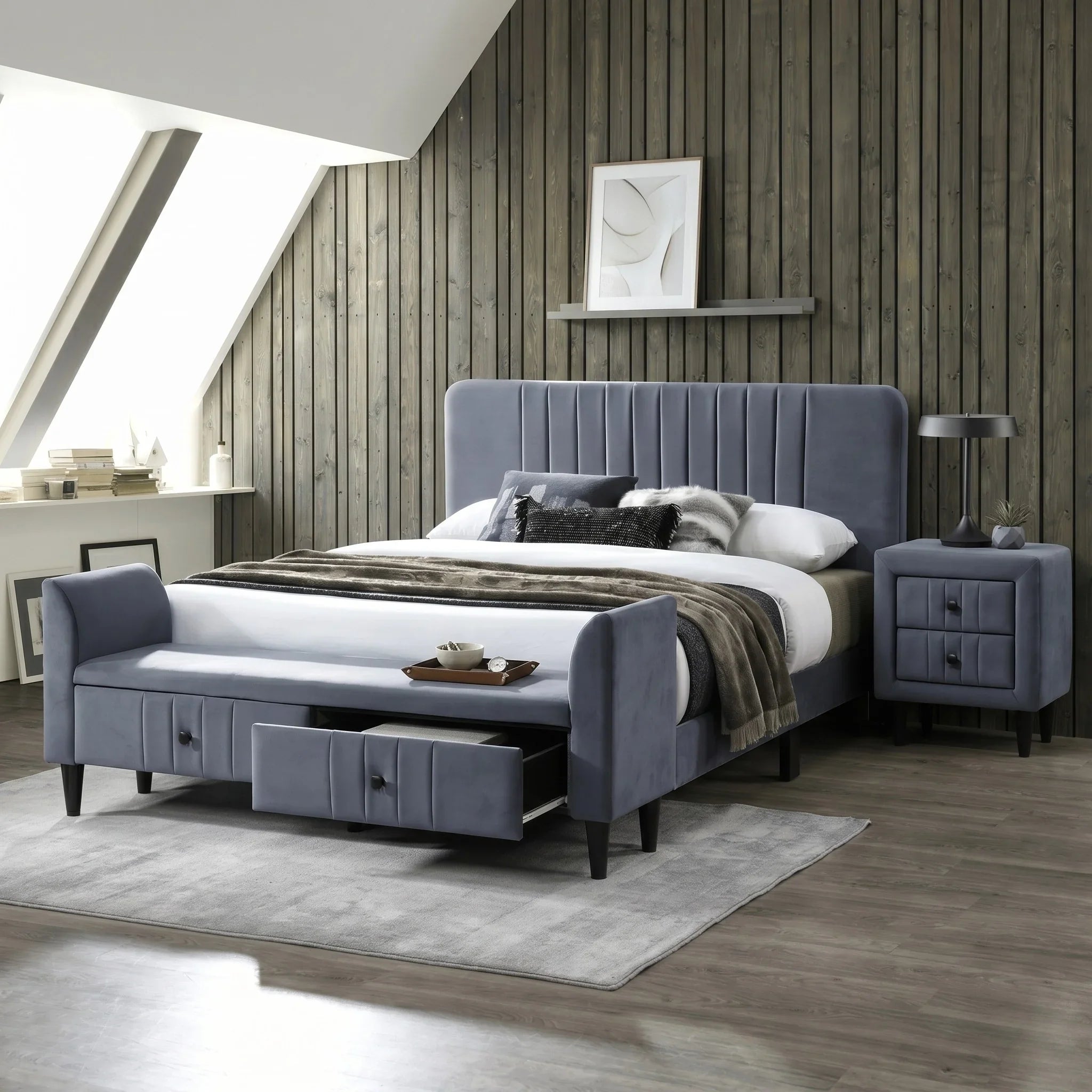
All three are upholstered bed frames. The timber or metal structure underneath is essentially the same. What differs is the surface — the material stretched and padded over the headboard and side rails — and that surface affects how easy the frame is to clean, how it feels to lean against, how it holds up over time, and what the room looks like. PU leather, velvet, and woven fabric each make sense for a specific type of buyer. This guide explains which is which.
What each material actually is
PU leather (polyurethane leather) is a synthetic material with a smooth, wipe-clean surface. It mimics the look of genuine leather without the price or the animal-product sourcing. The surface is non-porous, making it the easiest of the three to clean. Most PU leather beds come in black, white, or brown and have a sleek, contemporary finish.
Velvet is a cut pile fabric — the surface fibres are trimmed short, creating a soft, directional nap that catches light differently depending on angle. Velvet on a bed frame is typically polyester velvet (durable, colourfast) rather than silk velvet (fragile, expensive). It comes in a wide colour range and reads as luxurious and decorative in most rooms.
Woven fabric covers a range of textures: linen, chenille, boucle, tweed, and plain-weave polyester/cotton blends. These are the most common upholstery materials for budget-to-mid-range fabric beds. They look clean and relaxed, are available in neutral palettes, and suit coastal, Scandi, and contemporary styles. This category includes what most retailers simply call "fabric" beds.
One thing that doesn't vary: all three types use foam or fibre padding behind the surface material. The headboard cushioning you get is determined by the padding, not the fabric. A velvet bed isn't softer to lean on than a woven fabric bed — the pile feels different against skin, but the foam layer behind both is similar.


Side-by-side comparison
| Factor | PU Leather | Velvet | Woven Fabric | Winner |
|---|---|---|---|---|
| Cleaning | Wipe with damp cloth — non-porous surface repels spills | Weekly vacuum; spot-clean spills promptly; pile direction matters | Vacuum; spot-clean; fabric protector spray recommended | PU Leather |
| Durability | Surface can crack or peel at stress points (corners, armrests) after 5–10 years | Pile can flatten in high-contact areas; restorable by steaming | Woven structure is robust; pilling possible on lower-quality blends | Woven Fabric |
| Look / style range | Contemporary, minimal, industrial — limited to smooth finishes and dark/neutral tones | Glam, Art Deco, Hamptons, maximalist — rich colour range, light-catching texture | Coastal, Scandi, contemporary, traditional — widest style range | Woven Fabric |
| Feel / tactile quality | Cool and smooth — can feel slightly clinical in some bedrooms | Soft, warm, luxurious to touch — strongest sensory appeal | Natural, textured feel — neutral sensory impression | Velvet |
| Heat retention | Can feel warm or slightly sticky against bare skin in summer | Breathes well — pile doesn't trap heat against skin | Breathes well — most natural fabrics are comfortable year-round | Tie (Velvet/Fabric) |
| Kids & pets | Best — wipe-clean, no pile to trap hair or dander | Moderate — pile traps pet hair; velvet shows marks | Moderate — some fabrics attract pet hair more than others | PU Leather |
| QLD humidity | Non-porous — won't absorb moisture, but surface can degrade with prolonged heat | Can retain moisture in low-airflow rooms — choose legs over plinth base | Breathes better than velvet pile in humid conditions | PU Leather |
| Price range | $299–$799 (broad mid-range) | $449–$999 (generally mid-to-premium) | $179–$799 (broadest range — most entry-level options) | Woven Fabric |
When to choose PU leather
PU leather is the right call when maintenance is your top priority. If you have young children, pets, or a track record of spilling things in bed, a PU leather frame wipes clean in seconds. There's no pile to absorb liquid, no fabric protector to reapply, no grain direction to restore. You wipe it with a damp cloth and it's done.
It also suits a specific aesthetic strongly — contemporary, minimal, or industrial bedrooms where a smooth, sleek headboard surface is intentional rather than a compromise. Black PU leather in a room with dark-stained timber floors and minimal colour reads as sharp and deliberate. It doesn't suit every style: it can look out of place in a Hamptons-style bedroom or a warm, natural-material scheme.
One caution: lower-quality PU leather can crack or peel at stress points (headboard corners, edges) after several years, particularly in rooms with high temperature swings. Mid-to-upper price points use a thicker, more durable PU layer. If longevity is a concern, woven fabric will outlast PU leather on the surface.
When to choose velvet
Velvet is the choice when the bed needs to anchor the room as a visual statement. No other upholstery material has the same ability to hold colour deeply and shift tone as light changes through the day. A grey velvet headboard looks different at 8am with morning light than at 10pm with bedside lamps — the pile catches the light differently each time. That quality makes velvet beds appear more expensive and considered than their price suggests.
It's particularly strong in glam interiors, Art Deco-influenced rooms, boutique-hotel-style bedrooms, and Hamptons rooms where a textured, deep-pile headboard complements the overall palette. Blue, sage, charcoal, and blush velvet all perform well in these contexts. In a minimal or Scandi bedroom, velvet can feel decoratively overloaded — woven linen or textured fabric suits those styles better.
Velvet requires slightly more upkeep than the other two: weekly vacuuming with a soft brush attachment to maintain the pile direction, and prompt spot-cleaning for spills before they set. The pile can flatten in areas of sustained contact (where pillows press against the headboard nightly) — this is usually restorable with a fabric steamer. It's not high maintenance, but it does require more attention than PU leather.

When to choose woven fabric
Woven fabric is the default choice for most bedrooms because it works across the widest range of styles and has the most forgiving long-term surface. A well-woven polyester or linen-look fabric won't crack like PU leather, won't flatten like velvet pile, and comes in the broadest palette of colours and textures — from oatmeal linen-look to dark charcoal boucle.
It suits any style that doesn't specifically call for the sleekness of leather or the luxury of velvet: coastal, Scandi, contemporary, mid-century, and transitional. If you're not sure which direction your room is going, a neutral woven fabric bed (grey, oatmeal, beige) gives you the most flexibility to change the rest of the room around it without the bed fighting the new direction.
It's also the category with the broadest price range — you can find quality woven fabric frames from around $179 up to $799+, which makes it more accessible than velvet at the entry and mid levels. For most buyers without a strong reason to choose PU leather or velvet, woven fabric is the practical default.

Choose PU Leather if…
- You have kids or pets
- You spill things in bed
- You want the easiest-to-clean option
- Your style is contemporary/minimal
- You don't like vacuuming upholstery
Choose Velvet if…
- The bed should be the room's centrepiece
- You love rich colour and depth of texture
- Your style is glam, Art Deco, or Hamptons
- You're happy with regular vacuuming
- You want a boutique-hotel feel
Choose Woven Fabric if…
- You want the widest style compatibility
- You prefer neutral, versatile palettes
- Your style is coastal, Scandi, or contemporary
- You want the best long-term surface durability
- Budget is a priority
A2Z Furniture upholstery range
PU leather beds
A2Z's PU leather bed frame collection focuses on contemporary styles, primarily in black.
- Falcon Black PU Leather Bed Frame — sleek low-profile headboard in black PU leather. Minimal and sharp. Double from $399, Queen $499, King $599.
- Victory — PU leather frame with integrated LED lighting. A statement option for a feature bedroom.
Velvet beds
Velvet frames sit within A2Z's broader upholstered bed frame range.
- Faith Bed Frame — tall velvet-upholstered headboard with integrated storage drawer. Available in grey and ocean blue. Queen from $649, King $749.
Woven fabric beds
The widest selection is in the fabric bed frame collection.
- Aurora Bed Frame — woven fabric headboard in grey or oatmeal. Traditional curved silhouette. Double $399, Queen $449.
- Franco Bed Frame — coastal-style woven fabric headboard. Grey, ocean blue, or black-grey. From $179 Single.
- Finch Bed Frame — contemporary fabric headboard in black or white. Double $449, Queen $549, King $599.
For a broader comparison of all upholstered bed frame types — headboard styles, storage options, and care by material — see our Upholstered Bed Frames: The Complete Guide.
Queensland climate note
Southeast Queensland's subtropical climate affects all three materials differently:
PU leather has a non-porous surface so it won't absorb moisture — an advantage in humid rooms. However, prolonged exposure to high temperatures can degrade the surface layer over years, particularly in rooms without air conditioning. If your bedroom gets very hot in summer and you don't run air conditioning much, PU leather may age faster than the other two options.
Velvet is more susceptible to mould in low-airflow rooms than woven fabric, due to the denser pile structure. In a room with good ventilation or air conditioning, this isn't a practical concern. If your bedroom has limited airflow, choose a frame on legs (not a sealed plinth base) to allow underbed air circulation, and consider a fabric protector spray.
Woven fabric handles Queensland conditions most reliably of the three — it breathes well, doesn't degrade in heat, and is less prone to moisture retention than velvet pile. For detailed care advice for each material type, see our upholstered bed frame guide.
For help choosing the right frame size, slat type, or storage option, see our Complete Australian Bed Frame Buying Guide.
Frequently asked questions
Is PU leather a good choice for a bed frame?
Yes, for the right buyer. PU leather is the easiest upholstery to clean — spills wipe off the non-porous surface with a damp cloth. It suits contemporary bedrooms and households with children or pets. The trade-off is longevity: the surface layer of lower-quality PU leather can crack or peel at stress points after 5–10 years, whereas woven fabric headboards are structurally more durable long-term. Mid-to-upper price points use heavier PU material that holds up much better.
Does velvet on a bed frame get flattened or matted over time?
The pile can flatten in areas of sustained contact — where pillows press against the headboard every night. This is normal and usually reversible: a fabric steamer or a firm brush used with the pile's natural direction will restore most flattening. To reduce it, vacuum weekly with a soft brush attachment to keep the pile upright. The areas most prone to flattening are the centre-upper headboard (where pillows rest) and any surface a person leans against regularly.
Which is easier to keep clean — velvet or fabric?
Woven fabric is generally easier than velvet. Both require vacuuming and spot-cleaning, but velvet's pile structure holds onto dust, pet hair, and marks more visibly than a flat woven surface. On a light-coloured velvet bed, pet hair is very noticeable. On a textured woven fabric, the same amount of hair is far less visible. If you have pets or prefer low-maintenance, woven fabric (or PU leather, which is easiest of all) is the better choice.
Can I get a velvet or PU leather bed with storage?
Yes — upholstery material and storage type are independent choices. The Faith velvet bed frame includes an integrated storage drawer. Fabric beds with gas lift storage are also available. The upholstery is on the headboard and sometimes the side rails; storage mechanisms are in the base — they don't interfere with each other. For a full breakdown of storage bed options, see our storage bed types guide.
Does a velvet bed frame make a room look smaller?
Dark velvet in deep colours (navy, charcoal, forest green) can make a small room feel more intimate and enclosed — this is either a feature or a problem depending on what you want. In a small bedroom, lighter velvet colours (blush, sage, dove grey) maintain the luxury texture without compressing the space. A large floor-to-ceiling velvet headboard actually creates an illusion of height regardless of colour, because the eye tracks vertically up the headboard. The colour choice matters more than the velvet material itself.
How do I remove a stain from a PU leather bed frame?
For most spills: wipe immediately with a barely-damp cloth (not dripping wet). For dried marks or light staining: use a small amount of mild dish soap diluted in warm water, apply with a soft cloth, wipe clean, then buff dry. Avoid abrasive cleaners, acetone, or solvent-based products — they can lift the PU surface coating. For stubborn stains, a dedicated leather/PU cleaner from a hardware store is the safest option. Never scrub the surface; gentle circular motions avoid micro-scratching the coating.
References
- CHOICE Australia — furniture care and upholstery guide, 2024.
- Sleep Health Foundation Australia — bedroom environment factors, 2024.