
Home Theatre Seating Guide · The Comfort Zone
A home theatre lives or dies on the seating. You can spend big on a 4K projector and a surround system, but if the seats are too close to the screen, too few to go around, or just an ordinary sofa pushed against the back wall, the room never quite feels like a cinema. Dedicated theatre recliners fix that — powered recline, a centre console with cup holders, USB charging and the right geometry to put every seat in the sweet spot. This guide covers how to plan the seating: how many seats, what row layout, how far back, which features earn their place, and how to handle power and a second tier.

The short version. Plan the row width first — each theatre seat is roughly 75–90 cm wide, and consoles add 25–30 cm each, so a 4-seat row with consoles needs about 3.2–3.6 m of wall. Get the viewing distance right: for a TV, sit back roughly 1.5–2.5× the screen's diagonal; for a projector, around 1.5× the screen width. Electric recline is worth it here — quiet, infinitely adjustable, and pairs with a powered headrest to keep your eye-line on the screen. Console features matter (cup holders, USB charging, hidden storage, and on some models LED lighting), and if you're running two rows, raise the back row 15–20 cm on a riser so sight lines clear the front headrests.
In this guide
How many seats, and what layout
Start with the wall you're seating against, because that sets the realistic seat count. Theatre recliners are usually sold as connected rows with a console between each pair of seats. Allow roughly 75–90 cm per seat and 25–30 cm for each console, then leave breathing room at each end.
| Wall width available | Typical row | Notes |
|---|---|---|
| Under 2.2 m | 2 seats + 1 console | Couples; or pair a single recliner alongside a smaller sofa |
| 2.6–3.0 m | 3 seats + 2 consoles | The most popular family setup — our Blair 3-seat theatre row |
| 3.2–3.6 m | 4 seats + consoles | Full row for four; the classic cinema look — our Byron and Bonza 4-seat rows |
| 3.8 m+ (two rows) | Two 3–4 seat rows, tiered | Dedicated theatre rooms — use a riser for the back row rather than a single very wide row |

Straight versus curved rows. A straight row is simplest and suits most suburban media rooms. A gently curved ("angled") row, where the end seats toe inward toward the screen, improves sight lines for wider rows of four — worth it in a dedicated theatre, unnecessary in a multi-purpose lounge. And remember the reclined depth: a theatre recliner extends 50–70 cm when the footrest is out, so leave that clearance in front of the row. The full five-measurement method is in our sizing checklist for recliners.
Get the viewing distance right
This is the number that separates a real theatre from a sofa facing a telly. Sit too close and you can't take in the whole image; too far and you lose the immersion. As a practical starting point:
- Flat-panel TV: seat the front row about 1.5–2.5 times the screen's diagonal measurement away. For a 75-inch (190 cm) TV, that's roughly 2.8–4.8 m.
- Projector and screen: sit back around 1.5 times the screen width — for a 2.5 m-wide screen, about 3.75 m.
- Eye line: aim for your seated, reclined eye level to land around the lower third of the screen. A recliner with an adjustable headrest makes this easy to dial in.
Why the headrest matters in a theatre. When you recline, your head naturally drops back — and your gaze can drift toward the ceiling instead of the screen. An adjustable (or powered, on dual-motor models) headrest lets you bring your eye-line forward again without sitting up. It's the difference between watching a whole film comfortably and craning your neck through the third act.
Features that earn their place
Theatre recliners come loaded with extras. The ones that genuinely improve movie nights:
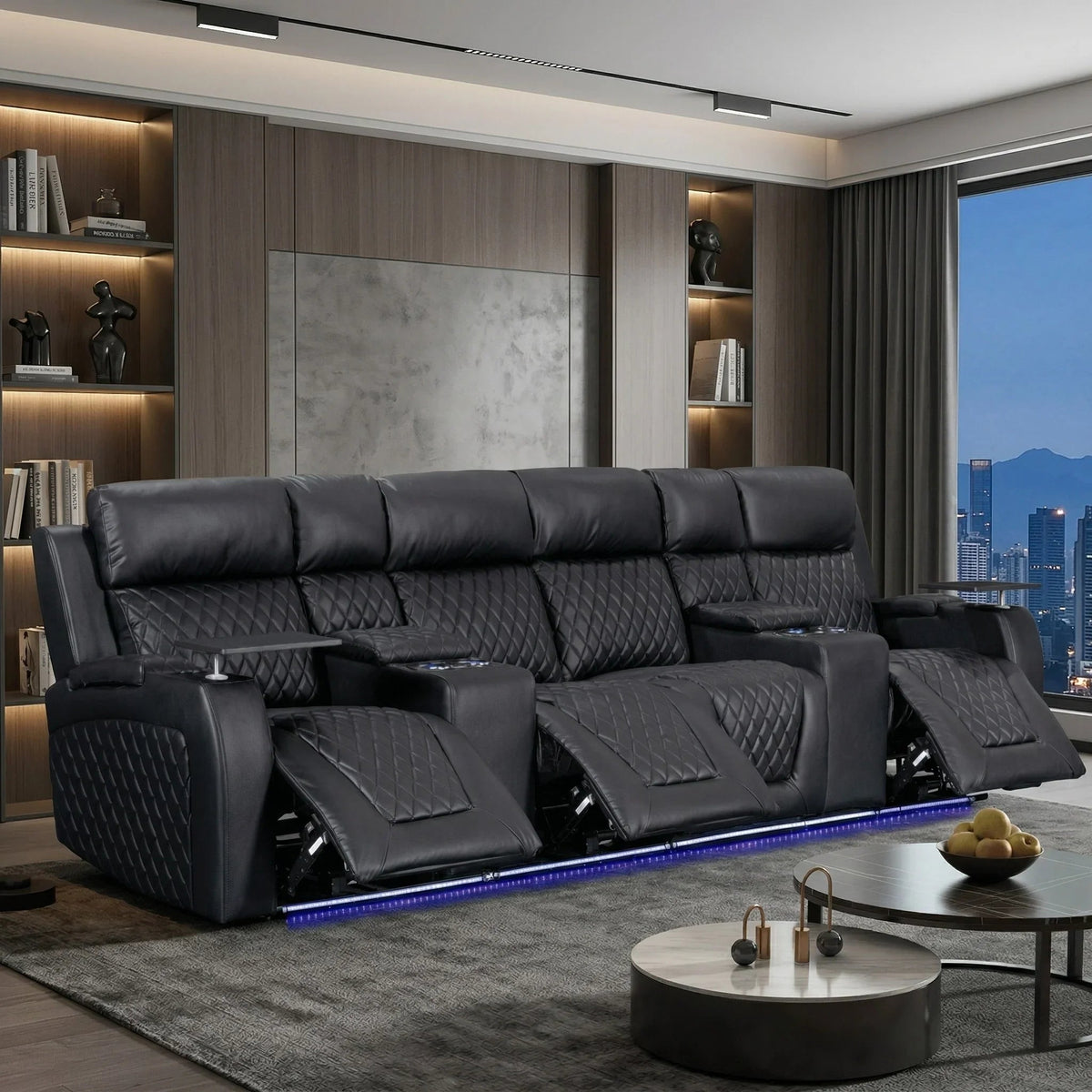
- Centre console with cup holders — the defining theatre feature; keeps drinks stable and seats separated.
- USB charging — phones and tablets stay topped up through a long session. Standard on most electric theatre models.
- Hidden storage — consoles often lift to stash remotes, glasses and snacks.
- Adjustable headrest — powered on dual-motor models — the sight-line fix described above.
- Ambient LED base lighting — a soft floor glow that helps people move safely without lights up.
- Tray tables — available on some models for snacks and drinks without leaving the seat.

What you don't necessarily need is the most expensive everything — prioritise the console, USB charging and headrest, then treat lighting and tray tables as nice-to-haves.
Power, recline and cabling
For a home theatre, electric recline is the better call. It's near-silent (no mechanical clunk mid-scene), holds any position rather than fixed stops, and pairs naturally with adjustable headrests and USB. If you want to understand the trade-off in full, see choosing between electric and manual, and the inner workings are explained in how electric recliners actually work.
Practical cabling notes for a theatre row:
- Each powered row needs a mains point — plan a floor or wall outlet near the seating so the transformer cable isn't stretched across a walkway.
- For a row positioned away from a wall, an in-floor power point under the seating is the tidiest solution — worth raising with your electrician during a fit-out.
- An external rechargeable battery pack (sold separately as an accessory) lets our electric recliners run cord-free or through a power cut — useful if getting mains power to the row isn't practical.
Two rows and tiered seating
If your room is deep enough for two rows, the back row needs to see over the front. The fix is a riser — a raised platform that lifts the rear seating 15–20 cm. Combined with the natural recline angle, that's usually enough to clear the front headrests. Keep these in mind:
- Allow about 90–120 cm between rows so the front row's reclined footrests don't crowd the back row's feet.
- Edge the riser with a low-level LED strip so the step is visible in the dark.
- Build the riser before the seating arrives — it's far easier to position a row on a finished platform than to lift one onto it later.
Shop the range
Ready to plan your row? Browse dedicated theatre seating:
Recommended A2Z theatre setups
A2Z carries dedicated theatre recliner rows built for exactly this:
- The Byron theatre recliner lounge — a 4-seat electric row with consoles, the pictured setup above, ideal for a full media room.
- The Bonza theatre recliner lounge — another 4-seat electric row, a strong alternative finish for the same wall width.
- The Blair theatre recliner set — a 3-seat electric row, the popular family-room size.
- Browse the full home theatre recliner range to compare configurations and finishes.
For where a media room fits in the wider home, and how recliners work across other rooms, see our room-by-room recliner guide, or step back to the recliner guide overview for the full picture.
Home theatre seating FAQs
How far should home theatre seats be from the screen?
For a flat-panel TV, seat the row about 1.5 to 2.5 times the screen's diagonal away — roughly 2.8–4.8 m for a 75-inch TV. For a projector screen, sit back around 1.5 times the screen width. Aim to have your reclined eye-line fall around the lower third of the screen.
How much wall width do I need for a 4-seat theatre row?
About 3.2–3.6 m. Each theatre seat is roughly 75–90 cm wide and each centre console adds 25–30 cm, so a four-seat row with consoles between the seats lands in that range — plus a little breathing room at each end.
Should home theatre recliners be electric or manual?
Electric is the better choice for a theatre. It's near-silent so it won't clunk mid-scene, holds any recline position instead of fixed stops, and pairs with adjustable headrests and USB charging. Manual recliners are fine in a casual media space but less suited to a dedicated cinema room.
Do I need a riser for two rows of theatre seating?
Yes, if you want the back row to see over the front. A platform that raises the rear seating 15–20 cm, combined with the recline angle, usually clears the front headrests. Allow 90–120 cm between rows and edge the riser with low LED lighting for safety.
What features should a home theatre recliner have?
Prioritise a centre console with cup holders, USB charging, and an adjustable headrest for sight lines. Hidden console storage, ambient LED base lighting and tray tables are useful extras on some models but secondary to the core three.
Written by the A2Z Furniture team — five South-East Queensland showrooms, family-owned and operated since 2013. Last updated July 2026.