
Bedroom Storage · Bedroom Bliss
Tallboy, chest of drawers, dresser: three names, one family of furniture, and a naming convention that shifts depending on which country the page you are reading was written in. The choice is easier than the vocabulary. Stop asking which piece is best, ask what your room can give up, and the answer picks itself.

The short version. A tallboy is tall and narrow, and buys storage without spending floor space. A chest of drawers is wider and lower, so it gives you a usable top. A dresser, in Australian retail, is that lower, wider piece sold with a mirror. Small room: tallboy. Long wall: chest. Getting ready in the bedroom: dresser. And anchor whichever you choose — a tallboy is top-heavy and a genuine tip-over hazard around young children.
In this guide
Three names, one family
All three do the same job: they hold folded clothing in drawers. What separates them is proportion, and in one case an accessory.
Tallboy
Tall and narrow, drawers stacked vertically in a single column, so it holds a great deal relative to the floor it occupies. The trade-offs come with the shape: the top is usually too high and too small to be useful, the upper drawers can be a stretch, and the centre of gravity sits high — which matters enormously for safety.
Chest of drawers
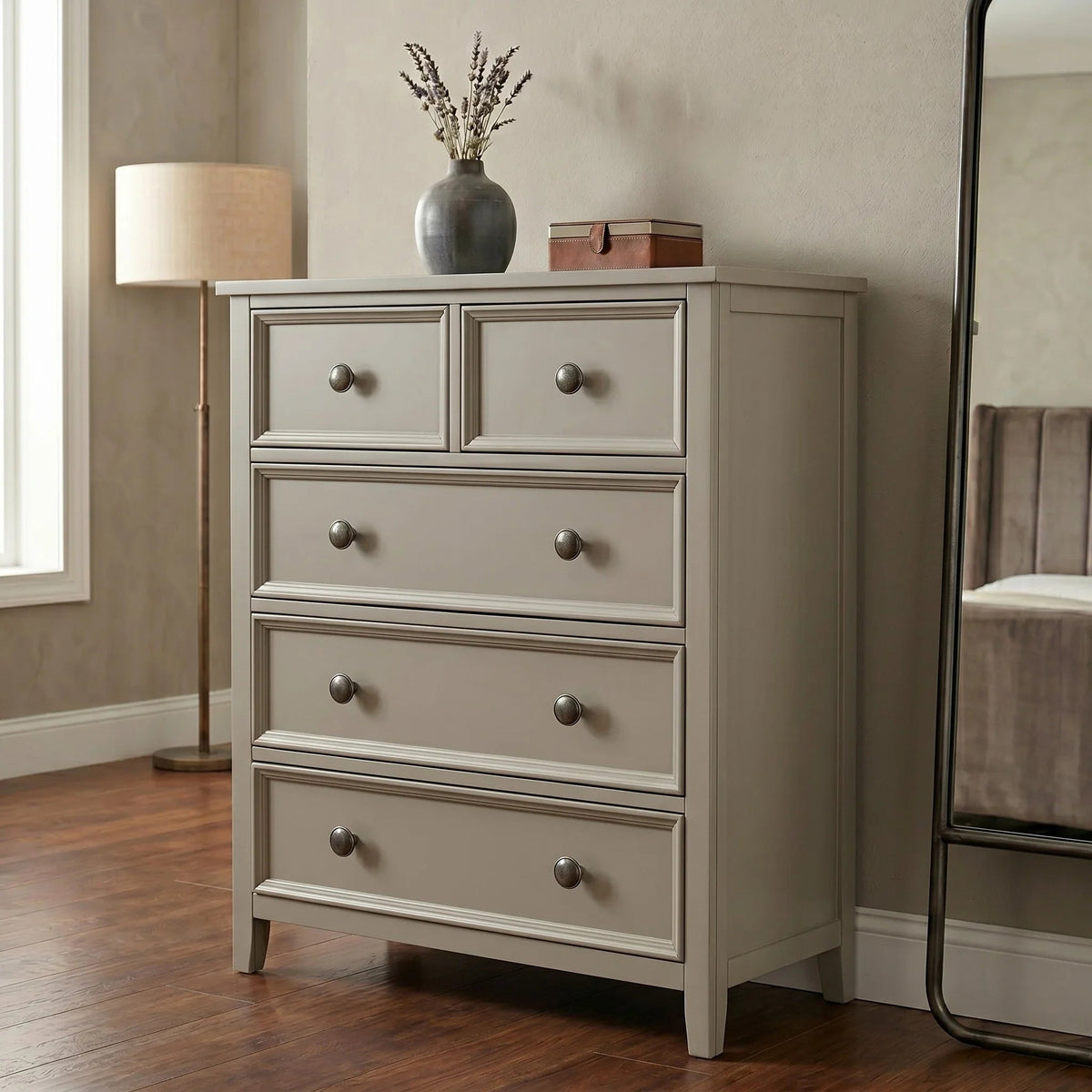
Wider and lower, drawers side by side or in wide full-width runs. You give up floor-space efficiency and gain a broad, usable top, wider drawers for bulky items, and a more planted stance.
Dresser
In Australian retail a dresser is generally that lower, wider piece sold with a mirror — the mirror is what makes it a dresser rather than a chest. In American usage, "dresser" simply means any chest of drawers, which is why so much of what you read online contradicts itself. Retailers use the terms loosely too, ourselves included. Do not buy on the noun: look at the proportions and whether there is a mirror.
The three pieces at a glance
| Tallboy | Chest of drawers | Dresser | |
|---|---|---|---|
| Shape | Tall, narrow, drawers in one column | Wider and lower, drawers side by side | Same low, wide body as a chest |
| Floor space | Least | More | More, plus stand-back room |
| Usable top | Small and high | Broad, comfortable height | Partly taken by the mirror |
| Mirror | No | No | Yes — the defining feature |
| Stability | Most top-heavy; anchoring essential | More planted, still anchor it | More planted, still anchor it |
| Suits | Small bedrooms, apartments, narrow walls | Long walls, under windows, anywhere you want a surface | Bedrooms where you get ready |
The decision is the room, not the piece
Nobody needs a tallboy in the abstract. They need somewhere to put clothes in a room that already has a bed, a door, a window and probably a wardrobe. Start there.
Small bedroom or apartment: tallboy
If floor area is the constraint, build upwards. A tallboy turns an otherwise unusable strip of wall — beside the wardrobe, in an alcove, behind the bedroom door — into real storage. The Joseph Tallboy is a straightforward modern take on the shape; the Tennyson Tallboy does the same job in black; and the Lucy Tallboy is a solid timber version of the same narrow footprint.

A wide wall, or you want a surface: chest of drawers
If you have a run of wall doing nothing, a chest is the better use of it. The low, broad top becomes the surface the room was missing, and it sits low enough to go under a window without blocking light — which a tallboy cannot do. Wide drawers also hold bulky things flatter, and you see the contents at a glance. Compare both shapes across the chest of drawers and tallboys range.
You get ready in the bedroom: dresser with a mirror
If the bedroom is where you do your hair, skincare or makeup, buy the dresser and stop borrowing the bathroom. A dresser with a mirror gives you a surface with the mirror already fixed in the right relationship to it.
Placement relative to the window is what people get wrong. Put the window in front of you or to one side, never behind you — with it at your back, daylight lands on the back of your head and your face sits in its own shadow. Facing it, or at a right angle to it, puts soft light where you need it.

Shared or main bedroom: often one of each
In a shared main bedroom the best combination is usually not two matching chests, but one tallboy and one dresser. Two different footprints fit a real room better than two identical ones — the tallboy takes the short wall, the wider piece the long one. Storage divides cleanly, and you get one good surface and one good mirror rather than two half-used tops.
Wardrobe-adjacent: drawers versus hanging
- Hang what creases: shirts, dresses, tailored trousers, jackets, linen.
- Fold what does not: t-shirts, denim, activewear, underwear, socks, sleepwear.
- Always fold knitwear — jumpers stretch over a hanger and come out with shoulder bumps.
- Deep bottom drawer for bulk: spare linen, towels, the winter quilt cover.
- Top drawer for daily things: socks, belts, watches, at the easiest height.
Our bedroom storage range covers the options, and our guide to space-saving bedroom furniture goes deeper on tight rooms.
Shop the range
Compare all three in person, or browse them here:
Buy the matching set one piece at a time
This is the most useful thing we can tell you about the category. Several of our ranges span all of it, so the tallboy and the dresser are the same design in two proportions — matching finish, handles and drawer fronts. Buy them one at a time, months apart, and the room still looks deliberate rather than assembled from whatever was available.
- Joseph. The Joseph Tallboy and the Joseph Dresser with Mirror — the narrow vertical piece and the low, wide mirrored one, in a single design.
- Jayden. The Jayden Tallboy and the Jayden Dresser with Mirror — the same pairing in a different look.
That is the one-of-each combination a shared main bedroom wants. Furnishing from scratch? Start with our guide to selecting the perfect bed frame, since the bed decides where everything else can go.

Anchoring and tip-over safety
A tallboy is the most top-heavy piece of furniture in a typical bedroom. The base is narrow, the body is tall, and every drawer you pull out moves weight forward and upward. Open two or three at once, or let a small child use them as a ladder, and the whole piece can come over on top of them. Loaded drawers are heavy. Treat a tallboy as a fixed item attached to the wall, not furniture you slide around.
- Anchor it, every time. Use the restraint strap or bracket supplied with the piece, or a separate anchoring kit. Fix into a timber stud, or masonry with the correct plug — a screw into plasterboard alone will pull straight out under load.
- Load the bottom drawers heaviest. Denim and linen low, light things high. It lowers the centre of gravity.
- One drawer open at a time. Several open together is the classic failure mode, and this is the easiest habit here to build.
- Keep the top clear of anything a child wants. Remotes, toys, chargers and treats are an invitation to climb. So is a television — a tallboy is not a TV unit.
- Re-anchor after every move, including pulling the piece out to vacuum behind it.
- Renting? Ask. Anchoring costs two small screw holes, and most agents treat a wall anchor as a safety fixture, not damage.
The same applies to a chest and a dresser. Lower and wider is genuinely more stable — but "more stable" is not "stable", and a loaded chest with a child hanging off an open bottom drawer will still go over. Anchor those too. If you are unsure what hardware comes in the carton, ask us and we will check that item.
What to open and feel for
Photographs tell you the shape and the finish. They tell you nothing about how a drawer behaves on its four-thousandth pull, which is what decides whether you still like the piece years later.
Runners and drawer boxes
Pull a drawer out to full extension. Does it stay level, or does the front dip? Then push it closed with one finger at a front corner, not the middle — a drawer that racks off-centre will do it every day, because nobody closes a drawer squarely. Metal ball-bearing runners generally glide more smoothly and carry more weight than timber or plastic ones. Take the drawer right out if you can: you want solid sides, a base sitting in a groove rather than pinned underneath, and corners properly joined.
Carcass, tops and handles
Push gently sideways on a top corner. A well-built carcass barely moves; a poor one racks like a parallelogram. The back panel does that work, and on a tall piece the rigidity is a safety matter as much as a quality one. Tops range from solid timber to engineered board with a veneer or laminate surface, which matters most on a dresser: perfume, deodorant and skincare all mark finishes, so use a tray.
Door swings and drawer clearance
A chest, tallboy or dresser does not only occupy its own footprint. It occupies that, plus a fully open drawer, plus the space where a person stands to use it.
- Stand where you would actually stand. Open a drawer fully in the showroom. Could someone still walk past behind you?
- Check what else swings there. A bedroom, wardrobe or ensuite door meeting an open drawer is a problem you notice every morning.
- Mind the bed. A tallboy beside the bed can beat a bedside table, if the drawers clear the mattress.
- A mirror needs stand-back room. A dresser jammed into a corner you cannot step back from defeats the point of it.
- Getting it into the room. Hallway turns, stair landings and doorways all have to be negotiated on delivery day.
None of this needs a tape measure. It needs you to picture one ordinary morning and walk through it.
Tallboy, chest and dresser FAQs
What is the difference between a tallboy and a chest of drawers?
A tallboy is tall and narrow, drawers stacked in one column: it stores a lot for very little floor space, but the top is small and high and the centre of gravity is high. A chest of drawers is wider and lower, giving you wider drawers and a usable top. Retailers use both terms loosely, so judge the proportions rather than the name.
Is a dresser just a chest of drawers with a mirror?
In Australian retail, essentially yes — a dresser is usually the lower, wider piece sold with a mirror, and the mirror is the defining feature. In American usage, dresser simply means any chest of drawers, which is why advice online so often contradicts itself.
Which is better for a small bedroom or apartment?
A tallboy, in almost every case: it builds storage upward instead of outward and fits where a wider chest will not — a narrow return of wall, beside the wardrobe, or an alcove. The trade-off is that you lose the usable top surface.
Do I really need to anchor a tallboy to the wall?
Yes. A tallboy has a narrow base and a tall, heavy body, and every open drawer shifts weight forward and up, so a child climbing on those drawers can bring the whole piece over. Use the supplied restraint or an anchoring kit fixed into a timber stud or masonry, load the heaviest items low, and open one drawer at a time. Anchor chests and dressers too.
Can I buy a matching tallboy and dresser?
Yes, and piece by piece rather than all at once. The Joseph range includes a Joseph Tallboy and a Joseph Dresser with Mirror, and the Jayden range includes a Jayden Tallboy and a Jayden Dresser with Mirror — the same design in two proportions, with matching finish and handles.
What should go in drawers and what should stay hanging?
Hang what creases or holds a shape: shirts, dresses, tailored trousers, jackets and linen. Fold what does not: t-shirts, denim, activewear, underwear, socks and sleepwear. Always fold knitwear, because jumpers stretch over a hanger, and keep the deep bottom drawer for bulk such as spare bed linen.
Written by the A2Z Furniture team — five South-East Queensland showrooms, family-owned and operated since 2013. Last updated September 2026.