
A straight desk suits most home offices: it fits more rooms, sits against any wall and moves easily when the room changes use. A corner desk, also called an L-shaped desk, earns its place when you have a clear corner and genuinely use two work zones, such as dual screens or paperwork beside a laptop.
In this guide
How each shape changes the way you work
A straight desk, also sold as a single desk, writing desk, study desk or flat desk, is one rectangular work surface. Everything happens in front of you: screen, keyboard, notebook. You sit square to the work and the desk sits square to the wall.
A corner desk wraps around you. In its L-shaped form it has two arms meeting at a right angle, so you work at one arm and swivel to the other. That swivel is the whole point. One arm holds the screen; the other holds paperwork, a drawing pad, a printer or a second screen. People who use both arms every day tend to love them. People who don't usually end up with a second arm covered in mail and chargers.
So before you think about floor space, think about your working day. If most of your work happens on one laptop or one monitor, you are already working in a straight line, and a straight desk matches that. If you genuinely move between two kinds of task through the day, such as screen work and spread-out paper, a corner layout matches that instead.
Pieces in this guide
Corner desk vs straight desk at a glance
Here are the practical differences in one place. None of them is about quality; they are about how each shape fits a room and a routine.
| Feature | Straight desk | L-shaped corner desk |
|---|---|---|
| Footprint | One rectangle along one wall | Two arms across two walls |
| Chair space | Behind the desk only | Inside the corner, with room to roll back from either arm |
| Work zones | One | Two, separated by a swivel |
| Rooms with doors, windows or power points | Usually fits along the clearest wall | Needs a corner with both walls clear |
| Moving rooms or homes | Fits almost any wall | Needs a similar corner in the new spot |
| Dual monitors | Screens sit side by side | One screen per arm is a natural fit |
| Best for | Laptop or single-screen work; rooms with a second job | Dedicated offices with two genuine work zones |
The pattern is simple. A straight desk asks for less from the room. A corner desk gives you more surface, but only if the room can give it a clean corner and you have a use for both arms.
Does a corner desk actually save space?
The common line is that a corner desk saves space because it uses a corner that would otherwise be wasted. Sometimes that is true. Often it is not, for two reasons.
The chair needs more floor. With a straight desk, you need room to roll the chair back behind it, and that's it. With an L-shaped desk you sit inside the L, so you need clear floor inside the corner plus room to roll back from either arm. The desk surface is bigger, but so is the patch of floor you can't use for anything else.
The corner is rarely empty. A corner desk needs two clear walls meeting at a right angle. In many spare bedrooms and apartments, the "spare" corner sits beside a doorway, a wardrobe, a window, a power point or an air-conditioning unit. A desk that blocks a door swing or half a window isn't saving space; it's adding a daily workaround.
Where a corner desk does save space is a room with a genuinely dead corner and a need for lots of surface. Smaller corner units that tuck into the angle, rather than a full L, can suit a bedroom or a nook, as long as the corner is truly free. If it isn't, a straight desk against the longest clear wall usually leaves you more usable floor.
When a straight desk is the better pick
Most home offices fall into at least one of these situations:
- The room does more than one job. A spare bedroom, guest room or living area has to work when you're not working. A straight desk sits along one wall and leaves the rest of the room alone.
- You might move. Renters, and anyone planning a move in the next few years, do better with a piece that fits whatever wall the next home offers.
- You work on one screen. One laptop or one monitor doesn't need a second arm. A straight desk gives you the surface you'll actually use.
- Your corners are interrupted. Doors, windows, wardrobes and power points rule out a lot of corners before you've measured anything.
- You want to choose which way you face. A straight desk can sit side-on to a window, which keeps glare off the screen and puts soft light on your face for video calls. A corner desk faces wherever the corner faces.

When an L-shaped desk is worth it
An L-shaped desk earns its place in three situations:
- Two screens in constant use. One screen per arm means you turn your chair to face each one rather than leaning towards the far edge of a wide setup.
- Paper or drawing beside the screen. Bookkeepers, designers, illustrators and students working from textbooks often need a second surface that stays out of the keyboard's way. A corner art desk works on the same idea.
- A room that will stay an office. If the room won't become a guest room or nursery any time soon, committing a corner to the desk costs you little.
If two or more of these describe you, an L-shaped desk is worth a look. If only one does, a long straight desk often does the same job: a wider surface gives you room for a second screen or a paper zone at one end, without committing the room to an L.
To be upfront: we don't currently sell corner or L-shaped desks. If you've decided you need one, a specialist range will give you more choice than we can.
Setting up a straight desk from our range
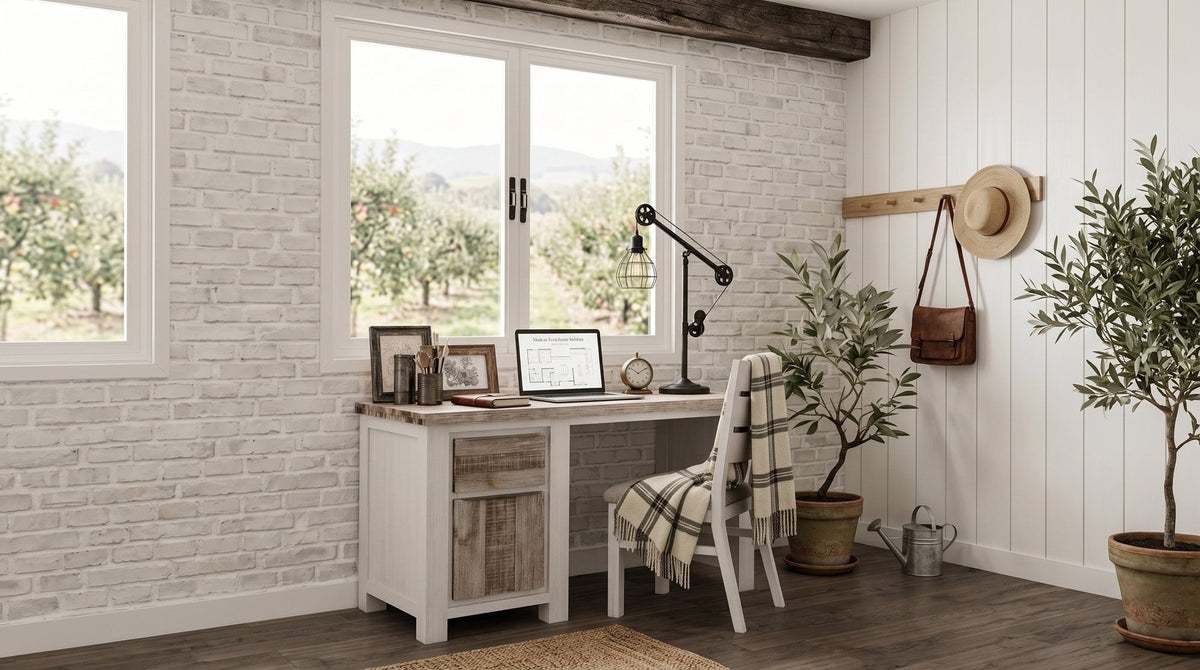
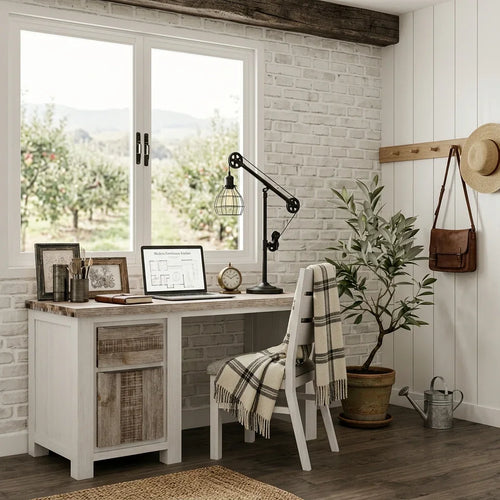
Our desks and study tables are straight desks. The Homestead Study Desk is a compact, single-pedestal desk with acacia wood across its visible timber panels, a soft white painted frame and a washed, farmhouse-inspired finish. The pedestal has a drawer above a cupboard, so stationery and notebooks go out of sight without a separate cabinet. Its compact footprint suits a study corner, a bedroom nook or a spare room that still needs to work as a guest room.
You can still use a corner with a straight desk. Slide one end into the corner along the longest clear wall and leave the other end open for the chair. Check which side the pedestal sits on first, so the drawer and cupboard stay easy to reach.

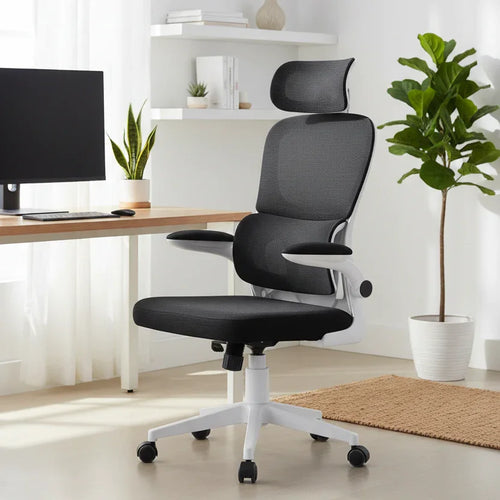
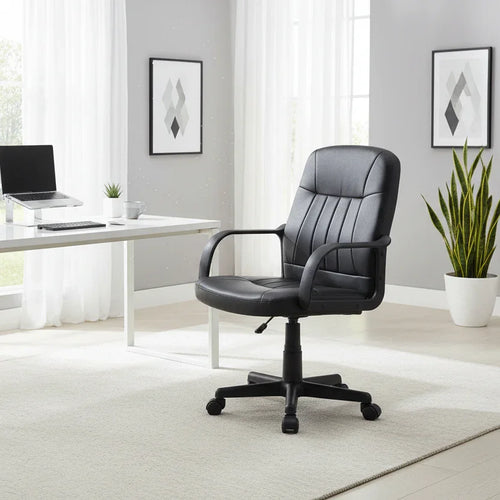
Then choose a chair for the room. The Cloud Ergonomic Mesh Office Chair has a full mesh back and seat, an adjustable headrest, a reclining tilt with adjustable tension, and flip-up armrests that fold against the backrest so the chair tucks under the desk when you finish. For a smaller room, the Clontarf Fabric Office Chair is a compact mid-back chair in black technology fabric, with channel-stitched padding, fixed loop armrests and a gas-lift seat on castors.
Browse the wider home office furniture range for chairs and storage, and ask which of our five showrooms (Rocklea, Virginia, North Ipswich, Bundall and Beenleigh) has the Homestead on display, so you can sit at it before you measure up at home.
Corner and straight desk questions
What is a corner desk called?
A corner desk with two full arms meeting at a right angle is usually called an L-shaped desk. Smaller units built to fill the angle of a room are often sold simply as corner desks or corner workstations. A straight desk also goes by single desk, writing desk, study desk or flat desk.
Is an L-shaped desk the same as a corner desk?
Mostly, yes. Every L-shaped desk is designed to sit in a corner, but not every corner desk is a full L. Some are compact units with a smaller surface that tucks into the angle. Check the length of both arms and how much clear floor the chair will need inside the corner.
Can a corner desk go in a bedroom?
It can, if the bedroom has a corner with no door swing, wardrobe door, window or power point in the way, and you can still walk around the bed. In many bedrooms a compact straight desk against one wall fits more easily and leaves the corner free.
What desk shape is best for a small space?
In most small rooms, a compact straight desk is the easier fit because it needs one clear wall and chair space on one side only. A corner desk only beats it when the room has a genuinely free corner and you need two work zones.
Is a long straight desk a good alternative to an L-shaped desk?
Often, yes. A longer straight desk gives you room for a second screen or a paper zone at one end while still sitting against a single wall, so the room is easier to rearrange later.
Does A2Z Furniture sell corner desks?
No. Our current desk range is straight study desks, including the Homestead Study Desk. If you need an L-shaped desk, a specialist range will have more choice. We can help with a straight desk and an office chair to suit it.