Office Chairs · A2Z Furniture

Choose the wrong office chair and you'll feel it within a fortnight — first as a stiff lower back, then a sore neck, then a dull resentment for the desk you used to enjoy. The right chair disappears under you and lets you focus on the work. The hard part is figuring out which one is which before you commit. This guide is the practical version of that question, written for people furnishing a real Australian home office — not a corporate fit-out, not a $2,000 Steelcase showroom — and it covers the chair types worth considering, the features that actually matter, the ones that are oversold, and the price tiers that make sense for home use. It's part of our broader home office furniture guide for Brisbane and Queensland homes, where we cover desks, storage and ergonomics in the same plain-English style.

Why your chair is the most important home office purchase

If your home office is going to see more than two hours a day of focused work, the chair is the piece that earns or loses you those hours. The desk barely matters by comparison — almost any flat surface at a sensible height will do. The chair is what your spine sits in for thousands of hours over the next few years, and it's the piece where buying logic most often breaks down.

People who comfortably spend $1,500 on a sofa they sit on for two hours a night will hesitate at $300 for a chair they'll sit in for eight hours a day. The maths doesn't survive scrutiny. Spread across a typical three-year ownership window, a $300 chair used full-time costs roughly fifteen cents an hour — and the alternative tends to involve physiotherapy bills that comfortably outweigh the saving.

The good news: you don't need a $2,000 chair to get the major benefits. A $200–$500 chair that genuinely fits your body and pairs correctly with your desk height outperforms a more expensive chair you bought on faith. Fit matters more than the spec sheet — which is the whole reason this guide exists.

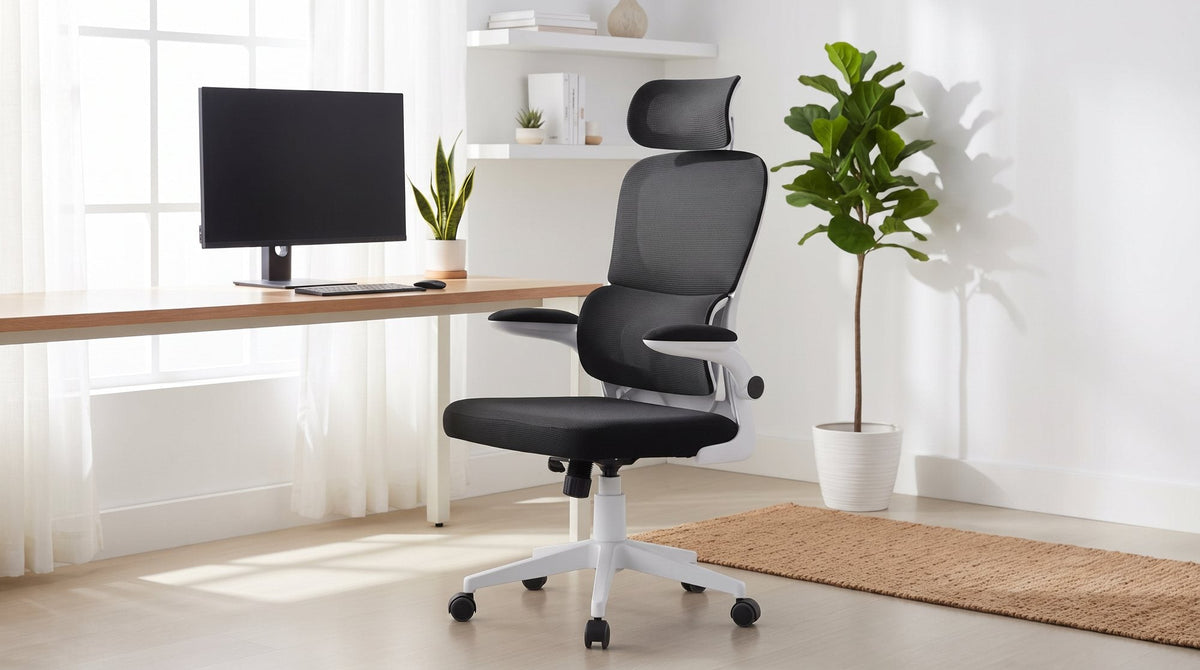
Casino Ergonomic Mesh Office Chair set up in a modern home office with a desk and indoor plants

A well-fitting mid-range chair beats a poorly-fitted premium one every time.

The four types of office chairs for Australian home offices

There are four chair categories worth considering for an Australian home office, each with a clearly different best-use case. The differences aren't subtle. Choose the wrong category and even the most expensive version of it will frustrate you; choose the right category and even a budget version will quietly do its job for years.

Type Best for Climate fit (QLD) Look Typical price
Ergonomic mesh 4+ hours/day focused work Excellent — breathes well Modern, technical $180–$500
Executive Mixed admin and video calls Average — solid back retains heat Substantial, professional $200–$400
Fabric task General purpose, lighter use Good — fabric breathes Soft, domestic $125–$300
PU leather Mixed-use rooms, easy clean Below average — hot in summer Sleek, formal $200–$300

Ergonomic mesh

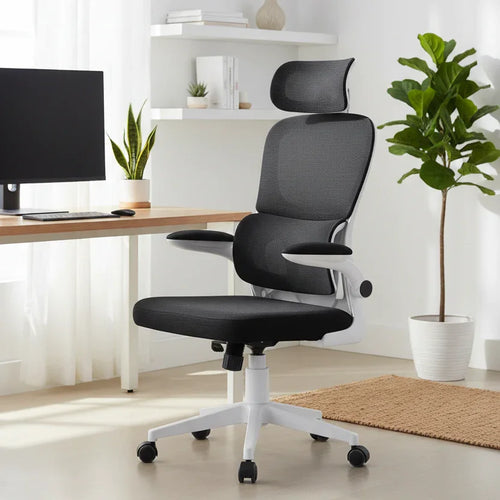
The ergonomic mesh chair is the right answer for most Australian home WFH workers, especially in Brisbane and the Gold Coast. The breathable back panel keeps you cool through humid summer afternoons in a way fully-upholstered chairs simply can't, and the mesh tension distributes pressure across your back rather than concentrating it in two padded zones. Models like the Cloud Ergonomic Mesh Office Chair and the Casino Ergonomic Mesh Office Chair pair adjustable lumbar support with multi-axis armrests at price points that don't require a corporate procurement budget.

Cloud Ergonomic Mesh Office Chair styled in a bright home office with a desk and decor

Mesh distributes pressure evenly and breathes through Brisbane summers.

Executive

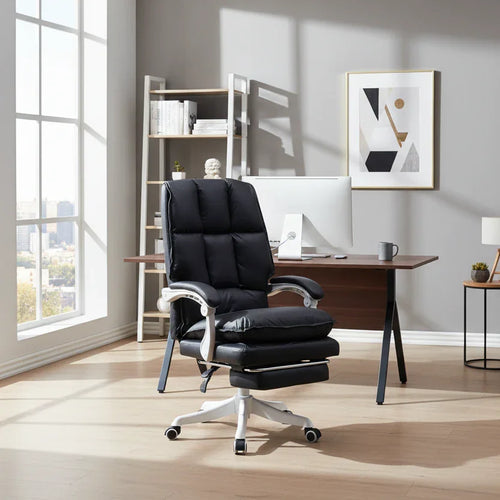
Executive chairs are designed for the kind of work where presentation matters — frequent video calls, client-facing meetings, the occasional in-room interview. The deeper, more substantial silhouette photographs better than mesh on a video call, and the higher back can be more comfortable for leaning back during long phone conversations. The trade-off is heat: the solid padded back retains warmth in a way you'll notice by 2pm in a Queensland summer. The Copenhagen Executive Office Chair sits at the practical end of this category — boardroom look, home-office price. If you're weighing up a mesh ergonomic chair against a traditional executive style, the choice usually comes down to airflow versus presentation.

Copenhagen Executive Office Chair in a modern home office setting with a desk and armchair

Executive chairs photograph well on video calls but retain heat in Queensland summers.

Fabric task

Fabric task chairs are the friendly middle ground — lighter than executive, softer than mesh, more domestic than either. They suit home offices that share a room with a guest bed, a living area, or a kid's homework corner, where the chair needs to look like it belongs in a home rather than a corporate floorplate. Build quality varies more in this category than the others, so adjustability and the quality of the lumbar support are the things to test before committing. The Clontarf Fabric Office Chair and Camp Fabric Office Chair are both worth a sit-test for buyers in this category.

Clontarf Fabric Office Chair set up in a modern home office with a desk and decor

Fabric chairs soften the room — a good fit for offices that share a space.

PU leather

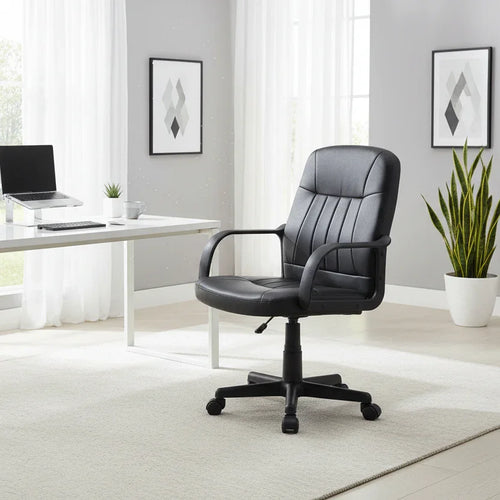
PU leather chairs land in a niche that doesn't suit every household, but suits the right one well. The wipeable surface is a real practical advantage in shared dining/office rooms or kitchens where lunch happens at the desk. The look reads more formal than fabric or mesh — useful for client-facing video calls. The downside is heat: PU leather is the worst of the four for Queensland summers, and the surface temperature genuinely matters between November and March. The Camp PU Leather Office Chair and Calypso PU Leather Office Chair are the two worth comparing if this category fits your room.

If you choose a PU leather chair, care it correctly: link to the Guardsman ProGuard Care Kit, never the standard Leather Care Kit. PU leather and real leather are formulated differently and using the wrong product can damage the surface.

Camp PU Leather Office Chair set up in a home office with a desk and decorative plants

PU leather wipes clean — useful in shared rooms, less ideal for hot afternoons.

If you're stuck deciding between mesh and executive specifically — the two most popular categories — the trade-offs are worth a closer look:

Full guide: Ergonomic Mesh vs Executive Office Chairs — Which Is Right for You?

Matching the chair to your hours of use

How long you'll actually sit in the chair changes the whole buying calculation. The chair that's "fine" for two hours a day at a side hustle is genuinely punishing for eight hours of full-time WFH work. Match the spec to your hours, and you'll spend the right amount of money on the right features.

Hours per day Chair tier Critical features
1–2 hours (admin, side projects) Basic task chair Adjustable height, comfortable cushion
3–5 hours (hybrid work) Mid-range ergonomic + Adjustable lumbar, tilt-tension control
6–8 hours (full-time WFH) Higher-spec ergonomic + Adjustable armrests, mesh back, seat-depth flexibility
8+ hours (intensive desk work) Premium ergonomic + Synchro-tilt, depth-adjustable lumbar, longer warranty

The biggest mistake we see is buyers in the 6–8 hour bracket trying to economise into the basic task tier. That chair was never designed to absorb a 40-hour working week, and it shows up as discomfort by the end of the first month. The reverse mistake — over-buying premium for casual use — is much rarer and much less harmful. For buyers settling into full-time work-from-home and 8+ hour days, the spec sheet matters more than the marketing.

Full guide: How to Choose an Office Chair for 8+ Hour Work Days

Materials and the Brisbane climate question

Material choice matters more in Queensland than almost anywhere else in Australia. The combination of high summer humidity, long sun-exposed afternoons, and the fact that most home offices in older Brisbane houses don't have the constant air-conditioning of commercial floors creates a real climate-fit question that generic Australia-wide guides rarely address.

Mesh — best for Queensland summers

The breathable mesh back is the single best feature for Brisbane and Gold Coast home offices. Air moves across your back as you work, the chair surface doesn't accumulate body heat, and you can sit through a 32-degree afternoon without that distinctive "stuck to the chair" sensation that fully-upholstered chairs produce. Mesh seats (less common, but available) extend the same airflow advantage to the seat pan.

Fabric — the friendly compromise

Quality fabric breathes reasonably well — not as well as mesh, but considerably better than vinyl-style finishes. Fabric reads as more domestic than mesh, which is why it suits home offices that share a room. The downside is cleaning: fabric stains, and a knocked-over coffee on a fabric chair is a different conversation than the same accident on PU leather.

PU leather — wipeable but warm

PU leather is the easiest of the three to keep looking new — wipes clean in seconds, doesn't stain, doesn't absorb spills. The catch is summer comfort: PU is the least breathable surface, so a chair that feels supportive in winter can feel uncomfortably warm by mid-afternoon in February. The decision usually comes down to whether you'd rather optimise for cleanability (PU) or temperature comfort (mesh or fabric). For buyers who've narrowed it down to PU leather or fabric specifically for a Brisbane home, the comparison is closer than the climate alone makes it sound.

Full guide: PU Leather vs Fabric Office Chairs — Which Suits Brisbane Homes?

Sizing for body type and small home offices

Office chairs are sized for "average" adults, and most people are not exactly average. If you're under 160 cm or over 190 cm, the chair fit becomes the dominant factor — far more important than material, brand, or price band. The same is true for non-standard body shapes, longer or shorter torsos, broader or narrower shoulders. Sit before you buy, and don't trust online photographs to convey scale.

Seat depth and width

The seat should support roughly two-thirds of your thigh length, with a 2–4 cm gap behind your knees. Too short and the seat edge presses into your thighs; too long and the seat edge cuts circulation behind your knees. Width should accommodate your hips with about 2–3 cm clearance on each side — tighter than that and the chair feels confining within a few hours.

Compact chairs for small home offices

Apartment alcoves, hallway nooks and shared-room corners need chairs that respect the room's dimensions. Bulky executive chairs visually dominate small rooms and physically obstruct them; slimmer task and ergonomic mesh designs disappear into the space. Wheels and a swivel base matter more in compact spaces, not less — they let you move out of the way of the bookshelf or wardrobe behind you when you need to. We go deeper on compact chair picks for small Brisbane home offices, including how chair scale changes the feel of a 2 × 1.5 m corner.

Full guide: Office Chairs for Small Home Offices — Compact Picks for Brisbane Apartments

The features that actually matter (and the ones that don't)

Office chair spec sheets list dozens of features. Most don't change your daily experience much. Six genuinely do.

The six that earn their keep

  1. Seat height adjustment — your forearms should sit parallel to the desk, feet flat on the floor. This is the single most important adjustment and the one that has to fit your body and your desk together. Range matters more than any other spec.
  2. Adjustable lumbar support — the chair's lumbar curve should match your lower-back curve. Depth-adjustable is significantly better than height-adjustable; chairs that adjust both are best. Fixed lumbar that happens to fit you is fine, but you can't predict that without sitting in it.
  3. Tilt-tension control — the dial that controls how much resistance the backrest gives when you lean back. Set too loose and you fall back unpredictably; set too tight and you can't recline at all. A proper adjustable tilt-tension is what makes the chair feel like it's working with you.
  4. Adjustable armrests — they should swing out of the way when you push under the desk and adjust in height to support your forearms without lifting your shoulders. 2D (height + width) adjustment is the practical sweet spot; 4D adjustment is nice-to-have but rarely transformative.
  5. Seat depth flexibility — either a sliding seat pan or a model where the seat depth happens to suit your thigh length. This becomes critical for very tall or very short users; for average heights it matters less.
  6. Wheel quality and base stability — five-point bases (not four) for stability, and casters appropriate to your floor type (hard casters for carpet, soft for hardwood/tile). A chair that wobbles when you lean back is unsafe and tiring.

Two features that are oversold

Headrests. They look impressive in product photographs and add visible bulk to the chair, but for typing work they're rarely used. Headrests only matter if you spend significant time leaned back on phone calls. For most desk work, the headrest is decorative weight.

4D armrests. Marketing makes this sound essential. In practice, 2D armrests (height plus width) cover almost every realistic adjustment a home office worker actually makes. The third and fourth dimensions of adjustment are useful in commercial offices with 8+ users sharing the same chair, not in a home office where one person uses it.

Posture under the chair matters too — the right chair paired with the wrong screen height or desk height still leads to neck pain. We cover that in our setup and ergonomics guide for Queensland homes.

Realistic budget tiers — what you get at $150, $250 and $500+

Australian buyers wading through "best of" listicles often see chairs ranging from $150 to $2,000+ recommended in the same article. The price differences correspond to real feature differences, but the curve flattens fast above $500. Here's a realistic breakdown for home use.

Tier What you get Trade-offs Best for
$125–$200 Basic adjustability — height, basic tilt, fixed armrests or simple lumbar Limited adjustment range, simpler mechanisms, shorter warranty 1–4 hours/day, casual or hybrid use
$200–$400 Full ergonomic features — adjustable lumbar, tilt-tension, adjustable armrests, mesh option Build quality varies; some bells and whistles are decorative 4–8 hours/day, full-time WFH (the practical sweet spot)
$500+ Higher-grade mechanisms, extended warranties, premium materials Diminishing returns — most features beyond $500 are incremental, not transformative 8+ hours/day, multiple users, longer ownership window

The $200–$400 band is where most home offices land for good reason: it's where you get the features that actually matter without paying for the marketing extras. Buying below $200 for full-time work usually shows up as compromises within twelve months; buying above $500 for casual use is rarely repaid in any way you'll notice.

How to test an office chair in five minutes

Walking into a showroom and being told "have a sit" feels both essential and slightly aimless. Here's a practical five-minute routine that surfaces almost every chair issue you'd otherwise discover three months in.

  1. Sit for thirty seconds without adjusting anything. If it feels wrong before you touch any control, no amount of adjustment will fix it. Move on.
  2. Adjust the seat height until your forearms sit parallel to a desk surface and your feet are flat on the floor. If you can't reach those positions, the chair doesn't fit your body — material, brand and price are now irrelevant.
  3. Test the lumbar support. Push your hips all the way back into the chair. The lumbar curve should fit the small of your back without forcing you forward or leaving a gap. If it does neither cleanly, try the depth/height adjustment.
  4. Lean back through the recline. The tilt-tension should resist enough that you don't free-fall, but enough that you can comfortably lean back without holding yourself up. If the dial doesn't get to either extreme, the mechanism may be undersized.
  5. Stand up, push the chair under the desk, and sit back down. Armrests should swing out of the way; the chair should slide cleanly. If it catches on the desk frame or you bash your knees on the way in, you'll feel it every day.

Five minutes covers almost every issue worth catching. Anything more is diminishing returns until you've actually used the chair for a working week.

Sit-test the full A2Z office chair range at any of our 5 South East QLD showrooms.

Shop Office Chairs Find a Showroom

Why shop office chairs at A2Z

We've stocked office chairs since A2Z opened in 2013, and the category sits at the practical end of the market — chairs designed for real Australian home offices, priced for households rather than procurement budgets. We sit in every chair we stock before it makes the catalogue, and we keep the range tight on purpose: seven well-chosen models is more useful than seventy.

  • Five South East QLD showrooms — Rocklea, Sandgate, Beenleigh, North Ipswich and Bundall. Sit in the chair before you buy.
  • In-stock at our Rocklea warehouse with fast delivery across Brisbane, Gold Coast, Ipswich, Logan and surrounding SEQ.
  • 12-month manufacturer's warranty on office chairs, with Australian Consumer Law protections on top.
  • Buy now, pay later with Afterpay, Zip, Humm and Latitude Interest Free.
  • Open seven days at every showroom — visit any time without an appointment.

Frequently asked questions

  • What's the best office chair for working from home in Australia?

    For most full-time home workers in Australia — and especially in Queensland's climate — an ergonomic mesh chair in the $200–$400 range is the practical sweet spot. The mesh back breathes through summer humidity, the price band gets you the features that actually matter (adjustable lumbar, tilt-tension, adjustable armrests), and the build quality at this tier is reliably good. Match the spec to your hours of use rather than chasing premium features you may never notice.

  • How much should I spend on a home office chair?

    For 1–4 hours a day of casual or hybrid use, $125–$200 covers the basics. For 4–8 hours a day of full-time WFH, $200–$400 is the practical sweet spot — full ergonomic features without paying for marketing extras. Above $500, the features are incremental rather than transformative for home use. Spending below $200 for full-time work tends to surface as discomfort within a year.

  • Are mesh chairs better than executive chairs?

    For long-hour focused work in the Australian climate — yes, in most cases. Mesh breathes better, distributes pressure more evenly, and keeps you cooler through Queensland summers. Executive chairs photograph better on video calls and feel more substantial, which suits client-facing work. The right answer depends on what you do at the desk: heads-down work favours mesh, presentation-heavy work can favour executive. Our mesh-versus-executive comparison guide goes deeper on the trade-offs.

  • What's the difference between PU leather and real leather office chairs?

    PU (polyurethane) leather is a synthetic surface designed to look and behave like leather — wipeable, stain-resistant, and far more affordable. Real leather is a natural material that develops patina over time but requires more careful maintenance. For home office chairs, PU leather is the more common option at retail price points. The materials need different care products: PU leather should only be cleaned with the Guardsman ProGuard Care Kit, never the standard Leather Care Kit.

  • Does an office chair need to match my desk height?

    The chair adjusts to the desk, not the other way around. Standard Australian office desks are 73–75 cm tall, and most adjustable office chairs cover this range comfortably. Set the chair so your forearms sit parallel to the desk surface and your feet rest flat on the floor. If you're under 160 cm or over 190 cm, this is the part of the buying decision worth doing in person — pair the chair and desk on the same showroom visit.

  • Can I try office chairs before buying at A2Z Furniture?

    Yes — we stock our office chair range across five showrooms in South East Queensland: Rocklea, Sandgate, Beenleigh, North Ipswich and Bundall on the Gold Coast. All five are open seven days, no appointment needed. You can sit in every chair we sell, compare adjustability side-by-side, and pair a chair with a desk on the same visit. Our team can also help you match the chair tier to your hours of use.


Leave a comment

All comments are moderated before being published