
Wood suits you if you want warmth and a surface that shows character; glass suits a minimal look but shows every fingerprint and smudge; laminate is the low-fuss option, resisting everyday marks but hard to repair once chipped. The right pick depends on how often you clean, who uses the desk and where the sun hits.
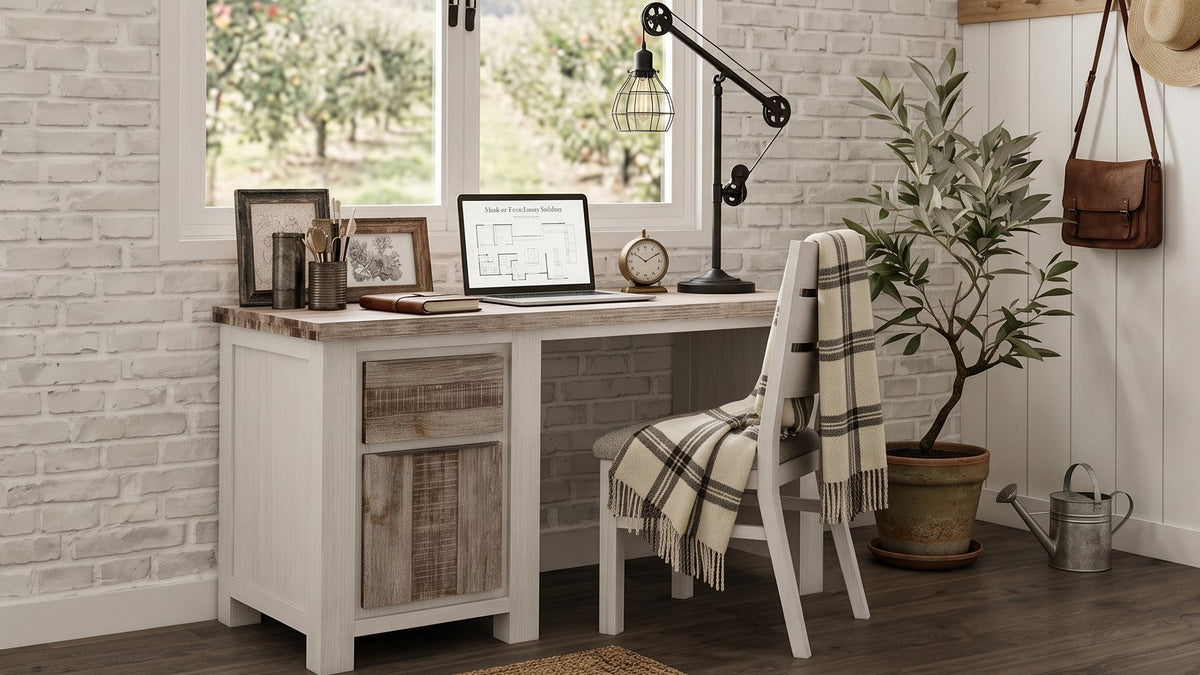
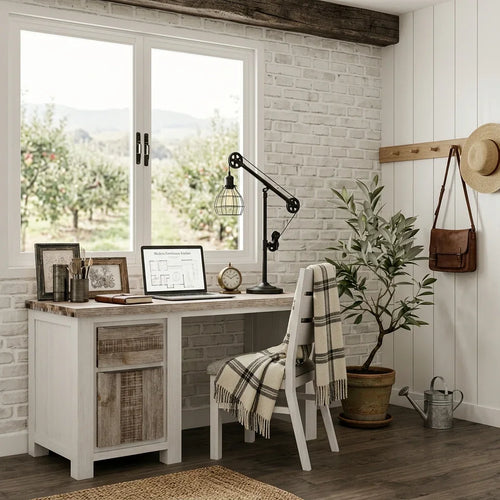
- If you want natural grain and warmth: pick timber, like the acacia-panelled Homestead Study Desk.
- If afternoon sun hits the desk: shade timber from direct sun, and expect glass to glare and show smudges.
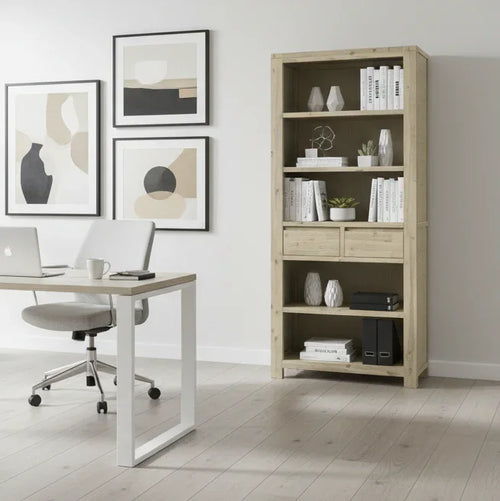
- If the desk needs storage beside it: add a bookshelf with drawers, like the Nelson.
In this guide
Solid timber, veneer, laminate and glass explained
Desk listings use these words loosely, so it helps to know what each one means before you compare them.
- Solid timber. The top and frame are cut from real wood all the way through. Scratches and dents can usually be sanded back and refinished, and the grain is genuine.
- Timber with engineered parts. Many wooden desks pair real timber on the visible surfaces with engineered wood in some structural parts, which helps with stability. The look and feel are still timber.
- Veneer. A thin layer of real wood bonded over an engineered board. It looks like timber because it is timber on the surface, but it can only be sanded lightly, if at all.
- Laminate. A thin decorative surface, often printed to look like wood grain, bonded to an engineered board such as particleboard or MDF. "Laminated wood desk" and "wood laminate desk" usually mean this: a wood look over an engineered core. Quality varies a lot, and most of it comes down to the surface layer and how well the edges are sealed.
- Glass. A toughened glass top resting on a metal or timber frame. The top itself is hard-wearing; the frame and the fixings that hold the glass are what you should inspect.
When you're shopping, ask what sits under the surface. Two desks that both look like oak can be very different underneath.
Pieces in this guide
Wood vs glass vs laminate: pros and cons
Each material wins somewhere. This table shows where.
| Feature | Timber | Glass | Laminate |
|---|---|---|---|
| Look | Warm, natural grain; no two alike | Sleek, light, minimal | Wide range of colours and wood looks |
| Everyday marks | Can show scratches, heat rings and water marks | Shows fingerprints, dust and smudges straight away | Resists most everyday marks |
| Repair | Solid timber can often be sanded and refinished | The top can be replaced; frame wear is harder to fix | Chips and lifting edges are hard to repair |
| Spills | Wipe up promptly and dry the surface | Wipe-clean, though water spots show | Wipe-clean on top; keep water off the edges |
| Afternoon sun | Can fade or dry out over time | Reflects glare onto the screen | Can fade over time |
| Care | Dust, coasters, a desk mat | Frequent wiping | Damp cloth as needed |
| Best for | A room you'll keep long term, where the look matters | Minimal rooms with regular cleaning | Busy households and shared desks |
On glass versus wood for a home office, the honest summary is this: glass looks lighter in a small room but asks for daily wiping, and its reflections can be tiring next to a sunny window. Wood feels warmer and hides fingerprints, but it needs a little protection from heat, water and sun.
Which desk top lasts longest?
The usual answer is "solid wood, because it costs the most". In real homes, how long a desk lasts depends as much on the conditions as on the material.
Timber lasts well when it's kept out of direct sun, spills are wiped promptly and heat and scratches are kept off with coasters and a desk mat. Solid timber has one big advantage: when the surface wears, it can usually be refinished rather than replaced. Timber does respond to humidity, which matters in a Queensland summer, and that's one reason many timber pieces pair real wood with engineered parts for stability.
Laminate shrugs off daily wear on top, but water that gets into a chipped edge can swell the board underneath, and once the surface is damaged there isn't much you can do. Check edges are well sealed before you buy.
Glass tops rarely wear out. The weak point is usually the frame and the fixings, so give the desk a firm push in the showroom and check it doesn't rock or flex.
Whatever the material, the desk that lasts is the one that suits the room. A beautiful timber top under a west-facing window, or a glass desk in a house full of small hands, will look tired sooner than the same desk somewhere kinder.

Desk size and height in a small room
In a small room, the material matters less than whether the desk and chair fit together and leave you room to move. Work through it in this order:
- Plan the chair, not just the desk. Measure the desk's footprint, then add the floor the chair needs to roll back. That combined zone is what the room has to give up.
- Tape it out. Mark the bed, the desk and the chair zone on the floor with masking tape, then check that doors and wardrobes still open and you can walk past.
- Watch the depth. In a narrow room, a shallower desk often matters more than a narrower one. A laptop and notebook need less depth than a large monitor.
- Use the walls for storage. A tall, narrow bookshelf keeps books and files off the desk without taking much floor.
- Let the chair do the adjusting. Desks are a fixed height, so set the chair so your forearms sit roughly level with the desk and your shoulders stay relaxed. If your feet don't then sit flat on the floor, add a footrest rather than hunting for a lower desk.
Built-in storage helps a small room too. A desk with its own drawer or cupboard saves adding a separate cabinet, and a chair whose armrests fold up can slide fully under the desk at the end of the day.

What we sell, and what we don't
To be upfront: our desks and study tables don't include a glass-topped desk. Our timber study desk is the Homestead Study Desk. It features acacia wood across its visible timber panels, a real hardwood with natural grain variation, paired with a soft white painted frame and a washed, farmhouse-inspired finish. Some structural parts may use engineered wood for stability. A side pedestal holds a drawer above a cupboard, and its compact, single-pedestal footprint suits a study corner, bedroom or spare room. To care for it, dust with a soft dry microfibre cloth, wipe spills promptly with a barely damp cloth and then dry the surface, use coasters and a desk mat, and keep it out of direct sun where you can.
For the chair, the Camp Fabric Office Chair has a mid-century-inspired look: a three-panel cushioned back in grey technology fabric, a polished chrome frame and armrests with leather-look pads, a reclining backrest with adjustable tilt tension and a gas-lift seat. If you'd rather sit on mesh, the Cloud Ergonomic Mesh Office Chair has a full mesh back and seat, an adjustable headrest and flip-up armrests that let it slide under the desk. For storage, the Nelson Bookshelf combines solid acacia with engineered wood, with five open shelves and two centre drawers.

See the full home office furniture range, and ask which of our five showrooms (Rocklea, Virginia, North Ipswich, Bundall and Beenleigh) has the Homestead on display before you visit.
Desk material questions
Does a wood-look laminate desk scratch easily?
A good laminate surface resists everyday scratches and stains better than many timber finishes. The weak spots are the edges and corners: a chip there is hard to repair and can let water into the board underneath, so check the edges are well sealed.
Are glass desks good for a PC setup?
A glass top looks sharp with a computer setup, but it shows dust and fingerprints quickly and some mice track poorly on bare glass, so most people add a large desk mat. Check that the frame feels rigid with the weight of your monitor and tower on it.
Is a glass desk cheaper than a wooden one?
Not reliably. Price follows how a desk is built, including the frame, the thickness of the top, the timber used and the joinery, more than the material name. Compare desks of a similar size and build rather than material against material.
Are solid timber desks worth it?
They are if you want a surface that can be refinished rather than replaced, you like the look of real grain, and you're happy to use coasters and keep the desk out of direct sun. If the desk will take hard daily knocks from the whole household, laminate may be easier to live with.
Will a desk fit in a small bedroom with a queen bed?
Often, yes, if you plan the chair as well as the desk. Tape out the bed, the desk and the floor the chair needs to roll back, then check the door and wardrobe still open. A compact desk with built-in storage helps because it saves adding a separate cabinet.
Does A2Z Furniture sell glass desks?
No, we don't sell glass-topped desks. Our timber study desk is the Homestead Study Desk, with acacia wood across its visible timber panels and a soft white painted frame. See Desks and Study Tables for what's currently available.