
A bedside table should sit roughly level with the top of your mattress, or up to about 5 cm below it, so a lamp or a glass of water is within easy reach. Measure from the floor to the top of your made bed first. The seven tables in this guide range from 55 to 62 cm high.
- If your bed sits low: start with the Jayden Bedside Table, the lowest here at 55 cm.
- If you have a deep mattress or a high frame: look at the Forest Bedside Table or the velvet Faith Bedside Table, both 62 cm.
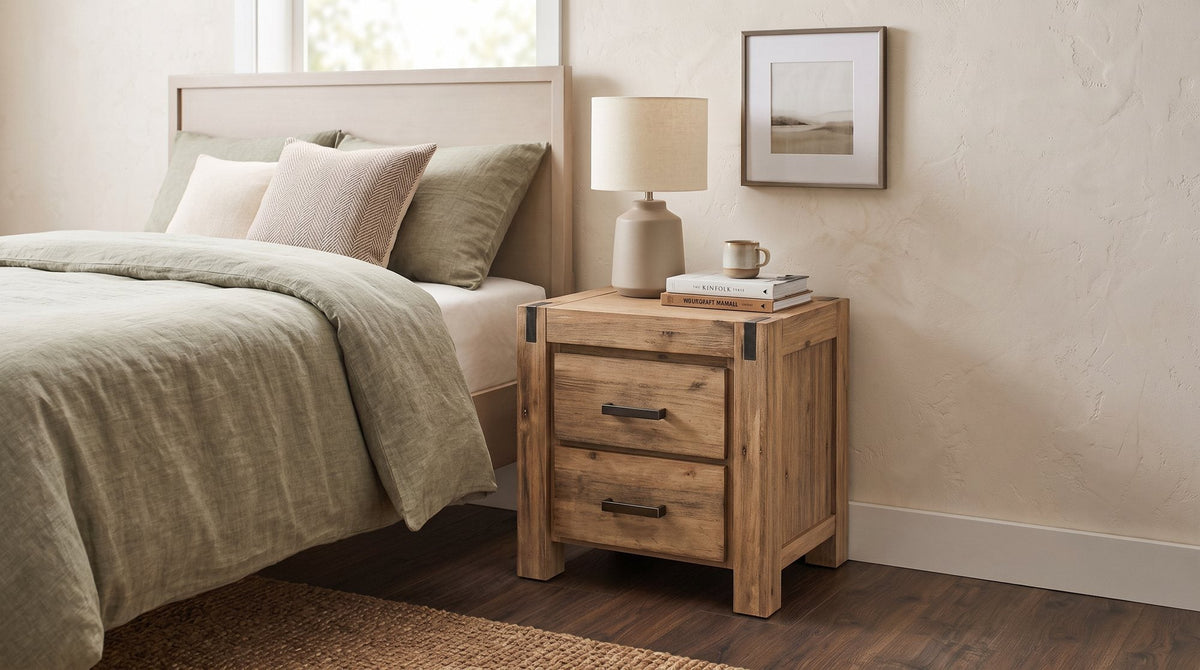
- If you want solid timber to match a timber bed: the Joyner Bedside Table is solid acacia with a matching bed and tallboy in the same range.
In this guide
How to measure for a bedside table
The number that matters is not the height of the bed frame. It is the height of the top of your mattress, with the bedding on, because that is where your hand is when you reach across in the dark. Two beds with the same frame can end up several centimetres apart once you add a thicker mattress, a topper or a pillow top.
- Measure the made bed. Run a tape from the floor to the top of the mattress with the sheets and quilt on. Write it down.
- Subtract up to 5 cm. That gives you a height range. A table anywhere from that number up to your mattress height will feel natural to reach.
- Measure the gap beside the bed. Measure from the edge of the bed frame to the wall, the wardrobe or the nearest door. That is the most floor you have to work with.
- Check the swing. Make sure the bedroom door, the wardrobe doors and the bedside drawers can all open without hitting each other.
If you are buying a new mattress or bed frame as well, buy those first and measure once they are set up. It is much easier to match a table to a bed than the other way round.
Pieces in this guide
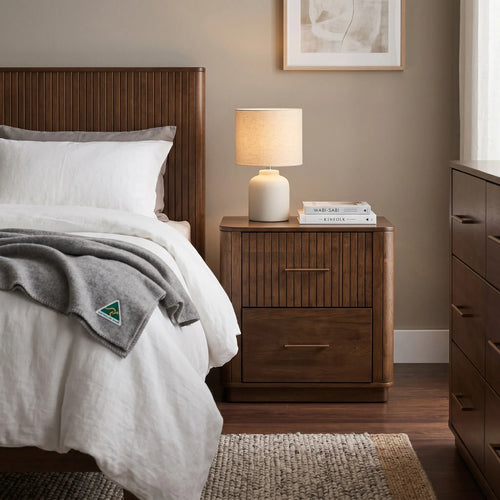
Bedside table heights in our range
Here are the heights and sizes exactly as printed on each product page's Dimensions tab. Measurements are taken by hand and can vary slightly between shipments, so confirm with the showroom team if you are working to a tight number.
| Bedside table | Height | Length × width | Material |
|---|---|---|---|
| Jayden | 55 cm | 60 × 45 cm | Solid acacia |
| Jack | 57 cm | 56 × 40 cm | Solid acacia |
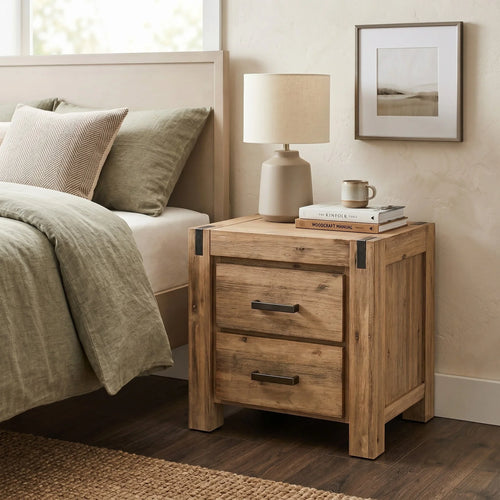
| Joyner | 60 cm | 60 × 40 cm | Solid acacia |
| Cannon | 61 cm | 59 × 40 cm | Rubberwood frame, MDF veneer panels |
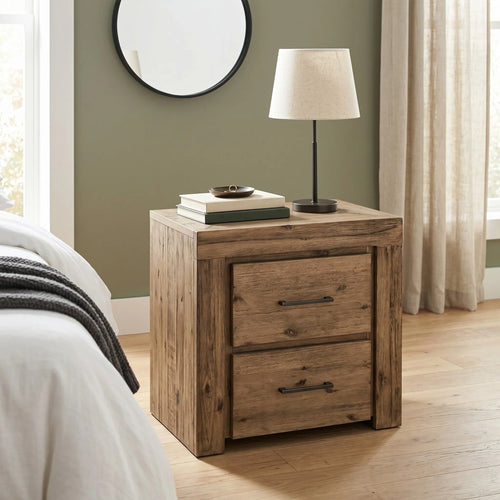
| Jericho | 61 cm | 42 × 58 cm | Solid acacia |
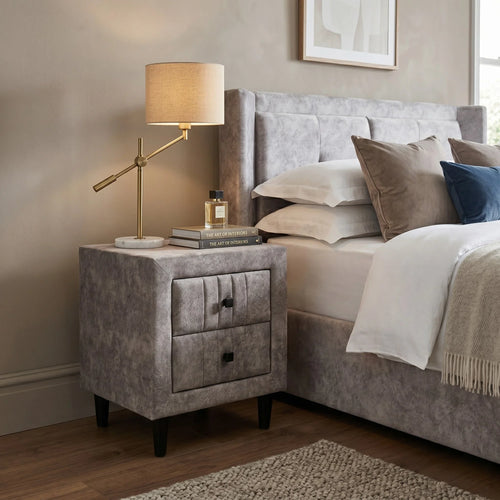
| Faith | 62 cm | 50 × 40 cm | Plywood cabinet, velvet upholstery |
| Forest | 62 cm | 50 × 40 cm | MDF and hardwood frame, fabric upholstery |
Notice how tight the spread is: seven centimetres separates the lowest from the highest. That is why measuring your own bed matters more than any "standard" figure. A 55 cm table beside a tall mattress will feel low; a 62 cm table beside a low platform bed will feel high. Browse every option in our bedside tables collection.

How wide should a bedside table be?
Width is about proportion and floor space. A wider table looks settled beside a queen or king bed, while a single or king single usually looks neater with something slimmer. But the floor beside the bed decides more than the bed does.
Work it out on the bed wall. A king mattress is 183 cm wide, and the frame adds a little more. Put a 60 cm table on each side and you are already past 300 cm before leaving any gap or walking space. In a narrower room, choose a slimmer table or use one on the side with more room.
- For a queen or king: tables around 56 to 60 cm long, like the Jack, Joyner or Jayden, balance the width of the bed.
- For a smaller room: the Faith and Forest are both listed at 50 × 40 cm. The Faith's product page describes its compact form as suited to smaller bedrooms and tight bedside spaces.
- Leave a small gap: a few centimetres between the table and the bed frame stops bedding catching and lets drawers open cleanly.
Drawers, shelves and what you keep at night
Before choosing between drawers and an open shelf, look at what actually ends up on your bedside table: a phone and charger, glasses, a book, hand cream, a water glass. If most of it would look better out of sight, choose drawers.
- Drawers hide chargers and clutter and keep the top clear for a lamp. Every table in this guide has drawers.
- Open shelves are quicker to reach and look lighter, but whatever sits on them is on display.
- Two drawers let you split things: the top for what you reach for nightly, the lower for spares and books.
The Cannon Bedside Table has two smooth-glide drawers behind a Mendozza Oak finish, and the Jayden's two drawers run the full width of the cabinet. If you run a lamp and a phone charger, plan where the cords will go, and check that the table can sit close enough to a power point.

Choosing a low bedside table
Low bedside tables suit platform beds, low-profile frames and thinner mattresses, where a standard table would tower over the pillows. Choose a low one the same way you choose any bedside table: measure the made bed first, then look for a top at or a few centimetres below that height.
Of the seven in this guide, the Jayden is the lowest at 55 cm, with the Jack close behind at 57 cm. If your mattress top sits well below that, a wall-mounted shelf fixed at mattress height can do the same job and keeps the floor clear. On the other side of the scale, if you have a deep pillow-top mattress on a raised frame, a low table is the wrong choice; go for one of the 61 or 62 cm tables instead.
Matching bedside tables to your bed
A bedside table does not need to match the bed exactly, but it should look like it belongs in the same room. Share at least one thing: timber tone, colour or hardware finish.
The simplest route is a range. The Jayden, Jack, Joyner, Cannon and Jericho Bedside Table each belong to a range that includes a matching bed and tallboy, so you can build the room around one look. The Jericho has a coastal-inspired Hamptons silhouette in solid acacia. For timber pieces in one place, see our wooden bedside tables.

Upholstered beds pair well with upholstered tables. The Forest is wrapped in grey fabric with recessed fabric-panel drawer fronts and sits in the same range as the Forest Storage Bed Frame. The Faith comes in blue velvet, alongside the Faith Bed Frame. A matching pair either side of the bed gives a balanced, symmetrical look; a single table works where one side of the bed is against a wall.
For the rest of the room, our bedroom furniture checklist covers what to buy and in what order, and our guide to queen vs king beds helps if the bed itself is still undecided. To see a table in person, ask which of our five showrooms has it on display.
Bedside table FAQs
What is the standard bedside table height in cm?
There is no single standard, because beds and mattresses vary so much. The seven bedside tables in this guide are listed at 55 to 62 cm high. Measure your made bed and pick a table at that height or up to about 5 cm below.
What is the rule for bedside tables?
The usual rule is that the top of the table sits level with the top of the mattress, or no more than about 5 cm below it. Leave a few centimetres between the table and the bed, and make sure drawers and doors can open freely.
Should a bedside table be higher than the bed?
Ideally no. A table that sits well above the mattress means lifting a glass or phone at an awkward angle. Level with the mattress, or a little below, feels more natural.
What size bedside table suits a king bed?
A wider table, around 56 to 60 cm long, balances a 183 cm wide king. Check the wall first: a king plus a 60 cm table on each side already needs more than 300 cm of wall before any gaps.
Can you have only one bedside table?
Yes. If one side of the bed is against a wall, or the room is tight, one table is often the better layout. A matching pair suits a shared bed with open floor on both sides.
How big a gap should be left between the bed and a bedside table?
A few centimetres is enough. It stops the quilt catching on the table and lets the drawers open without rubbing the bed frame.