
Style Guide · The Furniture Canvas
Minimalist furniture has become the default look for new Queensland homes — and for good reason. Between the region's natural light, the indoor-outdoor lifestyle and the smaller footprints of modern townhouses and units, clean-lined furniture simply works harder for less visual noise. This guide breaks down what "minimalist" actually means for furniture buyers (not just a Pinterest aesthetic), why it suits South-East Queensland living in particular, and how to put together a living room, coffee table and TV unit combination that looks calm without looking bare.

The short version. Minimalist furniture means fewer pieces, chosen deliberately: clean lines, a limited colour palette, honest materials and genuinely useful storage instead of clutter-hiding bulk. In Queensland's bright, humid climate it also tends to be the most practical choice — lighter pieces breathe better, pale palettes reflect heat, and open floor space keeps rooms feeling cooler. You don't need to gut your home to get there; start with the pieces that see the most daily use — the sofa, the coffee table and the TV unit — and let the rest follow.
In this guide
What "minimalist furniture" actually means
Minimalism in furniture isn't about owning as little as possible — it's about owning fewer things that each do their job well. Four traits define the style:
- Clean lines. Straight edges, simple silhouettes and minimal ornamentation, rather than heavily carved timber or busy upholstery detailing.
- A limited palette. Two or three tones per room — usually a neutral base (white, oak, grey, black) plus one accent — instead of mixing many colours and finishes.
- Quality over quantity. Fewer, better pieces that are built to last, rather than filling a room with occasional furniture that competes for attention.
- Function first. Every piece earns its spot — storage that's actually used, seating that's actually sat in — rather than furniture bought purely for decoration.
It's worth separating this from "empty" or "stark" — a well-styled minimalist room still has warmth, texture and personality, it just achieves it through material choice (timber grain, woven textures, matte versus gloss) rather than through volume of objects.
Why minimalism suits Queensland homes
A few things about South-East Queensland make the minimalist approach a particularly natural fit, rather than just a style trend borrowed from elsewhere.
Natural light and open-plan layouts
Queensland homes — from renovated Queenslanders to new-build townhouses — lean heavily on natural light and open-plan living/dining zones. Fewer, lower-profile pieces let that light travel further through a room and keep sightlines open between the kitchen, living and outdoor areas that Queensland floor plans tend to connect.
Indoor-outdoor living
Where a lot of Australian homes treat the living room as a closed-off box, South-East Queensland homes routinely open it onto a deck, alfresco area or pool zone. A simpler indoor furniture palette reads more consistently against timber decking and outdoor greenery than a heavily patterned or ornate indoor scheme does.
Heat, humidity and smaller footprints
Lighter furniture with raised legs allows airflow underneath — genuinely useful in Queensland's humidity — and pale, neutral upholstery reflects rather than absorbs heat. It also suits the smaller footprints common in newer Brisbane and Gold Coast builds: a handful of well-chosen pieces make a compact living room feel considered rather than cramped, where the same room stuffed with bulky, ornate furniture would feel smaller than it is.
Building a minimalist living room
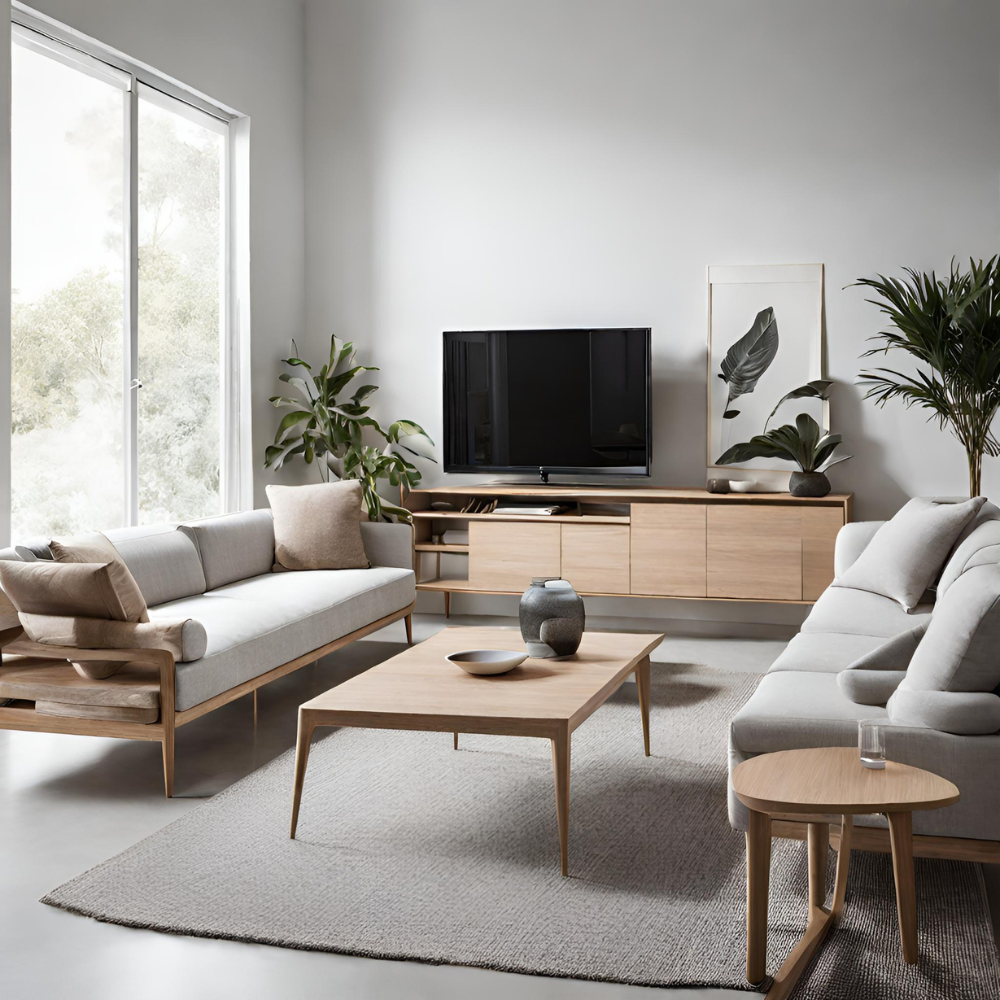
The living room is the easiest place to start, because three pieces do most of the visual work: the sofa, the coffee table and the TV unit. Get those three right and the rest of the room falls into line. Start with our living room furniture range for the full selection across styles and budgets.
Sofa: pick a shape before a colour
A low-profile, straight-armed sofa in a single neutral fabric will do more for a minimalist look than any specific colour choice. If you need extra seating, a modular or corner configuration in the same fabric reads as one clean shape rather than several competing pieces — our lounges and sofas range covers both fixed and modular options.
Rug and soft furnishings
A2Z doesn't sell rugs, but the same rule applies when you're sourcing one elsewhere: one plain or subtly textured rug in a tone close to your flooring will anchor the room without adding visual competition to your furniture.
Negative space is a design choice
Resist the urge to fill every wall and corner. Leaving genuine breathing room around your sofa and coffee table is what makes a minimalist room read as calm rather than empty — it's a deliberate choice, not a placeholder for furniture you haven't bought yet.
Shop the range
Start with the pieces that anchor a minimalist living room:
Choosing a minimalist coffee table

The coffee table sits at eye level from the sofa, so it draws attention fast — which makes it one of the highest-impact pieces to get right in a minimalist room.
Shape and material
A single-material top (timber, glass or marble-look stone) on a simple base tends to read as more considered than a table combining several finishes. Round and oval shapes soften a room with a lot of straight lines elsewhere; rectangular shapes suit longer, lower sofas. Our coffee table range covers wooden, glass and stone-look finishes if you want to browse by material.
Storage without clutter
If you need somewhere for remotes, coasters or magazines, a coffee table with a closed shelf or drawer keeps that clutter out of sight rather than adding an open shelf that ends up as a catch-all. Our coffee tables with storage collection covers this without breaking the clean-lined look.
Scale check
A coffee table that's too small relative to the sofa looks like an afterthought; too large and it dominates the room. As a rule of thumb, aim for a table roughly two-thirds the length of your sofa, with 30–45 cm of clearance in front of the seating for comfortable legroom.
Choosing a minimalist TV unit

The TV unit is where minimalist rooms most often go wrong — it's the piece most likely to become a dumping ground for remotes, cables, gaming consoles and odds and ends, which undercuts the whole look if it's left open.
Concealed storage beats open shelving
A unit with closed cabinets or drawers, rather than open shelving, hides the day-to-day clutter that accumulates around a television. It also makes cable management far easier — most concealed-storage units have back cut-outs for cords to run through discreetly. Browse our full TV and entertainment unit range for concealed-storage options across sizes.
Low profile, simple legs or a plinth base
A low, horizontal unit on slim legs (rather than a boxy cabinet sitting flush to the floor) keeps the room feeling open and lets light and airflow pass underneath — useful in Queensland's climate as well as visually lighter. Timber-finish units suit warmer, natural-material schemes; glass and matte-lacquer units suit a cooler, more contemporary palette.
Match the width to your wall, not your old TV unit
Size the unit to your wall and seating distance rather than defaulting to whatever width your last TV unit happened to be — an undersized unit on a large wall looks lost, and an oversized one crowds the room. Our TV unit size guide walks through matching unit width to screen size and room dimensions.
A simple buying framework
If you're starting from scratch, work through these four questions in order rather than shopping piece by piece.
1. What's the base palette?
Pick one neutral (white, oak, grey or black) as your dominant tone before you buy anything. Every major piece should sit within that palette, with at most one accent tone layered in through cushions or a single feature piece.
2. What actually needs to be in the room?
List the pieces that get daily use — usually a sofa, coffee table and TV unit for a living room. Anything beyond that (a second armchair, a console table, an ottoman) should earn its place based on how you actually use the room, not how a showroom display looked.
3. Where does clutter need to be hidden?
Identify where remotes, chargers, magazines and everyday items will land, and choose furniture with closed storage in those spots — a coffee table drawer, a TV unit cabinet — rather than trying to keep surfaces bare through sheer discipline.
4. Does the scale suit the room?
Minimalist furniture still needs to be sized correctly. A too-small sofa in a large room looks sparse rather than intentional; oversized pieces in a small room undo the sense of space minimalism is meant to create. When in doubt, measure the room before you shop.
Budget tip. Minimalist doesn't have to mean expensive. A clean-lined, well-proportioned piece in an affordable finish will usually look better in a minimalist room than an ornate piece at a higher price point — simplicity is as much a design decision as a spending one.
Common mistakes to avoid
- Mixing too many wood tones. Two different timber finishes in the same room (say, a warm oak coffee table against a cool grey TV unit) can undercut an otherwise coordinated palette — try to keep timber tones consistent across the main pieces.
- Buying occasional furniture "just in case." Extra side tables or accent chairs that don't get regular use are exactly the kind of visual clutter minimalism is meant to remove.
- Going too small on the sofa or coffee table. Undersized furniture in a genuinely spacious room looks like an oversight, not a style choice.
- Choosing open shelving everywhere. Open shelving looks great styled for a photo and cluttered within a week of daily use — reserve it for display items only, and put everyday clutter behind closed doors.
- Ignoring texture. A room with only smooth, glossy surfaces can feel cold. Layer in at least one textured material — a woven cushion, a matte timber grain — to keep the room feeling warm.
Minimalist furniture FAQs
What makes furniture "minimalist"?
Minimalist furniture is defined by clean lines, a limited colour palette (usually two to three tones), honest single-material construction and genuine functionality — every piece earns its place in the room rather than being purely decorative.
Is minimalist furniture suitable for a Queensland home?
Yes — arguably more so than in cooler climates. Lighter, raised-leg furniture allows airflow, pale palettes reflect heat rather than absorb it, and a simplified indoor scheme reads well against the indoor-outdoor living common in South-East Queensland homes.
Do I need to replace all my furniture to go minimalist?
No. Start with the sofa, coffee table and TV unit — the three pieces that do most of the visual work in a living room — and build out from there as budget allows. A full-room gut isn't necessary to shift the look meaningfully.
How do I stop a minimalist room from looking empty?
Layer in texture — a woven cushion, a natural timber grain, a matte versus gloss contrast — rather than adding more objects. Warmth in a minimalist room comes from material choice, not from filling floor space.
What coffee table shape works best for a small living room?
Round or oval tables generally suit smaller rooms better than large rectangular ones, since they don't create sharp corners that eat into walking space. A table around two-thirds the length of your sofa is a reliable scale guide. See our coffee table range for options across sizes.
Should a minimalist TV unit have open or closed storage?
Closed storage is generally the better choice for day-to-day minimalism — it hides cables, remotes and consoles that otherwise accumulate on open shelving. Reserve any open shelving for a small number of display items only.
Written by the A2Z Furniture team — five South-East Queensland showrooms, family-owned and operated since 2013. Last updated July 2026.