
A sectional sofa is a sofa built from separate sections that join together and can be rearranged, so the same pieces can often make an L, a U or a straight run. A corner sofa, or L-shaped sofa, is one fixed shape: it fits a corner neatly, but it stays that shape for good.
- If the sofa will stay in one corner for years: pick a fixed L from our corner lounges, like the Signature Corner Sofa with Chaise.
- If you might move house or rearrange the room: pick one with rearrangeable modules from our modular and sectional sofas, like the Skipper II Modular Corner Sofa.
- If you can't decide which side the chaise should go: pick a reversible chaise you can swap later, like the Samson 3 Seater Fabric Sofa Bed with Reversible Chaise.
In this guide
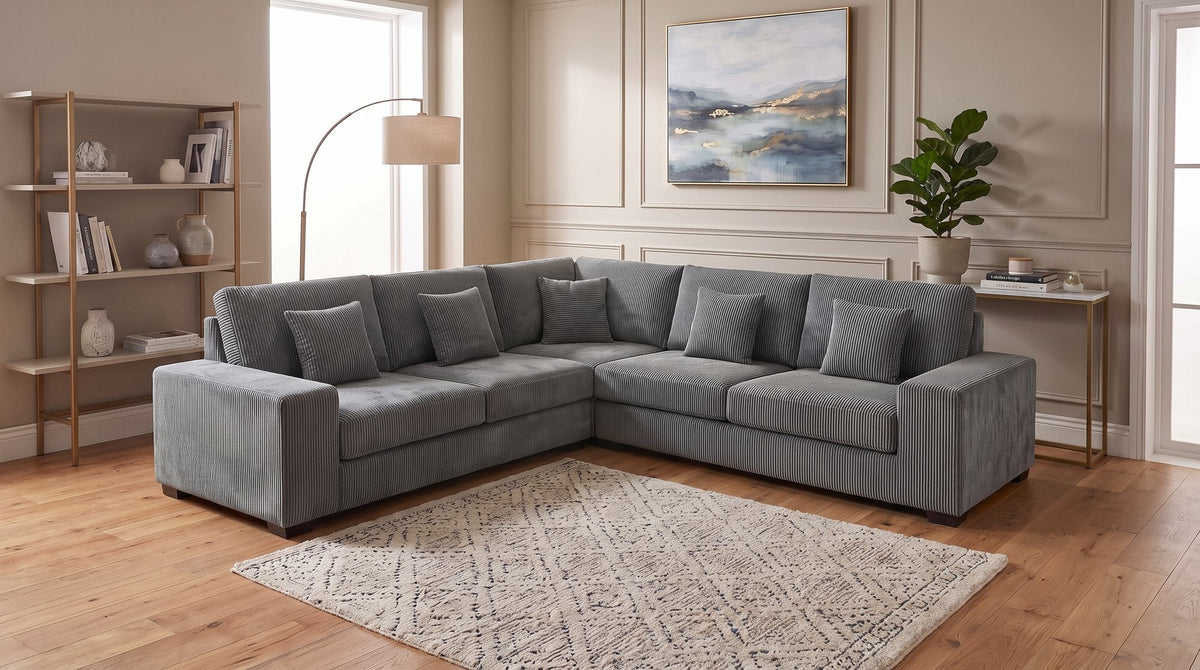
Fixed, reversible or modular: three ways to fill a corner
In showrooms and online, "corner sofa", "L-shaped couch" and "sectional" get used loosely, and plenty of fixed L-shapes are sold as corner sectionals. The useful question is whether you can change the shape once the sofa is home. There are three answers:
- A fixed corner sofa. One L-shape, with the chaise on the side you choose when you order. The Signature Corner Sofa with Chaise pairs a long main bench with a deep chaise and seats five, and its chaise side is fixed once it's built. Browse more in our corner and L-shaped lounges.
- A corner sofa with a reversible chaise. Still an L, but the chaise can move to the other end, so the L can face either way. The Spencer II Fabric Corner Sofa with Reversible Chaise seats five and comes with a storage ottoman and scatter pillows. It also comes in black PU leather with a button-tufted back.
- A modular sectional. Separate modules that join together and can be rearranged. The Skipper II Modular Corner Sofa is five modules in grey corduroy: a left arm chair, a right arm chair, a wedge corner and two armless chairs. The armless pair moves between the two legs of the L, so the corner can lean left, sit even or lean right. Browse more in our modular and sectional sofas, and check each listing for rearrangeable modules.
Two other shapes fill a corner too. A U-shape wraps seating around three sides: the Easton Corner Sofa with Ottoman has a chaise at each end and comes with a separate rectangular ottoman and scatter cushions. A curved corner sweeps round rather than meeting at a right angle, like the Bailey 5 Seater Corner Recliner Sofa, a five-seater in Rhino fabric with two reclining end seats and a built-in console.

Pieces in this guide
-

-
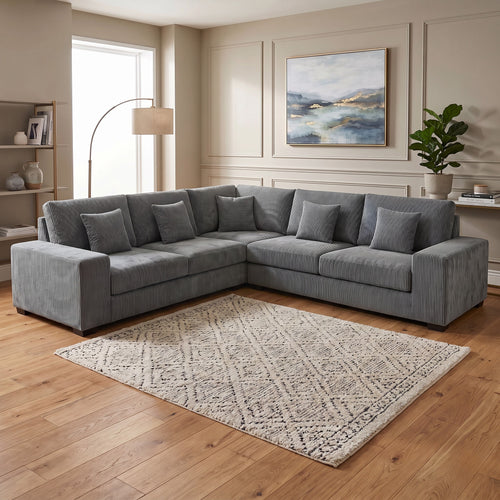
Skipper II Modular Corner Sofa
$2,099.00
-
-


Corner sofa vs sectional sofa at a glance
Neither is better in general. Each suits a different kind of room and household:
| Feature | Corner sofa | Sectional sofa |
|---|---|---|
| Shape | One fixed L | Separate modules you can arrange in more than one layout |
| Changing it later | Stays an L; a reversible chaise can swap sides | Move modules to change the layout |
| Changing sides | Fixed when you order, unless the chaise is reversible | Move modules from one side to the other |
| Best rooms | A settled room with one clear corner | Open-plan rooms, rentals and homes that change |
| Getting it inside | The ones in this guide ship flat-packed in two to five cartons | Flat-packed modules that connect at home |
| Moving house | Needs a similar corner in the next home | Can be rearranged for the next room |
| Styling | One clean outline that is easy to style around | Plan the rug and table around the layout you choose |
Whichever you choose, measure both sides of the L, the depth with the chaise and every doorway on the way in, and leave about 75–90 cm for the main path; our guide to measuring your living room for a corner lounge or modular sofa walks through each step.
Fixed or reversible chaise for a tight corner?
For a tight corner, start with size and position, then the mechanism. Measure the space against the full footprint: the Samson is 212 cm long and 134 cm deep with the chaise, while the Signature's main side is 280 cm with a 205 cm chaise side. Put the chaise on the side away from the doorway and the main path, so it doesn't block anyone. Then choose:
- A fixed chaise when you know exactly where the sofa will live. The Signature's chaise side is chosen at checkout and can't be swapped once it's built, so measure first.
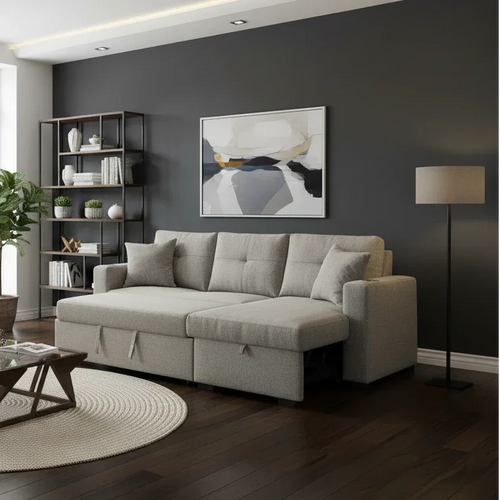
- A reversible chaise when you're unsure, renting or likely to move. The Samson 3 Seater Fabric Sofa Bed with Reversible Chaise switches sides any time, and it also has a pull-out bed and storage under the chaise.
Getting the side right. Our product pages name the chaise side "when sitting": sit on the sofa facing the room, and if the chaise is on your left, you want "left when sitting". Some retailers name the side as you face the sofa, which flips it, so check the diagram before you order.

Which suits your room?
Match the shape to the room and to the people who use it:
- Small living rooms and apartments. A compact three-seater with a chaise gives you somewhere to stretch out without adding an armchair. Check the depth with the chaise: 134 cm on the Samson and 160 cm on the Elvis.
- Open-plan rooms. The back of a sofa or the end of a chaise makes a soft boundary between the lounge and the dining or kitchen area. A modular sectional lets you redraw that boundary when the room's use changes.
- Big family rooms. A five-seat L like the Signature or the Skipper II, or a U-shape like the 365 cm wide Easton, seats everyone facing the same way for movie nights.
- Rooms that also sleep guests. A sofa bed with a chaise covers both jobs. The Elvis 3 Seater Pull-Out Sofa Bed seats three, sleeps two, and has storage under the chaise and cup holders in both arms. Our guide to corner sofa beds covers more.
- Renting or likely to move. A modular corner like the Skipper II, whose armless chairs move between the legs of the L, or a reversible chaise gives you the most room to adapt in the next home.
- A room with no clear corner. A straight sofa from our sofas, lounges and couches range, plus an armchair, may suit better than either.
Comfort is the one thing a tape measure can't tell you, so pick a favourite, ask which store has it on display and sit on it before you buy. We have five showrooms: Rocklea, Virginia, North Ipswich, Bundall and Beenleigh.
How to decorate around an L-shaped sofa
An L-shaped sofa is usually the biggest piece in the room, so decorate outwards from it:
- Set the layout first. Put the longer side against the longest wall or facing the TV, and let the chaise or open end mark the edge of the lounge in an open-plan room.
- Choose a coffee table both sides can reach. A square or round table suits the crook of an L. Keep 30–50 cm between the seats and the table; our guide to choosing a coffee table has the sizes in cm.
- Size the rug to the sofa. Choose a rug large enough for the front legs of both sides to sit on it, with the coffee table fully on the rug.
- Dress the corner first. Put your largest cushions in the corner seat, then work outwards along each side with smaller ones, in groups of three or five rather than pairs.
- Light the open end. A side table and a lamp at the open arm give you somewhere for a drink and a warmer light than the ceiling light alone.
- Use the wall above. Hang one large piece of art centred over the longer side, or a row of three prints with even gaps.
- Add colour with soft furnishings. Cushions and throws in one or two contrast colours change the look without changing the sofa. If yours is grey, our guide to colours that go with a grey sofa has palettes to try.

Corner and sectional sofa questions
Is an L-shaped couch the same as a sectional?
Not always. People often call any L-shaped couch a sectional or a corner sectional. Strictly, a sectional is built from sections that can be separated and rearranged, while a fixed L-shaped couch keeps one shape. If flexibility matters, confirm the pieces can be rearranged before you buy: the Skipper II Modular Corner Sofa is an L whose modules rearrange, while the Signature Corner Sofa with Chaise is a fixed L.
What is a corner sofa?
A corner sofa is a sofa shaped to fit the corner of a room, usually an L: a run of seats joined at a right angle to a chaise or a second run of seats. Most are one fixed shape, and some have a reversible chaise that can swap sides.
Is a corner sofa better than two sofas?
It depends on how you use the room. A corner sofa uses the corner seat that two separate sofas leave empty and points everyone the same way, which suits a TV room. Two sofas suit conversation and are easier to split between rooms later, but they need more floor and a clear path between them.
What is the difference between a chaise sectional and an L-shaped sectional?
A chaise sectional ends in one long, deep seat for stretching your legs out. An L-shaped sectional has two runs of upright seats that meet at a corner seat, so more people sit with back support. The Signature Corner Sofa with Chaise is the chaise kind: a long main bench with a deep chaise.
Can a corner sofa also be a sofa bed?
Yes. A sofa bed with a chaise reads as an L-shape by day and sleeps guests at night. The Elvis 3 Seater Pull-Out Sofa Bed seats three and sleeps two, with storage under the chaise. The Samson 3 Seater Fabric Sofa Bed with Reversible Chaise has a chaise you can move to either side, which helps if the room might change.